Public-domain ebook
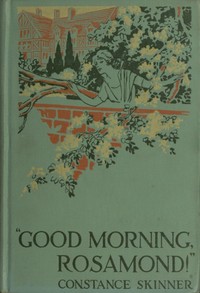
"Good-Morning, Rosamond!"
English423 downloads on Project GutenbergDownload EPUB
Public-domain ebook sourced from Project Gutenberg #57254.
Public-domain ebook
English423 downloads on Project GutenbergDownload EPUB
Public-domain ebook sourced from Project Gutenberg #57254.
The opening · free to read
Négligés were unknown in Roseborough. Even at seven in the morning, which was Rosamond Mearely’s hour for greeting the new day, the ladies of Roseborough did not kimono: they dressed.
Young Rosamond Mearely might be--as indeed she was--the richest and fairest woman in Roseborough, and the widow of a gentleman whose name the hamlet and countryside mentioned still with the bated breath of pride; but she would no more have dared to appear at breakfast before her housemaids, the imposing Frigget sorority--Amanda, aged forty-nine years “come Michelmas,” and Jemima, forty-seven and three quarter years--in what they would have pronounced (and condemned as) a “wrapper,” than she would wittingly have committed any other irretrievable faux pas.
The mother of the Frigget sorority had guided the first adventures of the late, distinguished Hibbert Mearely about the by-ways of Trenton Waters, his birthplace, in the infantile push-carts of his period--that is to say, fifty-odd years before this morning when his young widow slipped a decorous print gown (lavender with black floral design) over her dainty, white roundness and the whalebone and batiste article that confined it, and descended to her fourteen hundred and eightieth solitary breakfast. It was four years since Hibbert Mearely’s departure. His faithful nurse was slowly preparing to follow him; she lay bedridden in Trenton Waters. Her two daughters, who had been brought up to serve him, still dominated his household.
Rosamond saw them now, as the stairs circled to the door of the large living room where summer breakfasts were spread. They were tall, multi-boned women with straight, thin, gray hair--drawn sheerly to a polka dot at the back, which one, or at most two, hairpins controlled--and clad in skimpy, dark, cotton dresses, well starched and designed to reveal every puritan angle. They stood at opposite sides of a long, black table. The table was one of Hibbert Mearely’s antiques (a ticket attached to the foot gave its date and history); its “early Seventeenth” carvings were hidden now by a cloth of gleaming white damask bearing Mrs. Mearely’s breakfast. Rosamond’s glance, by habit, travelled in a direct line between her female grenadiers to the wall where a life-size portrait, in oils, of the late master depended. Outside the wide-open doors, the sunlight filtered through the overlacing trees and kindled the proud red of the dahlias to flame. A little breeze, vagrant and wilful, danced through the garden and set all the leaves to clapping their hands. Rosamond sighed. She flitted through the doorway and down the huge room, sedately, to her place.
“Good-mornin’, Mrs. Mearely, ma’am.”
“Good-mornin’, Mrs. Mearely, ma’am.”
“Good-morning, Amanda. Good-morning, Jemima.”
These salutations never varied. Rosamond spread her old-fashioned damask napkin on her lap slowly with a sense of apprehension. Amanda had her own manner of establishing an “atmosphere.” Out of the corner of her eye Rosamond perceived that she was more unbending than usual this morning.
“I was a’most a-comin’ up to see if you’d ben took sick--it’s five after.” Amanda’s tone was dry and accusative.
“Is it? Perhaps I may have dawdled a little ... I mean,” hastily, “I think one of my laces knotted.”
“Seven sharp was a’ways Mr. Hibbert Mearely’s breakfast hour”--Jemima’s tone was impersonal and final--“as we’d oughter know that cooked and served it to him twenty year, not countin’ the long time of his young an middle manhood when he was trapsein’ the world after them curios an’ antics of his’n.”
“Antiques, Jemima,” the lady of the house corrected.
“That’s wot I said,” stubbornly.
“Your porridge was dished at seven sharp an’ was perfec’ for that hour; but five minutes makes a world of difference in the nature of a hot bowl of porridge.”
“I’m sure it will be delicious, Amanda,” her mistress murmured. Her tone was timid and placating.
“Speakin’ of laces knottin’,” Amanda continued, “Mary Caroline was the only one of us girls that was inclined to fat, an’ maw a’ways made her let ’em out when she took ’em off, nights, so there’d be no time wasted in the mornin’.”
“It was my _boot_-lace, Amanda,” milady protested.
“Mebbe ’twas--an’ mebbe ’twasn’t. It’s loosenin’ ’em overnight that counts--both boots an’ stays. An’ so Mary Caroline found--leastways if she didn’t want maw to wallop her for bein’ late--sloth bein’ one of the seven deadly sins maw could not abide. Mary Caroline was a natural temptation to a high-tempered, energetic woman like maw--she bein’ inclined to fat.”
Mrs. Mearely motioned the porridge bowl away with a chill gravity.
“I’d like my toast and eggs now. Of course I do not suppose you mean anything personal, Amanda, by your repeated allusions to your deceased sister’s physique. Nevertheless I may say, without lowering my dignity, that, although I am not thin and--and--er--flat all over like some of Roseborough’s women, I am not fat. I am not even ‘_inclined_ to fat’ as it appears your--er--walloped sister was, according to your description.”
Mrs. Mearely’s attempt to reduce Amanda Frigget, domestic, to a proper sense of her relation toward the mistress of Villa Rose, failed miserably. The haughty eye of the would-be grande dame wavered from that forbidding countenance and weakly sought refuge in the colour-blend of buttered toast with yolk of egg. Alas, she had given Amanda the sort of opportunity which never passed unimproved.
“You’re not fat as compared with some, but you’ve got a general curve to you, which is on’y to be expected in the daughter-of-a-farmer’s figure.” Amanda proceeded, uncompromisingly, to make the Frigget position on curves and non-curves even plainer. “Now Mr. Hibbert Mearely’s sisters, both what married small but choice titles, was so lean an’ aristocratical you could count the ridges in their backbones--on’y you wouldn’t of persoomed that way on born ladies. But look who their father was--an’ Mr. Mearely’s father, too! A perfessor an’ clergy that had his descent from the middle ages of Henery Seven!”
“No wonder Mr. Mearely felt he could afford to be condescendin’,” Jemima put in, as she removed the tea cosy. “But I don’t s’pose he’d ever have set his a’most royal foot onto ploughed an’ harrowed groun’, if he hadn’t of seen you that day in the gate of your father’s farm in Poplars Vale. That’s when he forgot about Henery Seven an’ went back to the soil--a man that was past fifty an’ had seen all the museums of Europe!”
“Strange--strange, indeed!” Mrs. Mearely hissed softly, striking a small silver knife into a butter ball with intent to wound.
Amanda took up the theme.
“An’ how did it all come to happen? By the accident of him, a absen’-minded man, takin’ the wrong turn at the cross-roads as he come up from fishin’! The han’ of fate pinted him to Poplars Vale ’stead of Roseborough. An’ there was you, eighteen--an’ allurin’ no doubt, but ’umble an’ uncultured--a-sittin’ on your paw’s farm gate, but lookin’ higher. What a talk it made in these parts! When I says to maw, I says, ‘Mr. Mearely’s goin’ to marry Rosamon’ Cort of Poplars Vale,’ she took to her bed for the day with a spell. Such a shock it was to her to think how him as she’d used to trundle had forgot his station.”
“By marrying a butter-maker?” Rosamond’s voice was sharp at the edges now.
“We said then--maw an’ Jemima an’ me (Mary Caroline havin’ passed beyon’)--we said, ‘We’ll never remember again in this life that Mr. Hibbert Mearely’s fiancy’s mother made an’ sol’ the first roun’ fancy butter pats in this distric’.’ That’s the way all Trenton Waters an’ Roseborough felt bounden towards the Mearelys. That’s, in special, the way His Friggets felt bounden toward Mr. Hibbert Mearely.”
“No doubt he is very grateful to you both, and is waiting eagerly to reward your devotion”--she paused also at the “cross-roads,” so to speak, ere she gestured a vague direction and concluded--“wherever he is.”
If her inflections were strangely pungent and her phraseology speculative, the angle of vision sought by her too large, cloud-flecked, sky-blue eyes was absolutely right. They gazed ceilingward. Amanda folded her hands across her apron. She also looked upward.
“No doubt,” she repeated, solemnly.
“No doubt;” Jemima echoed her sister’s sepulchral accents, and folded her hands and looked at the same bit of the gold cornice. If they had concentrated on this point long enough in rapt faith--who knows?--they might have materialized there the shade of the departed collector of antiquities to demand of them, sternly, which careless handmaid with intrusive mop had nicked his Florentine gilding.
“The raspberries, Jemima, please. I shall always wonder why it is that ... (cream, please) ... the very persons who wouldn’t for worlds ... (and powdered sugar) ... recall the fact that Hibbert Mearely’s widow’s mother once sold butter ... (are you sure this is sugar, Jemima? It looks suspiciously like salt) ... are the very ones who are always reminding me of ... the butter, please.” She finished, tartly.
Jemima hastened to pass the hereditary slur.
“Well, ma’am, I wouldn’t go to say that exac’ly.” Amanda studied the question. “But them what thought so high of Mr. Mearely kind of wants to help you remember what he done for you.”
“Ah! that is it, eh?”
“Yes. An’ you bein’ a widow an’ havin’ to put all his blue blood in the tomb--when you hadn’t enjoyed it but a year an’ four month--we feel like it comforts you to remin’ you that, even if you come off a farm in Poplars Vale, your diseased husban’ didn’t. No, Sir! He come off of Henery Seven!”
An odd little squeak pierced through Rosamond’s damask napkin. It terminated hastily in a cough.
“May I ask, ma’am, when Mrs. Witherby stopped in here yesterday mornin’ did you happen to be wearin’ them white cuffs an’ collar with your lavender ’stead of the black watered ribbon ones as you’ve worn for nigh a year?”
“Yes. Yes, Amanda, I believe I did have these on yesterday--for the first time in the daytime. You know I’ve worn all white with flowers--in the evening.”
The book keeps going
Reading is free forever. Sign up and watch scenes appear while you read.



Scenes Storieta drew for other classics.
New illustrated classics
Once or twice a month: the latest books to get full character casts, scene art, and free comic editions. No account needed.