Public-domain ebook
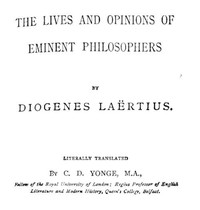
The Lives and Opinions of Eminent Philosophers
Language: en15,454 downloads on Project Gutenberg
Subjects
In: Biographies·Classics of Literature·Philosophy & Ethics
Public-domain ebook sourced from Project Gutenberg #57342.
Public-domain ebook
Language: en15,454 downloads on Project Gutenberg
Subjects
In: Biographies·Classics of Literature·Philosophy & Ethics
Public-domain ebook sourced from Project Gutenberg #57342.
The work is a biographical compendium of ancient Greek philosophers, assembled by the 3rd‑century author Diogenes Laertius. It opens with a series of poetic epigrams and letters that frame the lives of early thinkers, Pythagoras, Pherecydes, Thales, Anaximander, Anaximenes, and Anaxagoras, before moving into a systematic “Book II” that records each figure’s parentage, civic background, principal doctrines, and notable anecdotes. The opening passage mixes reverent verse, personal correspondence, and concise summaries of philosophical positions, such as Anaximander’s claim that the primary substance is the “Infinity” and Anaxagoras’s assertion that Mind orders the cosmos. The text proceeds in a straightforward, catalog‑like style, presenting dates, achievements, and occasional mythic details without extending into narrative fiction.
Diogenes writes in a clear, almost reportorial Greek prose, interspersed with occasional lyrical quotations. The tone is scholarly yet accessible, reflecting the Hellenistic tradition of preserving oral histories for later readers. Those who enjoy the study of ancient intellectual history, the origins of scientific thought, or the cultural context of early philosophy will find this collection rewarding. It appeals especially to students, classicists, and anyone interested in how the first “wise men” were remembered and evaluated by a later antiquarian.
The opening · free to read
Adorned with valour while alive, and modesty, Now that he’s dead he still exists in peace; For, like the wise Pythagoras, he studied The manners and the minds of many nations.
And I myself have composed an epigram on him in the Pherecratean metre:—
The story is reported, That noble Pherecydes Whom Syros calls her own, Was eaten up by lice; And so he bade his friends, Convey his corpse away To the Magnesian land, That he might victory give To holy Ephesus. For well the God had said, (Though he alone did know Th’ oracular prediction), That this was fate’s decree. So in that land he lies. This then is surely true, That those who’re really wise Are useful while alive, And e’en when breath has left them.
VIII. And he flourished about the fifty-ninth Olympiad. There is a letter of his extant in the following terms:—
PHERECYDES TO THALES.
May you die happily when fate overtakes you. Disease has seized upon me at the same time that I received your letter. I am all over lice, and suffering likewise under a low fever. Accordingly, I have charged my servants to convey this book of mine to you, after they have buried me. And do you, if you think fit, after consulting with the other wise men, publish it; but if you do not approve of doing so, then keep it unpublished, for I am not entirely pleased with it myself. The subject is not one about which there is any certain knowledge, nor do I undertake to say that I have arrived at the truth; but I have advanced arguments, from which any one who occupies himself with speculations on the divine nature, may make a selection; and as to other points, he must exercise his intellect, for I speak obscurely throughout. I, myself, as I am afflicted more severely by this disease every day, no longer admit any physicians, or any of my friends. But when they stand at the door, and ask me how I am, I put out my finger to them through the opening of the door, and show them how I am eaten up with the evil; and I desired them to come to-morrow to the funeral of Pherecydes.
These, then, are they who were called wise men; to which list some writers add the name of Pisistratus. But we must also speak of the philosophers. And we will begin first with the Ionic philosophy, the founder of which school was Thales, who was the master of Anaximander.
II. He used to assert that the principle and primary element of all things was the Infinity, giving no exact definition as to whether he meant air or water, or anything else. And he said that the parts were susceptible of change, but that the whole was unchangeable; and that the earth lay in the middle, being placed there as a sort of centre, of a spherical shape. The moon, he said, had a borrowed light, and borrowed it from the sun; and the sun he affirmed to be not less than the earth, and the purest possible fire.
III. He also was the first discoverer of the gnomon; and he placed some in Lacedæmon on the sun-dials there, as Phavorinus says in his Universal History, and they showed the solstices and the equinoxes; he also made clocks. He was the first person, too, who drew a map of the earth and sea, and he also made a globe; and he published a concise statement of whatever opinions he embraced or entertained; and this treatise was met with by Apollodorus, the Athenian.
IV. And Apollodorus, in his Chronicles, states, that in the second year of the fifty-eighth Olympiad, he was sixty-four years old. And soon after he died, having flourished much about the same time as Polycrates, the tyrant, of Samos. They say that when he sang, the children laughed; and that he, hearing of this, said, “We must then sing better for the sake of the children.”
V. There was also another Anaximander, a historian; and he too was a Milesian, and wrote in the Ionic dialect.
LIFE OF ANAXIMENES.
I. Anaximenes, the son of Eurystratus, a Milesian, was a pupil of Anaximander; but some say that he was also a pupil of Parmenides. He said that the principles of everything were the air, and the Infinite; and that the stars moved not under the earth, but around the earth. He wrote in the pure unmixed Ionian dialect. And he lived, according to the statements of Apollodorus, in the sixty-third Olympiad, and died about the time of the taking of Sardis.
II. There were also two other persons of the name of Anaximenes, both citizens of Lampsacus; one an orator and the other a historian, who was the son of the sister of the orator, and who wrote an account of the exploits of Alexander.
III. And this philosopher wrote the following letters:—
ANAXIMENES TO PYTHAGORAS.
Thales, the son of Euxamias, has died in his old age, by an unfortunate accident. In the evening, as he was accustomed to do, he went forth out of the vestibule of his house with his maid-servant, to observe the stars: and (for he had forgotten the existence of the place) while he was looking up towards the skies, he fell down a precipitous place. So now, the astronomer of Miletus has met with this end. But we who were his pupils cherish the recollection of the man, and so do our children and our own pupils: and we will lecture on his principles. At all events, the beginning of all wisdom ought to be attributed to Thales.
You are more prudent than we, in that you have migrated from Samos to Crotona, and live there in peace. For the descendants of Æacus commit unheard-of crimes, and tyrants never cease to oppress the Milesians. The king of the Medes too is formidable to us: unless, indeed, we choose to become tributary to him. But the Ionians are on the point of engaging in war with the Medes in the cause of universal freedom. For if we remain quiet there is no longer any hope of safety for us. How then can Anaximenes apply his mind to the contemplation of the skies, while he is in perpetual fear of death or slavery? But you are beloved by the people of Crotona, and by all the rest of the Italians; and pupils flock to you, even from Sicily.
LIFE OF ANAXAGORAS.
I. Anaxagoras, the son of Hegesibulus, or Eubulus, was a citizen of Clazomenæ. He was a pupil of Anaximenes, and was the first philosopher who attributed mind to matter, beginning his treatise on the subject in the following manner (and the whole treatise is written in a most beautiful and magnificent style): “All things were mixed up together; then Mind came and arranged them all in distinct order.” On which account he himself got the same name of Mind. And Timon speaks thus of him in his Silli:—
They say too that wise Anaxagoras Deserves immortal fame; they call him Mind, Because, as he doth teach, Mind came in season, Arranging all which was confus’d before.
II. He was eminent for his noble birth and for his riches, and still more so for his magnanimity, inasmuch as he gave up all his patrimony to his relations; and being blamed by them for his neglect of his estate, “Why, then,” said he, “do not you take care of it?” And at last he abandoned it entirely, and devoted himself to the contemplation of subjects of natural philosophy, disregarding politics. So that once when some said to him, “You have no affection for your country,” “Be silent,” said he, “for I have the greatest affection for my country,” pointing up to heaven.
III. It is said, that at the time of the passage of the Hellespont by Xerxes, he was twenty years old, and that he lived to the age of seventy-two. But Apollodorus, in his Chronicles says that he flourished in the seventieth Olympiad, and that he died in the first year of the seventy-eighth. And he began to study philosophy at Athens, in the archonship of Callias, being twenty years of age, as Demetrius Phalereus tells us in his Catalogue of the Archons, and they say that he remained at Athens thirty years.
IV. He asserted that the sun was a mass of burning iron, greater than Peloponnesus; (that some attribute this doctrine to Tantalus), and that the moon contained houses, and also, hills and ravines: and that the primary elements of everything were similarities of parts; for as we say that gold consists of a quantity of grains combined together, so too is the universe formed of a number of small bodies of similar parts. He further taught that Mind was the principle of motion: and that of bodies the heavy ones, such as the earth, occupied the lower situations; and the light ones, such as fire, occupied the higher places, and that the middle spaces were assigned to water and air. And thus that the sea rested upon the earth, which was broad, the moisture being all evaporated by the sun. And he said that the stars originally moved about in irregular confusion, so that at first the pole star, which is continually visible, always appeared in the zenith, but that afterwards it acquired a certain declination. And that the milky way was a reflection of the light of the sun when the stars did not appear. The comets he considered to be a concourse of planets emitting rays: and the shooting stars he thought were sparks as it were leaping from the firmament. The winds he thought were caused by the rarification of the atmosphere, which was produced by the sun. Thunder, he said, was produced by the collision of the clouds; and lightning by the rubbing together of the clouds. Earthquakes, he said, were produced by the return of the air into the earth. All animals he considered were originally generated out of moisture, and heat, and earthy particles: and subsequently from one another. And males he considered were derived from those on the right hand, and females from those on the left.
V. They say, also, that he predicted a fall of the stones which fell near Ægospotami, and which he said would fall from the sun: on which account Euripides, who was a disciple of his, said in his Phaethon that the sun was a golden clod of earth. He went once to Olympia wrapped in a leathern cloak as if it were going to rain; and it did rain. And they say that he once replied to a man who asked him whether the mountains at Lampsacus would ever become sea, “Yes, if time lasts long enough.”
VI. Being once asked for what end he had been born, he said, “For the contemplation of the sun, and moon, and heaven.” A man once said to him, “You have lost the Athenians;” “No,” said he, “they have lost me.” When he beheld the tomb of Mausolus, he said, “A costly tomb is an image of a petrified estate.” And he comforted a man who was grieving because he was dying in a foreign land, by telling him, “The descent to hell is the same from every place.”
VII. He appears to have been the first person (according to the account given by Phavorinus in his Universal History), who said that the Poem of Homer was composed in praise of virtue and justice: and Metrodorus, of Lampsacus, who was a friend of his, adopted this opinion, and advocated it energetically, and Metrodorus was the first who seriously studied the natural philosophy developed in the writings of the great poet.
VIII. Anaxagoras was also the first man who ever wrote a work in prose; and Silenus, in the first book of his Histories, says, that in the archonship of Lysanias a large stone fell from heaven; and that in reference to this event Anaxagoras said, that the whole heaven was composed of stones, and that by its rapid revolutions they were all held together; and when those revolutions get slower, they fall down.
The book keeps going
Reading is free forever. Sign up and watch scenes appear while you read.



Scenes Storieta drew for other classics.
New illustrated classics
Once or twice a month: the latest books to get full character casts, scene art, and free comic editions. No account needed.