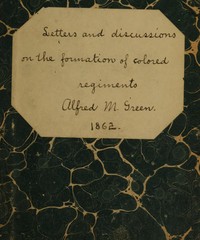
LETTERS AND DISCUSSIONS ON THE Formation of Colored Regiments, AND THE DUTY OF THE COLORED PEOPLE IN REGARD TO THE GREAT SLAVEHOLDERS’ REBELLION, IN THE UNITED STATES OF AMERICA.
BY ALFRED M. GREEN.
PHILADELPHIA: RINGWALT & BROWN, STEAM POWER PRINTERS, 111 SOUTH FOURTH STREET, 1862.
At the beginning of the great struggle between the Government of the United States and the traitors who lifted their hands against it, I sought the oracles of history for a precedent; and, having easily found it, before uttering a single sentence as to its influence or results upon the great question of slavery in America, I carefully scanned and surveyed the whole question or ground upon which the issue rested. By the fairest rules of comparison and analogy, I found it impossible to separate slavery extension, or the nationalization of this vilest of evils, from the purpose of the arch traitors as their avowed object, and the determination on the part of slaveholders to exercise unlimited power over their dejected victims of the African race as their leading object and the mainspring of the rebellion. Then, having followed history by the same rules of comparison and analogy, it was not very difficult for me to decide as to our duty. Nor have I ever seen anything written, spoken, or performed by the government—its agents—by my abolition friends and associates—or by the conservative Democracy of our land—which has given me occasion to change my opinion.
I have not a doubt at this hour, but that my hopes on the one hand, and my fears on the other, may both yet be realized. A careful reading of the following pages will clearly develop in what these hopes and fears consist. My friends, who ask me from time to time what I think of the present aspect of affairs, may learn from these pages that I am still sanguine of the success of our cause as the result. Still, much depends upon our own exertions as to the character and quality of freedom, suffrage or the enfranchisement that we may enjoy.
Having written much upon the subject, I have been induced to throw together some scraps of arguments offered in reply to the opposition I have met in regard to my opinions, &c.
The first two articles in this pamphlet may be justly styled the foundation of all discussion upon the questions presented. They were met and opposed by white and colored men, while many others of all parties gave my views support. After discussing the question through the columns of the Pine and Palm with my anti-slavery coadjutors, I met and discussed it before the Church Anti-Slavery Society of this city on the second Tuesday in September, 1861. A short report of said debate appearing in the Anglo-African, drew forth the vigorous discussion through the columns of that journal from which the body of this pamphlet is made up.
I have several lectures and a poem on this same subject, entering more minutely upon the details of the war and its results, which I have delivered with great success and which I now propose, at the suggestion of friends, to lay before the public for perusal at their leisure.
A. M. GREEN.
THE COLORED PHILADELPHIANS FORMING REGIMENTS.
From the Philadelphia Press, of April 22, 1861.
A number of prominent colored men are now raising two regiments at the Masonic Hall, in South Eleventh street, and hundreds of brawny ebony men are ready to fill up the ranks if the State will accept their services. Peril and war blot out all distinction of race and rank. These colored soldiers should be attached to the Home Guard. They will make Herculean defenders. Colored men, it will be remembered, fought the glorious battle of Red Bank, when the city was in peril in 1777. The following is the address:
The time has arrived in the history of the great Republic when we may again give evidence to the world of the bravery and patriotism of a race, in whose hearts burns the love of country, of freedom, and of civil and religious toleration. It is these grand principles that enable men, however proscribed, when possessed of true patriotism, to say: “My country, right or wrong, I love thee still!”
It is true, the brave deeds of our fathers, sworn and subscribed to by the immortal Washington of the Revolution of 1776, and of Jackson and others, in the War of 1812, have failed to bring us into recognition as citizens, enjoying those rights so dearly bought by those noble and patriotic sires.
It is true, that our injuries in many respects are great; fugitive-slave laws, Dred Scott decisions, indictments for treason, and long and dreary months of imprisonment. The result of the most unfair rules of judicial investigation has been the pay we have received for our solicitude, sympathy, and aid in the dangers and difficulties of those “days that tried men’s souls.”
Our duty, brethren, is not to cavil over past grievances. Let us not be derelict to duty in the time of need. While we remember the past, and regret that our present position in the country is not such as to create within us that burning zeal and enthusiasm for the field of battle, which inspires other men in the full enjoyment of every civil and religious emolument, yet let us endeavor to hope for the future, and improve the present auspicious moment for creating anew our claims upon the justice and honor of the Republic; and, above all, let not the honor and glory achieved by our fathers be blasted or sullied by a want of true heroism among their sons. Let us, then, take up the sword, trusting in God, who will defend the right, remembering that these are other days than those of yore—that the world to-day is on the side of freedom and universal political equality.
That the war-cry of the howling leaders of Secession and treason is, let us drive back the advance guard of civil and religious freedom; let us have more slave territory; let us build stronger the tyrant system of slavery in the great American Republic. Remember, too, that your very presence among the troops of the North would inspire your oppressed brethren of the South with zeal for the overthrow of the tyrant system, and confidence in the armies of the living God—the God of truth, justice, and equality to all men.
With a knowledge of your zeal and patriotism, and a hope of its early development, I am yours, for God and humanity,
A. M. GREEN.
PHILADELPHIA, April 20, 1861.
NEGROES IN THE SERVICE.
From the Philadelphia Sunday Transcript, May, 1861.
The colored portion of our population are anxious to do the State some service. Already they have organized one or more regiments, and are perfecting themselves in the drill. Among the documents which have already emanated from this branch of our population, as to the propriety of their engaging in such service, is the following from the pen of “Hamilcar,” a negro of more than ordinary ability. Without endorsing his communication we give it place, so that all sides may be heard:
“While many persons in the North—perhaps strong friends of the Union—are not prepared to endorse the idea of admitting colored regiments into its service, it might be well for us to remember that every effort is being made by the South to make their black population efficient aids in defending their soil against our army. The State of Louisiana, for more than three months, has had colored regiments in the home guard service, under the most efficient drill and pay. Vice President Stephens recommended this course to all the States. Tennessee, in pursuance of this recommendation, has passed an act to employ all the available muscle of her free black population. There are four colored regiments now in Virginia, in the service of the rebel government. It is said, on perfectly reliable authority, that black troops shot down Union men at the late battle at Manassas Gap.
“Where, then, is the consistency, or expediency, of fruitlessly wasting so much time at the North, in discussing the propriety of adopting such a measure, with reference to preparing our colored population for an emergency, such as may be thrust upon us by the introduction of 50,000 or 100,000 Indians and negroes brought into the field against us, and they having all the advantage of the most efficient drill and endurance, by long months of preparation and practice, that we have hopelessly wasted in discussing questions of propriety, &c., &c.
“Are we to be duped and forestalled in this last hope, so much relied upon as a means of bringing rebels to terms, as we have been in almost every other available means of speedy and honorable settlement? Should the South generally adopt the idea of their dictators, Davis and Stephens, to place in the field 50,000 free blacks, at $12 per month, (term of enlistment for three years,) will they not soon discover that the same amount of money would emancipate and place in the field 125,000 men, paying their masters liberally—settling also the question of servile rebellion among themselves, the question of contraband emancipation, and the general insecurity of that species of property during the rebellion?
“Would any offer of our government induce those people to desert or fight against their former masters and emancipators in such an event? Does not our own wars, and the French and Spanish wars in Hayti, sufficiently develop the fact that the slaves will defend the soil of their birth, even on the most superficial promise of those who are their superiors. Would not the South, by such an act, draw largely upon the moral sentiment of Europe, (that must in no small degree operate for or against their recognition,) by such an act in advance of the North?
“Could we draw more largely on that sentiment at home or abroad by adopting such a measure, by mere necessity, than would the South by the same principle? And especially, when we had to throw into the field raw and undisciplined recruits against the most able and efficiently drilled regiments?
“To me it seems that reason, prudence, and judgment, aided by the present signs of the times, would indicate that the available muscle, the bone and sinew of our 30,000 colored inhabitants of the city and county of Philadelphia should be encouraged in their (already manifest) patriotic efforts in preparing to sustain and defend the soil and interests of their native State.”
HAMILCAR.
From the Pine and Palm, June 22, 1861.
Mr. Editor:
Since I last wrote you, on the subject of American revolution, and the manifest interest we have in the great issue now before the country, I have been incessantly laboring, with might and main, to carry out, or to propagate, by all practicable means, the policy therein indicated. Of course, I have not closed my eyes to the various objections raised by learned and tried friends of the enslaved and disfranchised colored Americans of these United States. Nay, on the contrary, I have read and pondered them all over and over again, and I think I gave them the consideration they merit. I do not advance these suggestions I am now about to make, (in continuation of the position I have maintained in my previous letter,) with any direct reference to any one of the opinions I have met differing from my own; but merely for the purpose of indicating to those who have been long acquainted with me and my most implacable hostility to the slave power, and all who could in any way sympathize with or apologize for the cruel system of tyranny in this country: and to let those of our rulers who expect our cöoperation know, and know in time, that while I am largely filled with patriotism and sympathy for the government, yet that government must be magnanimously generous to the poor and oppressed of this land, ere it can have my hearty and willing support; and until it can have it thus, it cannot have it at all, by no principle, nor by any rule of coercion or impressment that it might adopt in this direction. I think, indeed I know, I have made myself more thoroughly understood on this point by those in authority, both of the State and of the United States, than among our own people. Many of our people would be willing, after an act was passed, by which they were to be forced into the field, to do the work white men would have them do, _i. e._—shoot down the slaves and free colored population of the South, who might have no possible means of escaping the necessity of going into the service of the Southern Confederacy. As I remarked to a gentleman, a few days ago, it would take a degree of patriotism that I do not possess, to go South for such a purpose. I would readily go to shoot the enemies of the government; but until it was made manifest to me that these men were possessed of discretionary power, of their own will to act in the case as they felt disposed, I should not be willing to shoot them; nor would I do it, whatever the consequences of a refusal might involve in such a case.