Public-domain ebook
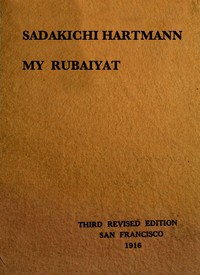
My Rubaiyat
Language: en181 downloads on Project Gutenberg
Subjects
In: Poetry
Public-domain ebook sourced from Project Gutenberg #58664.
Public-domain ebook
Language: en181 downloads on Project Gutenberg
Subjects
In: Poetry
Public-domain ebook sourced from Project Gutenberg #58664.
The opening · free to read
I will drop the mask and tell you the secret of my verses. You say they impress you as being uneven and unfinished. I heartily agree with you. As I have stated in my announcement to the public, a poem of the scope and range of “My Rubaiyat” is never complete. No doubt, it will undergo many changes within the next ten years. I say ten years deliberately. You see, I possess the arrogance of conviction. I believe it will survive, simply because it strikes a popular chord, and attempts, no matter how vaguely, to reproduce a broken melody that hums in every mind. Somebody else may venture forth on similar paths and succeed to please even the fastidious in rhyme. “My Rubaiyat” may be put on the back shelves. Well, we will see. I look at my work with objective eyes. It is a mere youngster now. It will grow and nobody will watch its growth with keener appreciation than I myself. The number of verses will not increase, but I sincerely hope that they will gain in clarity and strength as well as in musical and pictorial wealth of expression.
As for versification, let me make this explanation. I chose the eight syllable stanza on account of its terseness of expression. It is least pliable to any rush and swing of rhythm, but most conducive to the conveyance of fragmentary moods and thoughts. The omission of rhyme I essayed for no other reason than its technical difficulty. To make rhymeless lines read like a poem is the most laborious task a songsmith can set himself. It is the vanity of the alien to show his mastery over a language that was neither his father’s nor his mother’s tongue. But I object to your statement that I disdain rhythm. I have a vague suspicion that you really mean meter. My meter is rough and wilful and subject to impurities, as for instance counting the last two syllables in words like “happier” and “sunnier” either as one or two, just as my fancy, or rather my appreciation of rhythm, dictates. My rhythm changes constantly but it is palpable, underneath as it were, at all times. I have some experience as a reader (though elocutionists may shrug their shoulders at my style of interpretation—let them shrug) and I have, whenever I write, the habit of reading aloud the words as I put them down. Reading means to get a certain sense and swing, color and sound in the words as one utters them. If my verses contain this possibility of aural gratification they cannot be utterly devoid of rhythm. No doubt my sense of sound alliteration is foreign, unconsciously Oriental. I feel a sound relation, no, even a rhyme suggestion in words like “chance” and “spring,” “herd” and “feet” at the end of succeeding stanzas. The alliteration of Japanese poets is much subtler (due to the peculiarities of the language) than the word music of our Laniers and Whitmans, although it is never conducted with the elaborate precision of a Poe or Swinburne. It always remains fragmentary, it rarely resembles full orchestration. Also my lines lack the merit of contrapuntal structure. Yet they have one quality which is generally overlooked. They possess pictorial harmony. My long and persistent association with art makes me not only see but think things in pictures. Pictures abound throughout “My Rubaiyat” for all who have the mental pictorial vision to see them. Lines like “turn phantoms with the colder morn” and “in a hilltown among roses” are as concentrated as any image that can be found in a tanka (i.e. Japanese short poem).
Critics may contend that pictorial suggestion per se, as the main characteristic of a poem, does not conform to the accepted forms of poetry. This objection is meaningless to me. Without the spirit of innovation there would have been no incentive to write the poem. Like the composers of the day I believe in the old ideals but in new methods of expression.
My ambition was to write a simple poem which would appeal to all; to chambermaids as well as cognoscenti, ordinary business men as well as solitary artistic souls. Who will decide whether I have succeeded or failed? Only the public at large. The poem, no doubt, is too didactic for fragile aesthetics who glorify naught but evanescent words, but it is surely no shortcoming to try to express thought. Even exponents of the modern schools attempt this—occasionally. The way of expression is a different matter. It is open to criticism. But excuses that a critic knows nothing about a certain subject, and yet at the same time deliberate pricks at this very thorn in the flesh of his ignorance are sad to contemplate. Rhyme is surely out of date. And the supposed lack of rhythm is merely imaginary. Would you enjoy Japanese or Chinese music? Very likely not and yet they contain as fine a rhythm and as musical a quality as any modern composition. Only they are vaguer, subtle, different.
And on this difference hinges all logical and evasive argument. The practical philosophy contained in “My Rubaiyat,” of course, can be attacked for being non-moral or non-religious, but the technique of the poem can be discussed only from one viewpoint.
What should we dream, what should we say, On this drear day, in this sad clime! In the garden the asters fade, Smoke of weed-fires blurs the plain, The hours pass with a sullen grace— Can we be gay when skies are grey!
II.
Would joy prove a more steady guest, In palm-girt, sunnier Southern lands, Some lambient world of green and gold Fanned by the charm of Orient lay! ’Tis vain delusion thus to think That life will change with change of scene.
III.
Man cannot get away from facts— Alas, stern duty looms supreme, For certain things we must perform, Obey the inward voices’ call. Calm joyous days cannot be wooed Unless our conscience is at peace.
IV.
Life is to most a weary task, A ceaseless strife for daily bread, We cannot act as we would like, We cannot gain for what we strive. To bear the burden cheerfully Is all this earth allows to us.
V.
Our tired soul with faint forced smile But rarely scales the loftier themes, Fair Hafiz and Anacreon Have they drunk, laughed and sung in vain! Do grove and grange no longer yield The idyls of Theocritus!
VI.
Was man once happier than now? Who is there to tell the story Of slaves or Cesars of the past? Still our blood is stirred each spring, Still books and music make us dream, Why mourn the “snows of yesteryear?”
VII.
There were ever some more favored Who care-free basked in fortune’s sun. The rest did toil. And you and I? We hear the same recurrent rhymes, Like changing seasons, night and day, We simply come, sojourn, and go.
VIII.
We enter the world unbidden, Plod along roads as we know best. One is born rich, the other poor, Who knows what helps a mortal most. Ere sleep we rub from our eyes We are forever what we are.
IX.
The laughter of childhood is gone, The toy castles we built are lost— Can we redeem in future days The disappointments of the past! Our nursery songs will they change Into jubilant songs of love!
X.
Light-headed youth, all smiles around In dew-drenched gardens of spring morns No heed takes of the dial’s stealth. Youth wants to conquer—rule the spheres, While the sun runs his ruthless course And shadows begin to lengthen.
XI.
In open woods some summer night, The sound of the wind in the leaves— Two vagrant lovers hand in hand— O’er treetops the errant moon. Oh, this mad desire to possess! To waste the soul on blood-red lips.
XII.
Sex is a power all cherish, We worship it on bended knees, Like old wine it yields the magic Of oblivion and ecstasies, The moments drift on golden clouds To regions of the white beyond.
XIII.
Alas, that pleasures never last, That we must leave the fairy woods And pass along the great highway. As much as horizons may beckon, They flee us the more we pursue To distances we ne’er can reach.
XIV.
The more we give the less we gain— This is a bitter truth to tell. Yet passion is a fleeting thing As flowers wane in summer’s heat, Thus eager kisses, thigh to thigh Turn phantoms with the colder morn.
XV.
Why had you, dearest, to leave me! Why must friend from friend depart. Perchance, I shall find the answer Midst howling winds and rain Where sombre forests sway and moan And lightnings stir the darkest lairs.
XVI.
Few think they can give without gain, They attempt to barter with love. Love comes, it is here, it departs Leaving wet eyes and broken hearts. How when we are young can we guess: Love’s winter ne’er returns to spring.
XVII.
Love is a growth, a wondrous plant That scatters its seed-pods unseen, That sheds rarest unknown delights To those few that worship the dream. For love squanders all its treasures, Why should it ask for a return?
XVIII.
When youth departs, when love grows dim, To grey routine hope dwindles down, Sup well, sit warm, drink deep, sleep sound, Thus run the hours from the glass. New vistas beckon here and there Yet men stay, sullen, where they are.
The book keeps going
Reading is free forever. Sign up and watch scenes appear while you read.



Scenes Storieta drew for other classics.
New illustrated classics
Once or twice a month: the latest books to get full character casts, scene art, and free comic editions. No account needed.