I am sure that there is no one who goes to London for the first time, no matter how hurried he may be, who does not try to visit at least three places--the Tower, Westminster Abbey, and St. Paul’s Cathedral.
Of these three places, two are churches; but they are churches that are so connected with the history of our nation that they almost seem to stand at the heart of the Empire.
Their stories are linked together in a curious way, and yet they are quite distinct. As someone has said, ‘Westminster Abbey was ever the Church of the King and Government; St. Paul’s was the Church of the Citizens.’
When we come to study the history of Cathedrals, we find the way in which they came to be built is pretty much the same in most cases. A little church was raised to the glory of God, and a monastery was founded beside it, which became the home of a community of monks or nuns, ruled over by an Abbot or Abbess; and the church was known as the Abbey Church.
Then by-and-by, sometimes not till quite late, as at St. Albans, a ‘Bishop’s Stool’ was placed there, and the Abbey became a Cathedral.
But in the case of St. Paul’s Cathedral it is quite different. It was built for a Cathedral from the first. Its builder, instead of adding a monastery to it, as was usually done, built a monastery having its own Abbey on a little Island which stood in some marshy ground on the banks of the Thames, about a mile away.
This Island was called ‘Thorney Island,’ and the Abbey Church was dedicated to St. Peter, but soon it began to be spoken of as the ‘West Minster,’ or Westminster Abbey, by which name we know it to-day.
This was how it all came about. In the time of the early Britons there were Christian churches scattered up and down the land, and it is almost certain, from stones that were dug up when the foundations of the present Cathedral of St. Paul were being laid, that in those far bygone days a little church stood on the Hill of Ludgate, in the centre of Roman London. But, as you know, the Roman legions were recalled to Rome in A.D. 410 to help the soldiers there to drive back the vast hoards of Goths and barbarians who were pouring down from the north-west upon Italy; and when they were withdrawn from Britain, there were not enough fighting-men left to protect her shores from the next enemies who threatened her.
These were the Jutes, the Angles, and the Saxons, fierce and heathen warriors who came from Jutland and from Germany, and landed on our coasts.
They conquered the British, and rapidly forced their way inland, ravaging and pillaging wherever they went; and in the confusion and misery that followed, Christianity was completely swept away for a time, to come again with St. Augustine and St. Columba some two hundred years later. You know too, perhaps, that when St. Augustine came to Canterbury and began to preach the Gospel there, the King of Kent, Ethelbert by name, soon became a Christian. This King Ethelbert was a very powerful monarch, and he was Overlord of the King of the East Saxons, who chanced to be his nephew, and who lived in what we now call Essex. Now, while St. Augustine preached to the men of Kent, a friend of his, named Milletus, preached to the East Saxons. And when at last their King became a Christian, his uncle Ethelbert suggested that, as Kent had its Bishop of Canterbury, with his Cathedral Church, it would be a good thing for the Kingdom of the East Saxons to have a Bishop of its own who would have his Cathedral Church also.
So, as London was the Capital of the East Saxons, he proposed to help King Siebert to build a church there; and Augustine, only too glad to find that the Faith was spreading, said that Milletus should be its first Bishop.
It was in this way that the first Cathedral of St. Paul was built, and, as we have seen, Siebert also founded the church and monastery of Westminster.
AFTER THE PAINTING BY ERNEST NORMAND IN THE ROYAL EXCHANGE, LONDON
_By permission of the artist._]
Now, although their King had been baptized, and had built two churches in their midst, the people of London did not want to become Christians; they were pagans, and were quite content to worship Thor and Odin, the gods of the tribes of the North. So for a long time the good Bishop Milletus preached to them in vain; and far away in Rome, Pope Gregory, who had hoped that the new Cathedral in London would become what we call the ‘Metropolitan Church’ of England--that is, the church where the Archbishop has his throne--was sadly disappointed, and had to become accustomed to the idea of Canterbury, which was a far less important place than London, having that honour.
Indeed, for a time it seemed as though, in spite of Church and Bishops, the new religion would be driven out. Ethelbert died, and so did his nephew Siebert, and the Kings who succeeded them either went back altogether to their pagan worship, or tried, as an East Anglian King did, to worship Thor and Odin and Christ all at the same time. I will tell you just one story about those troubled days, and it will show you what a terrible struggle went on between Paganism and Christianity, and how much we owe to these brave men, priests, and Abbots, and Bishops, whose names are almost unknown to us, on whom rested the responsibility of maintaining the Faith in England, and of whom, to their honour be it said, hardly one failed.
One day Bishop Milletus was administering the Holy Communion in his church to the little congregation of Christians who still remained true to what he had taught them. It is probable that the altar stood then just where the high-altar in St. Paul’s stands to-day. Only the church would be much smaller and plainer, and the door would be locked to prevent unbelieving pagans entering and disturbing the service by irreverent jeering and laughter. Suddenly a loud knocking was heard, then the crash of falling wood. The young King and his friends had chanced to be passing, and, in a moment of heedless excitement, had determined to visit the Christian’s church, and see what amusement they could get there. Angry at finding the door locked against them, they had broken it down without further delay. Up the aisle strode the King, followed by his mocking companions, to where the old Bishop was engaged in distributing the consecrated Bread to the kneeling communicants. In those days white bread was a rarity, most of it being dark-coloured and unwholesome; and this white bread that was used for the Holy Communion was the whitest and purest of all; for, in order that it should be so, pious people, even the clergy themselves, used to grind the meal carefully with their own hands, and bake it into loaves, and bring it to the church as their offering.
‘Give me some of that white bread,’ cried the young King, stretching out his hand. ‘You gave it to my father Siebert; give it also to me.’
Perhaps he thought in his reckless insolence that the Bishop would obey. But King Siebert had been a baptized Christian, his son was a pagan and an unbeliever; so, King though he was, he could not be allowed to join with the Christians in their solemn Feast. And the brave old Bishop told him so, knowing full well that the refusal might cost him his life. The young King did not put him to death, however, though he was very angry--perhaps he was ashamed to do so--but it cost him his Bishopric, for he was driven out of the Kingdom, and had to leave to seeming ruin all the work that was so dear to his heart.
But it was only seeming ruin. He had done his work faithfully; he had laid the foundations, as it were; and, as has ever happened in the history of the Church, God saw to it that there were other men ready to step in, and build upon these foundations. Other Bishops were appointed--Bishop Cedd and Bishop Erkenwald--and in their days the Christian Faith began to take root again, and spread among the citizens of London, and they improved and beautified their Cathedral until it became famed for its riches and grandeur. Indeed, Bishop Erkenwald was such a famous preacher, and did so much for his church, that when he died he was buried in a golden shrine which people came to see, just as they visited the shrine of St. Cuthbert at Durham, and St. Thomas at Canterbury. As for stout old Bishop Milletus, although he was driven into exile for a time, he became in after-years Archbishop of Canterbury, and his bones lie in the Cathedral there.
Now, it is a curious thing how often those old churches that we are talking about were destroyed, either wholly or in part, by fire. And if there was one church that was fated to suffer more than another in this way, it was St. Paul’s. It was partly burned down in A.D. 951. By that time the Normans were in the country, and they set to work at once to rebuild it. When it was finished, it was a very splendid church indeed; but once more it suffered severely from a fire which broke out in the City, and destroyed everything from London Bridge to the Church of St. Clement Danes, which stands in the Strand.
Let us see what this Cathedral of the Middle Ages was like. It was the largest church in England, and was shaped like a cross, and, instead of having a dome, as the present Cathedral has, it had a great square tower in the centre, with a wooden spire, four hundred and sixty feet high. It stood in the middle of a churchyard, which was surrounded by a high wall. We still talk about ‘St. Paul’s Churchyard,’ although it is long years since anyone was buried there; but if we are in London, and take a bus along the crowded Strand, and up Ludgate Hill, we shall arrive at this old churchyard, and then we shall see the ‘St. Paul’s’ of to-day, and shall be better able to picture to ourselves the ‘St. Paul’s’ of the Middle Ages.
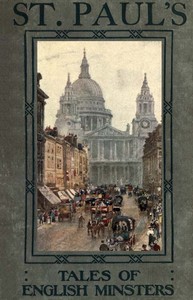
When we leave our bus, we find ourselves in an open space bounded on all sides by busy streets and fine shops. In the centre of this open space stands an immense church, with a huge dome rising from its centre, and on the top of the dome, standing clearly out against the sky, so far up that it can be seen from nearly all parts of London, is an immense gilded cross. In front of the church there are two great flights of steps, which lead down into a broad paved space, only separated from the street by a row of low stone pillars, while round at the sides lie pleasant gardens, with flagged walks, where pigeons flutter about, and where, in summer, hundreds of busy clerks, and shop-girls, and message-boys, come and sit in their lunch-hour, and get a breath of fresh air and a little sunshine.
‘But where is the old churchyard?’ you ask, looking round in amazement. I will tell you. These gardens, and the great space in front of the church, stand to-day where St. Paul’s Churchyard stood long ago, only there is no longer a wall round them, and although the name remains, the gravestones have long since disappeared. Let us try, however, to think that we are back in the Middle Ages, and imagine ourselves standing among the graves in the old churchyard. In front would be the great church, bigger than that which now rises before us, with its square tower and wooden steeple. At the north-east corner of it we should see a curious erection like a low, eight-sided tower, with a stone cross on the top of it. That was called ‘Paul’s Cross,’ and it was almost as important a place as the Cathedral itself.