Public-domain ebook
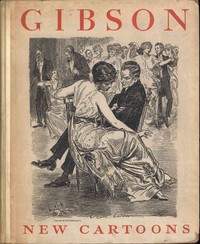
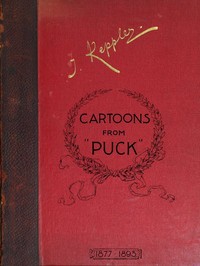
A Selection of Cartoons from Puck
Language: en921 downloads on Project Gutenberg
Subjects
In: Humour·American Literature·Art
Public-domain ebook sourced from Project Gutenberg #59604.
Public-domain ebook
Language: en921 downloads on Project Gutenberg
Subjects
In: Humour·American Literature·Art
Public-domain ebook sourced from Project Gutenberg #59604.
The opening · free to read
WIE DIE DEMOK-RATTEN IN DIESEM FALLE IN DIESE FALLE GERIETHEN.]
CONSOLIDATED.
PUCK, January 26th, 1881.
“The telegraph companies have been consolidated, which in simple language means that Mr. Jay Gould controls every wire in the United States over which a telegram can be sent,” said PUCK of January 26th, 1881, and the statement was no exaggeration.
The editorial went on to express a fear that this monopoly of telegraphic facilities might be used for stock-jobbing purposes, as it made suppression or falsification of price-quotations not only possible, but temptingly easy. This fear was far from groundless at the time, although it has since been removed by the enormous growth of the business of electrical communication, which has now become a machine too huge to be readily perverted from its proper working by any one man. It is, however, undeniable that the Western Union wires were misused for parties and purposes in the doubtful and troublous days immediately succeeding the Presidential election of 1884. At the time when this cartoon was published there was a very general feeling that the federal government ought to take charge of the whole telegraphic system. This feeling, however, changed when the people realized that a postal telegraph scheme would practically involve the enrollment of a new army of office-holders who would be, under our inadequate and ineffective civil-service reform laws, merely the hirelings and henchmen of the party in power. Although the phrase “pernicious activity” had not yet been coined to characterize the performances of unscrupulous office-holders, the people had seen quite enough of the thing itself to want no more of it; and the project of government interference became unpopular. At the same time, it can not be said that Mr. Gould, who lived until 1892, ever inspired the people with confidence or made any recognizable attempt to that end.
AN ATTACK ON OUR OUTER RAMPARTS.
PUCK, April 22nd, 1885.
The so-called “Freedom of Worship Bill Controversy” has been carried on so many years, through so many varying phases and under such exceptional and peculiar conditions, that it has become most difficult of description and characterization. Its exciting cause is a bill introduced into the New York legislature ostensibly in the interests of what might be called sectarian fair play. On the face of it, it aims to secure to the Catholic, confined by sickness or for other reasons in a public institution, the right to enjoy the ministrations of his religion at the hands of a priest of the Roman Church. Its opponents have alleged that it is calculated to go much farther than this in practical effect, and to afford a foothold for the regular and official installment of Roman Catholic Priests in the public institutions of the state. The bill has appeared and reappeared for many years. It has assumed many forms, has provoked a vast amount of discussion, and has engaged the interest of a very large, and in some respects a very peculiar, collection of friends and enemies. Its good faith has always been questioned, and we do not think it is expressing an ex parte opinion to say that it has always been open to question--in view of the breadth and comprehensiveness of our American common law as applied to the civil rights of the citizen and the equal status of all religious organizations in the commonwealth. At the time (April 22, 1885,) when this cartoon was printed, the bill had appeared in a form which gave good reason for the belief, in which the whole press of New York shared, that it was a covert attack upon non-sectarian institutions.
It is to be hoped that this cause of so much contention will some day be forgotten in the natural growth of a spirit of religious tolerance.
THE POLITICAL “ARMY OF SALVATION.”
PUCK, March 31st, 1880.
Loyalty and lack of moderation were equally marked as characteristic of the support which Mr. Roscoe Conkling gave to any cause that enlisted his sympathies. The hot, unreasoning, fanatical vehemence of the attempt which he made in 1880 to dragoon the Republican party into nominating General Grant for a third term undoubtedly made the third term idea far more unpopular than a more judicious advocacy might have made it. Mr. Conkling treated the question of General Grant’s nomination almost as though it were a matter of divine right; and although Mr. Conkling himself had a right to be considered honest in his enthusiasm, as much could not be said for the most of his active assistants in the management of the “Boom”--among whom were Ex-Secretaries Belknap and Robeson, two officials who had reflected anything but credit upon General Grant’s cabinet, Boss Shepherd, and other members of the ring that had been formed in Washington during the Ex-President’s second administration. The artist has drawn a parallel between the methods employed by the “Salvation Army,” which had invaded this country a little while before, and those of the “halcyon and vociferous” Mr. Conkling--to quote his own immortal phrase.
THE CINDERELLA OF THE REPUBLICAN PARTY AND HER HAUGHTY SISTERS.
PUCK, October 13th, 1880.
During the Presidential campaign of 1880, which ended in the election of Mr. Garfield, Mr. R. B. Hayes, then the incumbent of the Presidential chair, was treated with studied neglect and coldness by the leaders of his own party. Although General Grant had failed to get the nomination at the Chicago convention, in spite of the vigorous efforts of Mr. Roscoe Conkling, the ex-President and his ally were prominent in the campaign on their own account.
“They speak at mass-meetings, they are interviewed, they write letters; they are never out of the public eye,” says PUCK of October 13th, 1880. Mr. Hayes, however, received no pressing invitation from the party managers to assist in electing their Republican ticket. Undoubtedly this deliberate slight was due to the extreme sensitiveness felt by all classes of Republicans on the question of Mr. Hayes’s title to the office which he held; and it was in its inception a creditable feeling that prompted the desire to keep him in the background. At the same time, it was a severe, almost a cruel retribution to be visited upon a man who had tried hard to atone for his capture of the Presidential chair by trick and device, by giving the country an uncommonly good, and, in some respects, decidedly courageous administration. Messrs. Grant and Conkling seemed to be solicitous to draw attention to their complete silence concerning the outgoing administration, and their enthusiasm in Mr. Garfield’s behalf. Although, to quote again from PUCK, “both these talkative gentlemen might have found their eloquence at a discount if Mr. Hayes had not kept up the score of the party through the last four years.”
“His administration will be held notable, in days to come, not merely for its positive performances, its vetos of the infamous Silver Bill and the unconstitutional Chinese Act; but for its negative excellence. He has done his duty as he saw it. If he has made himself ridiculous by carrying the contemptibly small social practices of a little Ohio town into the wider sphere of life to which Fate has introduced him, it is a pardonable fault. Let us say for him, after all, that, considering the wretched way in which he got to be President, he has done far too well with his chances to be snubbed by men in such equivocal positions as Messrs. Grant and Conkling.”
A HARMLESS EXPLOSION.
PUCK, May 25th, 1881.
Mr. Conkling’s resignation to the Senate, in hope of re-election under circumstances which would have made such a triumph a severe rebuke to President Garfield, proved to be, as most people foresaw, the end of his political career. But, at the time, there were plenty of people to applaud his act and to liken his resignation to a “bombshell” thrown into the Senate. It was a sort of fireworks bombshell that destroyed nothing but itself, but it made a great noise for the moment. Mr. T. C. Platt chose at the same time to pop his toy balloon, and probably thought that it made part of the noise.
PUCK’S POLITICAL HUNTING GROUND.--HOW HE HAS MADE GAME OF THE POLITICIANS.
PUCK, January 14th, 1885.
The first cartoons were doubtless chalked on dead walls, and even when the art reached a higher development, sticking to walls remained the cheapest and most convenient method of publication. It is often a test of a cartoon’s worth to-day--its suitability as a wall-decoration. It is a natural and simple impulse that moves us to pin on the wall the picture that has pleased us. Readers of PUCK who travel much in this country can not but notice how many people delight in pasting and pinning their favorite cartoons to the walls of their offices and workshops, and even of their dwelling-houses. A really popular cartoon is always sure of these humble but well-meant honors; and, curiously enough, experience has shown that next to the really telling “hit,” a playful, familiarly puzzling trifle like “PUCK’S Political Hunting-Ground,” if it is conceived with some grace and prettiness, is the most certain of this sort of popular favor. This particular picture was, no doubt, made attractive to many by the simple puzzle afforded by the faces of the animals. As, however, the passing of time must make some of these faces unfamiliar, it may be well to offer the following key--first calling attention to the fact that all the personages introduced were at the moment, in one way or another, at odds with fortune--except the late Mr. Jay Gould, who is figured as a bird of prey (in a general way, and with no over-particular ornithological accuracy) comfortably bearing off a lamb. The fact that this one figure of success is quite unconscious of the attempts of PUCK’S water-dog to catch him, may be supposed to show the usual disregard that Wealth entertains for Wit:
The fox, of course, is the ingenious Mr. James G. Blaine. The hyena, ex-speaker Kiefer, and the next animal of doubtful breed “Star Route” or “Soap” Dorsey. The paw and the head seen in the reeds behind the dog belong to Brady. The lineaments of Ben Butler may be discerned in the head of the frog, and the nature of the beast in the distention of the belly thereof. At the other end of the cartoon, General Grant’s features, without distortion or caricature, fit the head of the dead lion. Next to him “Secor” Robeson lies in the similitude of a dead boar, incapable of mischief for all his glaring eye-balls. In the foreground, Roscoe Conkling lies a dead pouter pigeon. (Caricaturists frequently showed Mr. Conkling as a pouter pigeon, but most of them carried the analogy too far and made a frail, spindle-shanked thing of him. In this picture the thickly feathered legs and stout frame of the bird do not bely its sturdy original.) The owl is the late John Kelly--and a powerful and accurate owl he was, too, in his time! The pendent monkey is T. C. Platt, who was at that time suffering from one of the temporary eclipses which flecked the pathway of the political adventurer with appropriate forecasts of oblivion.
The book keeps going
Reading is free forever. Sign up and watch scenes appear while you read.



Scenes Storieta drew for other classics.
New illustrated classics
Once or twice a month: the latest books to get full character casts, scene art, and free comic editions. No account needed.