Public-domain ebook
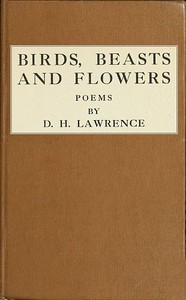
Birds, Beasts and Flowers Poems by D. H. Lawrence
Language: en1,161 downloads on Project Gutenberg
Subjects
In: Poetry
Public-domain ebook sourced from Project Gutenberg #60337.
Public-domain ebook
Language: en1,161 downloads on Project Gutenberg
Subjects
In: Poetry
Public-domain ebook sourced from Project Gutenberg #60337.
The opening · free to read
What is it? What is it, in the grape turning raisin, In the medlar, in the sorb-apple, Wineskins of brown morbidity, Autumnal excrementa; What is it that reminds us of white gods?
Gods nude as blanched nut-kernels, Strangely, half-sinisterly flesh-fragrant As if with sweat, And drenched with mystery.
Sorb-apples, medlars with dead crowns.
I say, wonderful are the hellish experiences Orphic, delicate Dionysos of the Underworld.
A kiss, and a vivid spasm of farewell, a moment’s orgasm of rupture, Then along the damp road alone, till the next turning. And there, a new partner, a new parting, a new unfusing into twain, A new gasp of further isolation, A new intoxication of loneliness, among decaying, frost-cold leaves.
Going down the strange lanes of hell, more and more intensely alone, The fibres of the heart parting one after the other And yet the soul continuing, naked-footed, ever more vividly embodied Like a flame blown whiter and whiter In a deeper and deeper darkness Ever more exquisite, distilled in separation.
So, in the strange retorts of medlars and sorb-apples The distilled essence of hell. The exquisite odour of leave-taking. Jamque vale! Orpheus, and the winding, leaf-clogged, silent lanes of hell.
Each soul departing with its own isolation, Strangest of all strange companions, And best.
Medlars, sorb-apples More than sweet Flux of autumn Sucked out of your empty bladders And sipped down, perhaps, with a sip of Marsala So that the rambling, sky-dropped grape can add its music to yours, Orphic farewell, and farewell, and farewell And the ego sum of Dionysos The sono io of perfect drunkenness Intoxication of final loneliness. San Gervasio.
The proper way to eat a fig, in society, Is to split it in four, holding it by the stump, And open it, so that it is a glittering, rosy, moist, honied, heavy-petalled four-petalled flower.
Then you throw away the skin Which is just like a four-sepalled calyx, After you have taken off the blossom with your lips.
But the vulgar way Is just to put your mouth to the crack, and take out the flesh in one bite.
Every fruit has its secret.
The fig is a very secretive fruit. As you see it standing growing, you feel at once it is symbolic: And it seems male. But when you come to know it better, you agree with the Romans, it is female.
The Italians vulgarly say, it stands for the female part; the fig-fruit: The fissure, the yoni, The wonderful moist conductivity towards the centre.
Involved, Inturned, The flowering all inward and womb-fibrilled; And but one orifice.
The fig, the horse-shoe, the squash-blossom. Symbols.
There was a flower that flowered inward, womb-ward; Now there is a fruit like a ripe womb.
It was always a secret. That’s how it should be, the female should always be secret.
There never was any standing aloft and unfolded on a bough Like other flowers, in a revelation of petals; Silver-pink peach, Venetian green glass of medlars and sorb-apples, Shallow wine-cups on short, bulging stems Openly pledging heaven: Here’s to the thorn in flower! Here is to Utterance! The brave, adventurous rosaceæ.
Folded upon itself, and secret unutterable, And milky-sapped, sap that curdles milk and makes ricotta, Sap that smells strange on your fingers, that even goats won’t taste it; Folded upon itself, enclosed like any Mohammedan woman, Its nakedness all within-walls, its flowering forever unseen, One small way of access only, and this close-curtained from the light; Fig, fruit of the female mystery, covert and inward, Mediterranean fruit, with your covert nakedness, Where everything happens invisible, flowering and fertilisation, and fruiting In the inwardness of your you, that eye will never see Till it’s finished, and you’re over-ripe, and you burst to give up your ghost.
Till the drop of ripeness exudes, And the year is over.
And then the fig has kept her secret long enough. So it explodes, and you see through the fissure the scarlet. And the fig is finished, the year is over.
That’s how the fig dies, showing her crimson through the purple slit Like a wound, the exposure of her secret, on the open day. Like a prostitute, the bursten fig, making a show of her secret.
That’s how women die too.
The year is fallen over-ripe, The year of our women. The year of our women is fallen over-ripe. The secret is laid bare. And rottenness soon sets in. The year of our women is fallen over-ripe.
When Eve once knew in her mind that she was naked She quickly sewed fig-leaves, and sewed the same for the man. She’d been naked all her days before, But till then, till that apple of knowledge, she hadn’t had the fact on her mind.
She got the fact on her mind, and quickly sewed fig-leaves. And women have been sewing ever since. But now they stitch to adorn the bursten fig, not to cover it. They have their nakedness more than ever on their mind, And they won’t let us forget it.
Now, the secret Becomes an affirmation through moist, scarlet lips That laugh at the Lord’s indignation.
What then, good Lord! cry the women. We have kept our secret long enough. We are a ripe fig. Let us burst into affirmation.
They forget, ripe figs won’t keep. Ripe figs won’t keep.
Honey-white figs of the north, black figs with scarlet inside, of the south. Ripe figs won’t keep, won’t keep in any clime. What then, when women the world over have all bursten into affirmation? And bursten figs won’t keep? San Gervasio.
Admit that apples and strawberries and peaches and pears and blackberries Are all Rosaceæ, Issue of the explicit rose, The open-countenanced, skyward-smiling rose.
What then of the vine? Oh, what of the tendrilled vine?
Ours is the universe of the unfolded rose, The explicit, The candid revelation.
But long ago, oh, long ago Before the rose began to simper supreme, Before the rose of all roses, rose of all the world, was even in bud, Before the glaciers were gathered up in a bunch out of the unsettled seas and winds, Or else before they had been let down again, in Noah’s flood, There was another world, a dusky, flowerless, tendrilled world And creatures webbed and marshy, And on the margin, men soft-footed and pristine, Still, and sensitive, and active, Audile, tactile sensitiveness as of a tendril which orientates and reaches out, Reaching out and grasping by an instinct more delicate than the moon’s as she feels for the tides.
Of which world, the vine was the invisible rose, Before petals spread, before colour made its disturbance, before eyes saw too much.
In a green, muddy, web-foot, unutterably songless world The vine was rose of all roses.
There were no poppies or carnations, Hardly a greenish lily, watery faint. Green, dim, invisible flourishing of vines Royally gesticulate.
Look now even now, how it keeps its power of invisibility Look how black, how blue-black, how globed in Egyptian darkness Dropping among his leaves, hangs the dark grape! See him there, the swart, so palpably invisible: Whom shall we ask about him?
The book keeps going
Reading is free forever. Sign up and watch scenes appear while you read.



Scenes Storieta drew for other classics.
New illustrated classics
Once or twice a month: the latest books to get full character casts, scene art, and free comic editions. No account needed.