Public-domain ebook
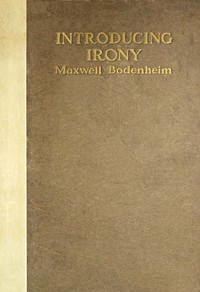
Introducing Irony: A Book of Poetic Short Stories and Poems
Language: en321 downloads on Project Gutenberg
Subjects
In: Short Stories·Poetry·American Literature
Public-domain ebook sourced from Project Gutenberg #60427.
Public-domain ebook
Language: en321 downloads on Project Gutenberg
Subjects
In: Short Stories·Poetry·American Literature
Public-domain ebook sourced from Project Gutenberg #60427.
The opening · free to read
With crafty brooding life turned to Jack Rose And made him heroin-peddler, and his pose Was sullenly reflective since he feared That life, regarding him, had merely jeered. His vanity was small and could not call His egoism to the dubious hall Of fame, where average artists spend their hour. Doubting his powers he was forced to cower Within the shrill, damp alleys of his time, Immersed in that brisk midnight known as crime. He shunned the fiercely shrewd stuff that he sold To other people, and derived a cold Enjoyment from the writhing of their hearts. A speechless artist, he admired the arts Of blundering destruction, like a monk Viewing a play that made him mildly drunk. And so malicious and ascetic Jack Bent to his trade with a relentless back Until he tapped an unexpected smile-- A woman’s smile as smooth and hard as tile. May Bulger pawned her flesh to him and gave His heroin to her brother, with a grave Reluctance fumbling at her painted lips. Though angry at herself, she took the whips Of undesired love, to quiet a boy Who wept inanely for his favorite toy. She hated Jack because he failed to gloss And soften the rough surface of her loss, His matter-of-fact frown biting at her heart. He hated her because her smiling guess Had robbed him of ascetic loneliness, And when her brother died, Jack sat beside Her grief and played a mouth-harp while she cried. But when she raised her head and smiled at him-- A smile intensely stripped and subtly grim-- His hate felt overawed and in a trap, And suddenly his head fell to her lap. For some time she sat stiffly in the chair, Then slowly raised her hand and stroked his hair.
“Have you ever played on a violin Larger than ten thousand stars And warmer than what you call sin?” Torban, a young man from Mars, Gave me the stretch of his voice, And my “no” fell down like a pin On the echoed din of his words. He said: “Then I have no choice. I must use the barrenly involved Words with which you have not solved The wistful riddles of your days. Leave the pale and ruddy herds Of men, with their surrendering ways, And come with me to Mars.”
Drums of Autumn beat on Mars, Calling our minds to reunion. The avenues of seaweed spars Have attained a paleness Equal to that of earthly philosophies, And the trees have lost The diamond violence of Spring. Their purple leaves have turned to grey Just as a human religion Gradually changes to pretence. In Mars we have only two seasons, Spring and Autumn--their reasons Rest in a treacherous sun That suddenly runs away, Creating a twilight-suspense. When the sun reappears Mars is once more amazed By the blazing flatteries of Spring. Again the heavy leaves ring With odor and light deftly pressed Into a stormy chorus. Then we abandon the screaming violins Of our minds, and each man wins An understanding rest. Once more we roam and jest Upon the avenues, with voices One shade louder than the leaves, Or sail upon the choral seas And trade our words with molten ease. Throughout the Autumn we stand Still and deserted, while our minds Leap into sweeping tensions Blending sound and form Into one search across the universe.
What do we find in this search? All of your earthly words lurch Feebly upon the outskirts of my mind, And when they pass beyond them, they are blind. Outward forms are but the graves Of sound, and all the different waves Of light and odor, they are sound That floats unshaped and loosely gowned. When sound is broken into parts Your ears receive the smaller arts, But when it drifts in broad release You cannot hear its louder peace. Your houses, hills, and flesh of red Are shapes of sound, asleep or dead. In Mars a stronger Spring of sound Revives our forms and makes Profound Music, softer than the dins That rose from Autumn violins. Our minds, whose tense excursions spread In chase of noisy walls that fled, Relent and drop within our heads, Enjoying the timid sound of their beds. Filled with a gracious weariness, We place it, like a lighter dress, Upon the sounds from other stars Brought back to celebrate on Mars.
A girl of Mars is burning Notes of thought within her throat. Her pale white lips are turning The fire to storied chords. The song is old but often made By girls who sit in Spring and braid The lanterned language of their hair. Its spacious gaiety cannot be sold To your narrow glow of words. The hint that I shall give is cold And like the sound of snowy air.
I shall journey with the men When my curling thoughts are ten. O the sternness of that number! Colored sounds from breath to umber Promising a first release. I have dwelt too long in peace Placing smallness on my breast. The prisoned whisper of my skin Longs to vanish in the din Of Autumn when great sounds are caught. Let the tall wildness of my thought Stride beside the thundering grace Of the man whose spring-time face Brought me tiny notes of rest.
She sits within a house of stone That lends a wise and balanced tone: A roofless house whose walls are low And level with her head’s grey glow. The bright sounds of her parents fly Around the house--we do not die In Mars, but change to gleams of sounds And stay within our gayer rounds Until when tired Spring has gone We lead the Autumn searchers on. Before we change, our bodies curve Like yours save that our skins are gray: Light shades of gray that almost swerve To white, like earthly men who pray.
We do not love and hate in Mars. These earthly cries are flashing bars Of sound from which our minds are free. They stand in our mythology: Legends elusive and weird, Acrid Gods that once were feared. They vanished imperceptibly And none among us can agree Upon the tangled way in which they fled. Starlit symbols of dread, They slowly exhausted themselves and died In striding heralds of a wilder bride. We have no emotions in Mars. They are like long-healed wounds Whose scars are softened by the gleam of our minds. We approach them with clearer kinds Of sound from deeply resting thought. Our youths and maidens have not caught The treacherous and tightly bound Confusion of your loving sound, For sex to us is but the ring Of different shades of thought in Spring When men recline upon the breast Of women, dissolving into thoughtful rest. In Autumn sex is left behind. Men and women no longer lined By different bodies raise their dins Above the screaming violins.
Negro, Chinaman, White servant-girl, Russian woman, Are learning how to be dead, Aided by the impersonal boredom Of a morgue at evening. The morgue divides its whole Of dead mens’ contacts into four Parts, and places one in each Of these four bodies waiting for the carts. The frankness of their decay Breaks into contradictory symbols And sits erect upon the wooden tables, Thus cancelling the validity of time. In a voice as passive as slime The negro speaks. “Killed a woman: ripped her skin. Saw her heart floating in a tumbler of gin. Had to drink her heart because it wouldn’t leave the gin. Because I wanted to reach all of her They ripped my flesh. They wanted to reach all of me And their excuse was better than mine.” Cowed baby painted black, The negro sits upon fundamentals And troubles them a little with his hands. The beautiful insanity Of his eyes rebukes The common void of his face. Then the Chinaman speaks In a voice whose tones are brass From which emotion has been extracted. “Loved a woman: she was white. Her man blew my brains out into the night. Hatred is afraid of color. Color is the holiday Given to moods of understanding: Hatred does not understand. When stillness ends the fever of ideas Hatred will be a scarcely remembered spark.” Manikin at peace With the matchless deceit of a planet, The Chinaman fashions his placid immensity. The Chinaman chides his insignificance With a more impressive rapture Than that of western midgets. His rapture provides an excellent light For the silhouette of the negro’s curse. Then the white servant-girl Speaks in a voice whose syllables Fall like dripping flower-juice and offal, Both producing a similar sound. “I made a neat rug for a man. He cleaned his feet on me and I liked The tired, scheming way in which he did it. When he finished he decided That he needed a smoother texture, And found another lady. I killed myself because I couldn’t rub out The cunning marks that he left behind.” Impulsive doll made of rubbish On which a spark descended and ended, The white servant-girl, without question or answer, Accepts the jest of a universe. Then the Russian woman Speaks in a voice that is heat Ill-at-ease upon its couch of sound. “I married a man because His lips tormented my melancholy And made it long to be meek, And because, when he walked to his office each morning, He thought himself a kindled devil Enduring the smaller figures around him. He abandoned me for German intrigue And I chased him in other men, Never quite designing him. Death, a better megalomaniac, Relieved me of the pursuit.” Symbol of earth delighted With the vibration of its nerves, The Russian woman sunders life Into amusing deities of emotion And bestows a hurried worship. Then the morgue, attended by a whim, Slays the intonations of their trance And slips these people back to life. The air is cut by transformation. The white servant-girl retreats to a corner With a shriek, while the negro advances, And the Russian woman Nervously objects to the Chinaman’s question. The morgue, weary housewife for speechless decay, Spends its helplessness in gay revenge: Revenge of earth upon four manikins Who straightened up on wooden tables And betrayed her.
Shun the abundant paragraphs With which a novelist interviews shades Of physical appearance in one man, And regard the body of Alvin Spar Curtained by more aristocratic words. “Alvin Spar in adolescence Was neither slim nor rotund, But slightly aware of future corpulence. The face that Aristotle may have had Was interfering, bit by bit, With an outer face of pouting curves. Alvin Spar in youth Held half of the face that Aristotle May have had, and the pungent directness Of a stable-boy. Alvin Spar in middle age Had the face that Aristotle May have had--a large austerity Disputing the bloom of well-selected emotions. Straight nose, thick lips, low forehead Were apprentices to the austerity That often stepped beyond them. Alvin Spar in old age Had drawn the wrinkled bed-quilts Over the face that Aristotle May have had, but his eyes peered out, Fighting with sleep.” Shuffle the cards on which I have written Alvin Spar’s changes in physical appearance, And deal them out to the various players. Accident first, then the qualities of the players-- These two will struggle to dominate The movements of the plot. The plot of this novel will ascend In twenty lines and escape The honoured adulteration so dear to men. “Alvin Spar loved a woman Who poured acid on his slumber By showing him the different fools within him. Sincerely longing for wisdom He married her, while she desired A pupil whom she could lazily beat. She convinced him that emotions Were simply periods of indecision Within the mind, and with emphasis He walked to another woman. The second woman loved him, But she was merely to him Clay for mental sculpture. She killed herself, believing That he might become to her in death A figure less remote and careful. He forgot her in an hour And used the rest of his life In finding women over whom he could tower.... He died while madly straying over his heights.” The incidental people, chatter, and background? You will find them between Pages one and four-hundred Of the latest bulk in prose.
The book keeps going
Reading is free forever. Sign up and watch scenes appear while you read.



Scenes Storieta drew for other classics.
New illustrated classics
Once or twice a month: the latest books to get full character casts, scene art, and free comic editions. No account needed.