Public-domain ebook
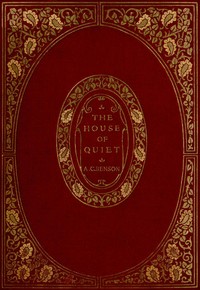
The House of Quiet: An Autobiography
Language: en304 downloads on Project Gutenberg
Subjects
In: Biographies·British Literature
Public-domain ebook sourced from Project Gutenberg #60783.
Public-domain ebook
Language: en304 downloads on Project Gutenberg
Subjects
In: Biographies·British Literature
Public-domain ebook sourced from Project Gutenberg #60783.
The opening · free to read
I have been a good deal indoors lately, and I have been amusing myself by looking through old papers and diaries of my own. It seems to me that, though the record is a very uneventful one, there is yet a certain unity throughout—I can hardly call it a conscious, definite aim, or dignify it by the name of a philosophy. But I have lived latterly with a purpose, and on a plan that has gradually shaped itself and become more coherent.
It was formerly my ambition to write a book, and it has gone the way of most ambitions. I suppose I have not the literary temperament; I have not got the instinct for form on a large scale. In the books which I have attempted to write, I have generally lost myself among details and abandoned the task in despair. I have never been capable of the fundamental brainwork; the fundamental conception which Rossetti said made all the difference between a good piece of art and a bad one. When I was young, my idea of writing was to pile fine phrases together, and to think that any topic which occurred to my mind was pertinent to the matter in hand. Now that I am older, I have learnt that form and conception are not everything but nearly everything, and that a definite idea austerely presented is better than a heap of literary ornament.
And now it seems to me that I have after all, without intending it, written a book,—the one book, that, it is said, every man has in his power to write. I feel like the King of France who said that he had “discovered” a gallery in one of his palaces by the simple process of pulling down partition walls. I have discarded a large amount of writing, but I have selected certain episodes, made extracts from my diaries, and added a few passages; and the result is the story of my life, told perhaps in a desultory way, but with a certain coherence.
Whether or no the book will ever see the light I cannot tell; probably not. I do not suppose I shall have the courage to publish it myself, and I do not know any one who is likely to take the trouble of editing it when I am gone. But there it is—the story of a simple life. Perhaps it will go the way of waste paper, kindle fires, flit in sodden dreariness about ashpits, till it is trodden in the mire. Perhaps it may repose in some dusty bookshelf, and arouse the faint and tender curiosity of some far-off inheritor of my worldly goods, like the old diaries of my forefathers which stand on my own bookshelf. But if it came to be published I think that there are some to whom it would appeal, as the thin-drawn tremor of the violin stirs the note in vase or glass that have stood voiceless and inanimate. I have borne griefs, humiliations, dark overshadowings of the spirit; there are moments when I have peered, as it were, into the dim-lit windows of hell; but I have had, too, my fragrant hours, tranquil joys, imperishable ecstasies. And as a pilgrim may tell his tale of travel to homekeeping folks, so I may allow myself the license to speak, and tell what of good and evil the world has brought me, and of my faint strivings after that interior peace, which can be found, possessed, and enjoyed.
I sit this evening, towards the end of the year, in a deep arm-chair in a large, low panelled room that serves me as bedroom and study together: the windows are hung with faded tapestry curtains; there is a great open tiled fireplace before me, with logs red-crumbling, bedded in grey ash, every now and then winking out flame and lighting up the lean iron dogs that support the fuel; odd Dutch tiles pave and wall the cavernous hearth—this one a quaint galleon in full sail on a viscous, crested sea; that, a stout sleek bird standing in complacent tranquillity; at the back of the hearth, with the swift shadows flickering over it, is a large iron panel showing a king in a war chariot, with a flying cloak, issuing from an arched portal, upon a bridge which spans a furious stream, and shaking out the reins of two stamping steeds; on the high chimney-board is a row of Delft plates. The room is furnished with no precision or propriety, the furniture having drifted in fortuitously as it was needed: here is a tapestried couch; there an oak bookcase crammed with a strange assortment of books; here a tall press; a picture or two—a bishop embedded in lawn with a cauliflower wig; a crayon sketch of a scholarly head. There is no plan of decoration—all fantastic miscellany. At the far end, under an arch of oak, stands a bed, screened from the room by a dark leather screen. Outside, all is unutterably still, not with the stillness that sometimes falls on a sleeping town, where the hush seems invaded by imperceptible cries, but with the deep tranquillity of the country-side nestling down into itself. The trees are silent. Listening intently, I can hear the trickle of the mill-leat, and the murmur of the hazel-hidden stream; but that slumbrous sound ministers, as it were, the dreamful quality, like the breathing of the sleeper—enough, and not more than enough, to give the sense of sleeping life, as opposed to the aching, icy stillness of death.
I may speak shortly of my parentage and circumstances. I was the only son of my father, a man who held a high administrative position under Government. He owed his advancement not to family connections, for our family though ancient was obscure. No doubt it may be urged that all families are equally ancient, but what I mean is that our family had for many generations preserved a sedulous tradition of gentle blood through poverty and simple service. My ancestors had been mostly clergymen, doctors, lawyers—at no time had we risen to the dignity of a landed position or accumulated wealth: but we had portraits, miniatures, plate—in no profusion, but enough to be able to feel that for a century or two we had enjoyed a liberal education, and had had opportunities for refinement if not leisure, and aptitude for cultivating the arts of life; it had not been a mere sordid struggle, an inability to escape from the coarsening pressure of gross anxieties, but something gracious, self-contained, benevolent, active.
My father changed this; his profession brought him into contact with men of rank and influence; he was fitted by nature to play a high social part; he had an irresistible geniality, and something of a courtly air. He married late, the daughter of an impoverished offshoot of a great English family, and I was their only child.
The London life is dim to me; I faintly recollect being brought into the room in a velvet suit to make my bow to some assembled circle of guests. I remember hearing from the nursery the din and hubbub of a dinner-party rising, in faint gusts, as the door was opened and shut—even of brilliant cascades of music sparkling through the house when I awoke after a first sleep, in what seemed to me some dead hour of the night. But my father had no wish to make me into a precocious monkey, playing self-conscious tricks for the amusement of visitors, and I lived for the most part in the company of my mother—herself almost a child—and my faithful nurse, a small, simple-minded Yorkshire woman, who had been my mother’s nurse before.
When I was about six years old my father died suddenly, and the first great shock of my life was the sight of the handsome waxen face, with the blurred and flinty look of the dulled eyes, the leaden pallor of the thin hands crossed on his breast; to this day I can see the blue shadows of the ruffled shroud about his neck and wrists.
Our movements were simple enough. Only that summer, owing to an accession of wealth, my father and mother had determined on some country home to which they might retire in his months of freedom. My mother had never cared for London; together they had found in the heart of the country a house that attracted both of them, and a long lease had been taken within a week or two of my father’s death. Our furniture was at once transferred thither, and from that hour it has been my home.
The region in which I live is a land of ridge and vale, as though it had been ploughed with a gigantic plough. The high-roads lie as a rule along the backs of the uplands, and the villages stand on the windy heights. The lines of railway which run along the valley tend to create a new species of valley village, but the old hamlets, with their grey-stone high-backed churches, with slender shingled spires, stand aloft, the pure air racing over them. The ancient manors and granges are as a rule built in the more sheltered and sequestered valleys, approached from the high-road by winding wood-lanes of exquisite beauty. The soil is sandy, and a soft stone is quarried in many places by the road-side, leaving quaint miniature cliffs and bluffs of weathered yellow, sometimes so evenly stratified as to look like a rock-temple or a buried ruin with mouldering buttresses; about these pits grow little knots of hazels and ash-suckers, and the whole is hung in summer with luxuriant creepers and climbing plants, out of which the crumbling rock-surfaces emerge. The roads go down very steeply to the valleys, which are thick-set with copse and woodland, and at the bottom runs a full-fed stream, with cascades and pebbly shingles, running dark under scarps of sandstone, or hidden deep under thick coverts of hazel, the water in the light a pure grey-green. Some chalk is mingled with these ridges, so that in rainy weather the hoof-prints in the roads ooze as with milk. The view from these uplands is of exquisite beauty, ridge after ridge rolling its soft outlines, thinly wooded. Far away are glimpses of high heathery tracts black with pines, or a solitary clump upon some naked down. But the views in the valleys are even more beautiful. The steep wood rises from the stream, or the grave lines of some tilted fallow; in summer the water-plants grow with rich luxuriance by the rivulet, tall willow-herb and velvety loosestrife, tufted meadowsweet, and luxuriant comfrey. The homesteads are of singular stateliness, with their great brick chimney-stacks, the upper storeys weather-tiled and the roof of flat tiles of sandstone; the whole mellowed by orange and grey lichens till the houses seem to have sprung from the very soil.
My own home—bearing the tranquil name of Golden End—is an ancient manor; out of a sandy lane turns an avenue of great Scotch firs, passing the house and inclining gradually in its direction. The house is a strange medley; one part of it is an Elizabethan building, mullioned, of grey stone; one wing is weather-tiled and of simple outline. The front, added at some period of prosperity, is Georgian, thickly set with large windows; over all is a little tiled cupola where an alarm bell hangs. There is a small square garden in front surrounded by low walls; above the house lies what was once a bowling-green, with a terraced walk surrounding it. The kitchen garden comes close up to the windows, and is protected on the one side by a gigantic yew hedge, like a green bastion, on the other by an ancient stone wall, with a tiled roof; below the house lie quaint farm-buildings, cartsheds, barns, granaries, and stables; beyond them are pools, fringed with self-sown ashes, and an orchard, in the middle of which stands a brick dovecot with sandstone tiles. The meadows fall from the house to the stream; but the greater part of the few acres which we hold is simple woodland, where the copse grows thick and dark, with here and there a stately forest tree. The house seen, as I love best to see it, from the avenue on a winter evening, rises a dark irregular pile, crowned with the cupola and the massive chimneys against a green and liquid sky, in which trembles a single star; the pine-trees are blacker still; and below lies the dim mysterious woodland, with the mist rising over the stream, and, beyond that, soft upland after upland, like a land of dreams, out to the horizon’s verge.
The book keeps going
Reading is free forever. Sign up and watch scenes appear while you read.



Scenes Storieta drew for other classics.
New illustrated classics
Once or twice a month: the latest books to get full character casts, scene art, and free comic editions. No account needed.