Public-domain ebook
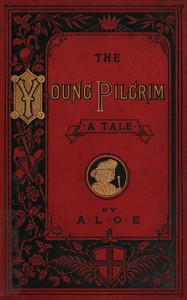
The Young Pilgrim: A Tale Illustrative of "The Pilgrim's Progress"
by A. L. O. E.
English403 downloads on Project GutenbergDownload EPUB
Public-domain ebook sourced from Project Gutenberg #61280.
Public-domain ebook
by A. L. O. E.
English403 downloads on Project GutenbergDownload EPUB
Public-domain ebook sourced from Project Gutenberg #61280.
The opening · free to read
“Is this the way to the ruins of St. Frediswed’s shrine?” said a clergyman to a boy of about twelve years of age, who stood leaning against the gate of a field.
“They are just here, sir,” replied the peasant, proceeding to open the gate.
“Just wait a moment,” cried a bright-haired boy who accompanied the clergyman; “that is your way, this is mine,” and he vaulted lightly over the gate.
“So these are the famous ruins!” he exclaimed as he alighted on the opposite side; “I don’t think much of them, Mr. Ewart. A few yards of stone wall, half covered with moss, and an abundance of nettles is all I can see.”
“And yet this once was a famous resort for pilgrims.”
“Pilgrims,—what were they?” inquired the boy.
“In olden times, when the Romanist religion prevailed in England, it was thought an act of piety to visit certain places that were considered particularly holy; and those who undertook journeys for this purpose received the name of pilgrims. Many travelled thousands of miles to kneel at the tomb of our Lord in Jerusalem, and those who could not go so far believed that by visiting certain famous shrines here, they could win the pardon of their sins. Hundreds of misguided people, in this strange, superstitious hope, visited the abbey by whose ruins we now stand; and I have heard that a knight, who had committed some great crime, walked hither barefoot, with a cross in his hand, a distance of several leagues.”
“A knight barefoot! how strange!” cried young Lord Fontonore; “but then he believed that it would save him from his sins.”
“Save him from his sins!” thought the peasant boy, who, with his full earnest eyes fixed upon Mr. Ewart, had been drinking in every word that he uttered; “save him from his sins! I should not have thought it strange had he crawled the whole way on his knees!”
“Are there any pilgrims now?” inquired Fontonore.
“In Romanist countries there are still many pilgrimages made by those who know not, as we do, the one only way by which sinners can be accounted righteous before a pure God. But in one sense, Charles, we all should be pilgrims, travellers in the narrow path that leads to salvation, passing on in our journey from earth to heaven, with the cross not in our hands but in our hearts; pilgrims, not to the tomb of a crucified Saviour, but to the throne of that Saviour in glory!”
Charles listened with reverence, as he always did when his tutor spoke of religion, but his attention was nothing compared to that of the peasant, who for the first time listened to conversation on a subject which had lately been filling all his thoughts. He longed to speak, to ask questions of the clergyman, but a feeling of awe kept him back; he only hoped that the gentleman would continue to talk, and felt vexed when he was interrupted by three children who ran up to the stranger to ask for alms.
“Begging is a bad trade, my friends,” said Mr. Ewart gravely, “I never like to encourage it in the young.”
“We’re so hungry,” said the youngest of the party.
“Mother’s dead, and father’s broke his leg!” cried another.
“We want to get him a little food,” whined the third.
“Do you live near?” asked Mr. Ewart.
“Yes sir, very near.”
“I will go and see your father,” said the clergyman.
The little rogues, who were accustomed to idle about the ruin to gain pence from visitors by a tale of pretended woe, looked at each other in some perplexity at the offer, for though they liked money well enough, they were by no means prepared for a visit. At last Jack, the eldest, said with impudent assurance, “Father’s not there, he’s taken to the hospital, there’s only mother at home.”
“Mother! you said just now that your mother was dead.”
“I meant—” stammered the boy, quite taken by surprise; but the clergyman would not suffer him to proceed.
“Do not add another untruth, poor child, to those which you have just uttered. Do you not know that there is One above the heavens who hears the words of your lips, reads the thoughts of your hearts—One who will judge, and can punish?”
Ashamed and abashed, the three children made a hasty retreat. As soon as they were beyond sight and hearing of the strangers, Jack turned round and made a mocking face in their direction, and Madge exclaimed in an insolent tone, “We weren’t going to stop for his sermon.”
“There’s Mark there that would take it in every word, and thank him for it at the end,” said Jack.
“Oh, Mark’s so odd!” cried Ben; “he’s never like anybody else. No one would guess him for our brother!”
These words were more true than Ben’s usually were, for the bright-haired young noble himself scarcely offered a greater contrast to the ragged, dirty children, than they with their round rustic faces, marked by little expression but stupidity on that of Ben, sullen obstinacy on Madge’s, and forward impudence on Jack’s, did to the expansive brow and deep thoughtful eye of the boy whom they had spoken of as Mark.
“Yes,” said Jack, “he could never even pluck a wild-flower, but he must be pulling it to bits to look at all its parts. It was not enough to him that the stars shine to give us light, he must prick out their places on an old bit of paper, as if it mattered to him which way they were stuck. But of all his fancies he’s got the worst one now; I think he’s going quite crazed.”
“What’s he taken into his head?” said Madge.
“You remember the bag which the lady dropped at the stile, when she was going to the church by the wood?”
Madge nodded assent, and her brother continued: “What fun we had in carrying off and opening that bag, and dividing the things that were in it! Father had the best of the fun of it though, for he took the purse with the money.”
“I know,” cried Ben, “and mother had the handkerchief with lace round the edge, and E. S. marked in the corner. We—more’s the shame!—had nothing but some pence, and the keys; and Mark, as the biggest, had the book.”
“Ah! the book!” cried Jack; “that’s what has put him out of his wits!”
“No one grudged it him, I’m sure,” said Ben, “precious little any of us would have made out of it. But Mark takes so to reading, it’s so odd; and it sets him a thinking, a thinking: well, I can’t tell what folk like us have to do with reading and thinking!”
“Nor I!” cried both Madge and Jack.
“I shouldn’t wonder,” said the latter, as stretched on the grass he amused himself with shying stones at the sparrows, “I shouldn’t wonder if his odd ways had something to do with that red mark on his shoulder!”
“What, that strange mark, like a cross, which made us call him the Red-cross Knight, after the ballad which mother used to sing us?”
“Yes; I never saw a mark like that afore, either from blow or burn.”
“Mother don’t like to hear it talked of,” said Madge.
“Well, whatever has put all this nonsense into his head, father will soon knock it out of him when he comes back!” cried Jack. “He’s left off begging,—he won’t ask for a penny, and he used to get more than we three together, ’cause ladies said he looked so interesting; and he’ll not so much as take an egg from a nest,—he’s turned quite good for nothing!”
The book keeps going
Reading is free forever. Sign up and watch scenes appear while you read.



Scenes Storieta drew for other classics.
New illustrated classics
Once or twice a month: the latest books to get full character casts, scene art, and free comic editions. No account needed.