Public-domain ebook
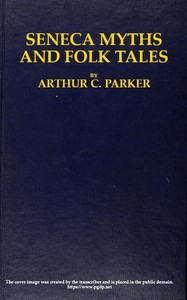
Seneca myths and folk tales
Language: en1,349 downloads on Project Gutenberg
Subjects
In: Mythology, Legends & Folklore
Public-domain ebook sourced from Project Gutenberg #61477.
Public-domain ebook
Language: en1,349 downloads on Project Gutenberg
Subjects
In: Mythology, Legends & Folklore
Public-domain ebook sourced from Project Gutenberg #61477.
Arthur C. Parker’s “Seneca Myths and Folk Tales” is a scholarly compilation of traditional narratives gathered from Seneca informants on the Cattaraugus and Tonawanda reservations in the early twentieth‑century. The opening pages recount Parker’s childhood exposure to stories signaled by the word Kă´kāā, his 1903 fieldwork with Raymond Harrington, and the subsequent winter spent recording legends, prayers, and customs directly from elders such as Edward Cornplanter and a host of local storytellers. The volume presents the material exactly as it was conveyed, with only minor spelling corrections, and is organized into thematic sections ranging from creation myths to horror tales, talking animals, and witchcraft traditions. Parker emphasizes that the collection is intended as an ethnological resource rather than a literary anthology, noting the scarcity of authentic Iroquois folklore and the value of these narratives for comparative study.
The work reflects the voice of an early‑1920s anthropologist who writes in a measured, academic prose that foregrounds cultural context over dramatic flair. Its style is descriptive and cautious, avoiding romanticized embellishment while preserving the oral tone of the original tellers. Readers with interests in Native American anthropology, folklore, or the history of the Seneca people will find the book rewarding, as will scholars seeking primary source material for comparative mythic analysis. Those looking for polished fiction should approach it as a cultural record rather than a conventional story collection.
The opening · free to read
The author of this collection of Seneca folk-tales cannot remember when he first began to hear the wonder stories of the ancient days. His earliest recollections are of hearing the wise old men relate these tales of the mysterious past. They were called Kă´kāā, or Gă´kāā, and when this word was uttered, as a signal that the marvels of old were about to be unfolded, all the children grew silent,—and listened. In those days, back on the Cattaraugus reservation, it was a part of a child’s initial training to learn why the bear lost its tail, why the chipmunk has a striped back and why meteors flash in the sky.
Many years later,—it was in 1903,—the writer of this manuscript returned to the Cattaraugus reservation bringing with him his friend Mr. Raymond Harrington, for the purpose of making an archæological survey of the Cattaraugus valley for the Peabody Museum of Archæology, of Harvard University. Our base camp was on the old Silverheels farm, which occupies the site of one of the early Seneca villages of the period after the Erie war of 1654. Here also is the site of the original Lower Cattaraugus of pre-Revolutionary days.
To our camp came many Indian friends who sought to instruct Mr. Harrington and myself in the lore of the ancients. We were regaled with stories of the false faces, of the whirl-winds, of the creation of man, of the death panther, and of the legends of the great bear, but in particular we were blessed with an ample store of tales of vampire skeletons, of witches and of folk-beasts, all of whom had a special appetite for young men who dug in the ground for the buried relics of the “old-time folks.”
To us came Tahadondeh (whom the Christian people called George Jimerson), Bill Snyder, Gahweh Seneca, a lame man from Tonawanda, Frank Pierce and several others versed in folk-lore. I filled my note-books with sketches and outlines of folk-fiction, and after our return to New York, I began to transcribe some of the stories.
The following winter was spent on the reservation among the non-Christian element in a serious attempt to record folk tales, ceremonial prayers, rituals, songs and customs. A large amount of information and many stories were collected. Some of this material was published by the State Museum, the rest perished in the Capitol fire at Albany, in 1911.
Later I was able to go over my original notes with Edward Cornplanter, the local authority on Seneca religion, rites and folk-ways, and to write out the material here presented. Cornplanter’s son Jesse assisted by way of making drawings under his father’s direction. I also had the help of Skidmore Lay, Ward B. Snow, Delos B. Kittle, Mrs. John Kittle, James Crow and others. My informants from the lower reservation, the Christian district, were Aurelia Jones Miller, Fred Kennedy, George D. Jimerson, Julia Crouse, Moses Shongo, Mrs. Moses Shongo, David George, William Parker, Job King, and Chester C. Lay; and Laura Doctor and Otto Parker of the Tonawanda Reservation.
In the preparation of these versions of old Seneca tales the writer used no other texts for comparative purposes. It was thought best to rest content with the version given by the Indian informant, and to wait until a time of greater leisure came before attempting to annotate the collection. Leisure has never seemed to be the privilege of the writer, and one busy year has crowded upon another, until eighteen have passed since the tales were written down. It may be best, after all, to present the text just as it was prepared, and merely correct the spelling of a name or two. It was not until after this text was in the hands of the Buffalo Historical Society that the Curtin-Hewitt collection of Seneca folk tales appeared, and though differences will be found between our texts and those of Curtin, it must be remembered that variations are bound to occur. All versions of folk tales recorded by different individuals at different or even identical times will vary in certain particulars, as is explained hereinafter.
In the preparation of this volume the writer wishes to record his indebtedness to Mr. George Kelley Staples, Senator Henry W. Hill, Mr. George L. Tucker and Dr. Frank H. Severance, all members of the Buffalo Historical Society, for the advice and encouragement given.
ARTHUR C. PARKER.
Buffalo Consistory, A. A. S. R.
Nov. 26, 1922.
The book keeps going
Reading is free forever. Sign up and watch scenes appear while you read.



Scenes Storieta drew for other classics.
New illustrated classics
Once or twice a month: the latest books to get full character casts, scene art, and free comic editions. No account needed.