Public-domain ebook
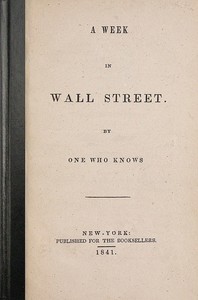
A Week in Wall Street By One Who Knows
Language: en256 downloads on Project Gutenberg
Subjects
In: Humour·Novels·American Literature
Public-domain ebook sourced from Project Gutenberg #62012.
Public-domain ebook
Language: en256 downloads on Project Gutenberg
Subjects
In: Humour·Novels·American Literature
Public-domain ebook sourced from Project Gutenberg #62012.
The opening · free to read
The following pages were written during leisure hours of the last six or eight weeks, of which “the times” have thrown rather too many upon the writer’s hands; and the statement of this fact, I conceive to be a tacit admission, that such hours might have been better employed.
They were originally composed for the writer’s own amusement; to beguile the tediousness of otherwise idle time. And not the least motive for this indulgence was a desire to abstract the mind from too near a contemplation of the dark side of that picture, which I have described as a panic. They were not written in the first place, with any view to publication, but as each chapter was successively read in the presence of friends, and principally for amusement, those friends at length advised their publication; and with their advice they have been submitted to the press, in the original manuscript, almost without correction.
The writer has no claims to literary qualifications, and of course he seeks no reward of literary reputation. Were it otherwise the reader would at once convict him of his presumption.
Those persons who are acquainted with the business of Wall-street, will be able to judge for themselves of the truth of the descriptions; and those who have not that opportunity of judging, are respectfully requested to consider the reflections and moralizing, occasionally introduced, as made in seriousness, and the rest as the truth in burlesque.
That there is existing, at the present time, a demoralised condition of principle, feeling, and practice, pervading the country throughout, in regard to pecuniary transactions and engagements, deserving a severe castigation, will not I believe be denied by any one; and for the vindication of good faith and honesty, the writer could wish that the subject had been taken in hand, by some one more skilful than himself in the use of the scourge.
The proper correction of public morals is public opinion; but so long as public opinion is indifferent to the innovations that have grown up, and so long as pecuniary credit, and the posts of honor, trust and profit, are so frequently accorded to the most successful in their negotiations or their intrigues, without regard to the principles, or practices, that have placed them where they are—so long we may expect nothing but the increase of those mischiefs, of which so many now complain.
I confess, that were I to write the same pages over again, with a view to publication, I would alter, amend, and expunge much that is here. But as I am now engaged in something that will afford more pleasure in its pursuit, and more profit if attained, I have not time for this purpose at present. And since the present is a time, when men’s minds are alive to the subjects which I have endeavored to bring out in ridicule, I submit the whole for what it is worth.
The introduction of vulgar wit may serve to amuse some, but it is not a passport to men’s good sense; and, although it may sometimes make a book sell, it is not, in my opinion, the best way to convince of the truth. And the only excuse for indulging in it is, that the subjects of remark, and the slang frequent in Wall-street, are not of that character which cultivate the delicate sensibilities—nor can they be pourtrayed to the life, by such language or figures, as should grace the conversation and writings of a gentleman.
The practice of making a book personal, is, and ought to be condemned; and, if it is objected that, in this, I have called persons by their right names, or pointed too clearly at individuals, the answer is, that, except in the case of one martial spirit, the notable Major Downing,[1] whom I have shorn of a little of his patriotism and courage, I have in “no instance made allusions which have not been directly applied, and treated with much greater asperity, by all the newspapers of the day.” And this fact, I conceive, has given me licence, since it would be folly to wing a shaft of invective or ridicule, if it aimed at no object.
The major, I must suppose, will not consider himself aggrieved, because, from his position, he was the only person whom I could conveniently make tributary to the information I wish to give; and, since he has so often asserted his courage, without fairly acknowledging his identity, he has no cause to complain at being assailed on that point.
The remark will generally hold true, that whatever requires to be explained, or excused, is always wrong; but, in this case, I think it will not apply. I would therefore be understood as excusing only the faults of the book, and not the object at which it is aimed.
And, lastly, the writer cannot help saying that, in the face of the trite remark that, “those who live in glass houses should not throw stones,” he will not deny, that, in the expressive language of Wall-street, he has himself been “flunked;” and, with this candid acknowledgement, which will, perhaps, satisfactorily account for the production of the book, in the minds of those who may please to consider it an effusion of spleen,—he subscribes himself—
Respectfully, THE AUTHOR.
N. B. It is perceived that a considerable number of errors have escaped notice and correction, in the following pages; but as they affect only the orthography and the grammar, without detracting from the truth, or the moral of the story, I have thought it best to leave their correction to the intelligent and good humored reader, rather than mar a page with a formidable list of errata—except, that, in one instance, as a mere friendly suggestion, I would request the substitution, on 129th page, 7th line, of “_stewardship_” for “_friendship_.”
As the practice of some readers is to begin in the middle and read a book backwards, I respectfully request those who may open here, to begin at the beginning and read the preface first. In case of any captiousness of disposition on their parts, they may thereby save themselves a good deal of ill nature, and quarrelling with the author. But if any one is perverse, and chooses to go on without taking my advice, I will not hold myself accountable for the preservation of his temper, nor even of this book; for I am not sure but he may throw it in the fire, before he gets through the first or second chapter. But, should he even persevere and go through, until he receives my parting “salaam,” still I request him to turn back and read the preface, that he may see what the writer thinks of his own book.
HOW BOOKS ARE WONT TO BE MADE.
It is usual with authors, in the outset of their story, to introduce to their readers their Hero and Heroine, with elaborate descriptions of their persons, manners, habits, dress, &c. &c.; all of which is intended, either to prepare the reader’s mind for the very interesting positions which these personages are designed to fill, or to amuse those who are fond of that kind of portraiture. But in this history of “a week in Wall-street,” there is neither hero nor heroine, but a great number and variety of characters, each of whom lives out his sunny hour, and passes again into oblivion. Some there are, it is true, who, from a crawling worm, pass into a chrysalis, and appear to be dead for a time, not only to revive again with new life and beauty, but to soar a lofty height into the world of fashion, and boast the gayest plumage among those who float on the wind of fortune’s fickle favors.
The veritable history of Diedrich Knickerbocker was not a truer story than is every whit of this history of “a week in Wall-street;” but alas for the mutations in all human affairs!—a sad change has come over the waking dreams of the inhabitants of this goodly city, since the days when Petrus Stuyvesant surrendered the government of Niew-Amsterdam to the conquest-loving Briton.
HOW NEW-YORK BECAME SO POPULOUS.
From that day, when first its name was changed to New-York, it has not ceased to be overrun by the stragglers from every country and clime, but especially by those cunning vagabonds from Connecticut, and her sister states, who had well nigh taken in their toils the venerable Petrus and his jolly trumpeter, Antony. And they have now trodden down, or overturned, every remnant of social order, that was so remarkable in the time of the honest Dutchman. In one respect, at least, these interlopers seem to be the favored of heaven—for their seed has multiplied as the sands on the sea shore; and it is shrewdly suspected, by some, that the gambols of the cunning Antony with the lasses of New-Haven, in his famous journey thither, may have had some hand in this, since never was a people known who could blow the trumpet of their own fame, better than these same descendants from the colony of New-Haven.
THE OLD WALL BROKEN DOWN.
From their love of continual change—which they call improvement—they had no sooner gained a footing in the city, than they persuaded the honest Dutchmen to break down the city wall, which had hitherto prevented them from robbing the cabbage garden or tapping the hollands of the rich burghers, and which, some have said, was erected partly to prevent their too frequent solace of themselves with the softer beauties concealed by close caps and short petticoats. And they further persuaded them to convert the ground into a street, thence called “Wall-street;” which, being the scene of their first victory over that prejudice which prefers to keep folks honest when they are so, has ever since continued to be the focus of all enterprises undertaken for one’s own benefit, to be accomplished by other peoples’ means. And it is even said, that the projectors of this work, in reality, designed only to gain for themselves unobstructed access to the good living, and the pretty damsels, of Niew-Amsterdam, now New-York. Want of means themselves to perform so great a work, first suggested to them the idea of a Stock Company, for objects of public improvement; the principal virtue of which is, to replenish the fortunes of those who plan and conduct it, as is more than suspected, since most of the money generally stops short of its intended application, and can only be accounted for by mistakes in the original estimates, or expenses preliminary to the commencement of the real work.
MR. SOLOMON SINGLE-EYE.
The good Dutchmen at first looked astonished at a project so bold and vast; they next smoked a pipe and doubted; but on an explanation being given by Mr. Solomon Single-Eye, of all its advantages, accompanied with a prompt offer to embark HIS whole fortune, and give his services for nothing, the shares were eagerly caught up. And as the scheme rose in public estimation, the shares rose in nominal value, greatly above their subscription price; and such was the clamor for more, that the directors—having nothing in view but the public good—disinterestedly consented to sell out theirs at an advance of only seventy-five per cent., in order to appease public opinion, in respect of their apparent partiality in having retained any for themselves. Still, however, the inquiry for shares was eager and constant, so great was the public confidence in the integrity and shrewdness of the directors, and of Mr. Single-Eye, particularly.
The book keeps going
Reading is free forever. Sign up and watch scenes appear while you read.



Scenes Storieta drew for other classics.
New illustrated classics
Once or twice a month: the latest books to get full character casts, scene art, and free comic editions. No account needed.