Public-domain ebook
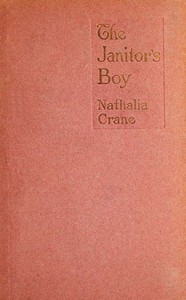
The Janitor's Boy, and Other Poems
Language: en388 downloads on Project Gutenberg
Subjects
In: Children & Young Adult Reading·Poetry·American Literature
Public-domain ebook sourced from Project Gutenberg #62146.
Public-domain ebook
Language: en388 downloads on Project Gutenberg
Subjects
In: Children & Young Adult Reading·Poetry·American Literature
Public-domain ebook sourced from Project Gutenberg #62146.
The opening · free to read
Oh, night, thy soothing prophecies companion all our ways, Until releasing hands let fall the catalogue of days.
These lines and the meditation from which they spring were the spontaneous phrasing and the natural meditation of--a child of ten. That in itself, I think, is sufficiently remarkable.
In the darkness who would cavil at the question of a line, Since the darkness holds all loveliness beyond the mere design.
Strange insight for a comparative infant!
In her lighter moments--and, naturally, there are a great many--Nathalia’s “heart is all a-flutter like the washing on the line”; she “could not stain romance with monetary fee”; and, when she has sat upon a bumble-bee, she knows “the tenseness of humiliating pain.” Many a grown humorist might envy the freshness of such amusing phrase.
There is much laughter and nonsense in this book--that of a rather romantic little girl with a quick eye and ear and a pert fancy. But there is, as I have intimated, more than that.
Cloud-made mountains towered Beckoning to me; Visionary triremes Talked about the sea.
There were strings of camels On the Tunis sands. There were certain cities Holding out their hands.
Here the thing we call poetry asserts itself. The instinct for remarkable phrase and striking figurative expression is either inborn or it is not. Facility with rhyme and metre is not nearly so remarkable. But when a child can write, as in the poem My Husbands,
I hear in soft recession The praise they give to me; I hear them chant my titles From all antiquity.
it is almost uncanny. Here is, if you like, a somewhat derivative diction, but here also is true poetry by every test.
He showed me like a master That one rose makes a gown: That looking up to Heaven Is merely looking down.
Well, I not only wonder how she has learned simple finality of phrase so quickly; I also wonder whether she can possibly realize the philosophical implications of her best poems.
As for imagery, Nathalia’s angels hearing “the hurdy-gurdies in the Candle-Maker’s Row” is an example of her fancy that quickens into imagination. She sees the Oriental bees flying “in golden convoys to the mountains of the moon,” she quizzically presents the pathos of The Dinosaurs’ Eggs; she has “steered by stars that sorrowed, with the moonlight in our wake”; she sees Berkley Common
Like a manuscript, all yellow, and with many things deleted, Yet a manuscript completed, with embellishments most rare, Berkley Common lies forgotten, with its fields of everlasting, And the sunlight on the windows of the empty houses there.
As to exactly what she is trying to say in The Symbols, I am in doubt, but it is hard to forget the Talmud stalking like a rabbi in a gown.
On the one hand, with Nathalia, we have simply a rhyming gift turned to amusing descriptions of certain fairly ordinary episodes and characteristics of life that interest every healthily alert young lady. On the other hand, we have the beginnings of a poet with a true ear for rhythm, an eye for the color of words, and a fancy that often rises into the realm of imagination. I only hope that the young lady will continue to enjoy all the ordinary incidents of her existence as much as she has heretofore, and to perfect her technique in her spare moments. It needs perfecting. It is hardly to be wondered at that her work is still in the experimental stage. She is not yet “the youngest of the seers,” nor yet “released from fetters of ancestral pose,” but there is undoubtedly conquest of poetic beauty “waiting down the years” for her--“revisions of the ruby and the rose,” as she puts it. Read the first two verses of The Vestal and marvel that a young lady of Nathalia’s age should be able to master without effort such a perfectly Emily Dickinsonian idiom. This is no copy; it is something that even Emily Dickinson would not have been at all ashamed to have written. And that is a good deal to say.
Now as to prophecies, who can make them? Frankly, I have not the slightest idea how Miss Crane’s gift may develop. I only know that she has given signs of astonishing precocity as a young poet. Her parents have wisdom and they will see that she is not spoiled. Her gifts will simply develop according to her experience of literature and her experience of life. It is a very ticklish thing to endeavor in any way to direct so young a gift. It will find by instinct its own nourishment; that is my belief.
Meanwhile, to Nathalia, good luck on the difficult road!
Nathalia’s day is today. All of Time that is past, from the birth of those odd old folk, the troglodytes, about which she has ruminated so pleasantly, up to and through the final scene of the latest Broadway moving picture is, to her, a harvested crop--important in its way but no longer interesting. And as for tomorrow and the next year, they will have their turn presently. It is today....
This extract from Nathalia’s as yet unarticulated philosophy is offered by way of information for those who are instinctively inclined to be harsh, on general principles, with a talent that springs, a little too boldly perhaps, ahead of its years.
Nathalia had been writing her verse for several months before Mr. and Mrs. Crane came across it, writing it without fuss or excitement and storing it in a small and private album, content apparently with the reward of whatever pleasure the rereading of it gave her. If she had, even secretly, any concern with such a vanity as applause, she certainly did not betray it. And when shortly before Christmas of 1922, the little girl mailed some of her poems to a Brooklyn newspaper and received immediate acknowledgment from the editor, her parents were as much astonished as, later on, was the editor of a newspaper when, after having accepted a number of poems signed Nathalia Crane, the author herself walked into the office and proved to be a mite of a human being.
I was one of the file of reporters that trailed into Nathalia’s home the morning after her first publication, bent less on nourishing and encouraging a young artist than on getting a human-interest story. It was a file that eventually included generous, vociferous, and indiscriminate eulogists, a file that threatened to demoralize or spoil whatever young talents Nathalia had.
Those kind-hearted newspaper folks showered her with a shocking amount of almost unqualified praise, some of it accurately placed but most of it merely blank fire. This would have been very bad for her but for one thing--Nathalia never read any of it.
And so, unaffected, she maintained the same tenor of her young days, playing with her dolls when she pleased and retiring to her boudoir to make rhythms when she pleased. She has always written, and still does write, only when the fancy prompts her.
What Nathalia has written is the kind of thing that she can write, whatever its merits or demerits. She has measured it against no other verse, youthful or adult. The inspiration for most of it comes from books she has read, which are mainly romantic in character. As for the rest, it happens that she is an extraordinarily articulate little girl, and if in some cases the conceits and fancies which she crystallizes are no rarer than those that, in all probability, throng the mysterious mind of every imaginative child, the explanation is simply that she is able to utter and clarify them, and these other children are, for the most part, normally unable to do that. That also they have, in Nathalia’s case, taken the form of mature work, as evidenced, in one way, by the fact that editors published her contributions for several months before learning that she was so much below the accepted age for serious consideration, is, I believe, another mark of her high singularity.
Others, unfortunately, will be less easily satisfied. A cynicism concerning the future careers of precocious children is one of the rigid fundamentals of nearly every mind. It has, no doubt, a valid basis. But, for that reason, Nathalia’s future, probably very dark in popular prospect, threatens to shade her present. That is why I offered at the outset, as a point of information, the comment on Nathalia’s general attitude toward life. Nathalia, I am sure, sees no reason why anybody else should read these poems with an eye any further ahead in time than this afternoon’s sunset. She is content to leave the verdict, so far as posterity is concerned, to her own grandchildren.
Oh I’m in love with the janitor’s boy, And the janitor’s boy loves me; He’s going to hunt for a desert isle In our geography.
A desert isle with spicy trees Somewhere near Sheepshead Bay; A right nice place, just fit for two Where we can live alway.
Oh I’m in love with the janitor’s boy, He’s busy as he can be; And down in the cellar he’s making a raft Out of an old settee.
He’ll carry me off, I know that he will, For his hair is exceedingly red; And the only thing that occurs to me Is to dutifully shiver in bed.
The day that we sail, I shall leave this brief note, For my parents I hate to annoy: “I have flown away to an isle in the bay With the janitor’s red-haired boy.”
Oh, Roger Jones! Oh, Roger Jones! Oh, Prince! O, Knight! Ah me! We used to play at keeping house, Beneath an old oak tree.
Your hair was red, your eyes were brown, You had a freckled nose; You were the father of my dolls, My husband--I suppose.
Oh, Roger! You were only nine, And I was half-past eight; It really was romantic, or As good, at any rate.
The book keeps going
Reading is free forever. Sign up and watch scenes appear while you read.



Scenes Storieta drew for other classics.
New illustrated classics
Once or twice a month: the latest books to get full character casts, scene art, and free comic editions. No account needed.