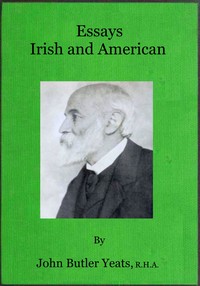
We admire some because of their accomplishment, others because of what they are. I admire Mr. John Yeats as an artist as much as any, but I feel that nature’s best gift to him was a humanity which delights in the humanity of others. Few artists I think found it more easy to be interested in the people they met or painted. All his portraits, whether of men or women, seem touched with affection. Rarely has he pourtrayed any, young or old, where something like a soul does not look at us through the eyes. I have liked people after seeing Mr. Yeats’ portraits of them, and I am sure I would not have liked them so much if I had not first looked at them with his vision. In his delightful letters, of which extracts have been already published, and in his essays he lets us unconsciously into the secret of his meditation about his sitters. He is always discriminating between themselves and their ideas, searching for some lovable natural life. He complains in one of his essays that the American women whom he admires cannot be easily natural. They want so much to be the ideal daughter or the ideal wife or the ideal friend that poor ordinary human nature is not good enough for them. He perhaps never heard of Laotze--how few people know of that fount of wisdom--but Mr. Yeats, who is, I fancy, unhappy in the society of metaphysicians, economists or theorists, would, I believe, have loved the Chinese sage who made a religion with this law, “Be ye natural.” All the other religions draw us away from hearth and home and love and dominate us by an overlaw, but Laotze alone among religious teachers heaves a sigh when he hears of someone setting out to reform the world because he knows there will be no end to it. When Laotze says in his ideal state people would be contented in themselves, think their poor clothes beautiful and their plain food sweet, I think of Mr. Yeats and his fear that the reformer will improve the Irish peasant off the face of the earth. He delights in him as he is. Why should anybody want to alter what is already natural, wild and eloquent? To be primitive is to be unspoiled. Mr. Yeats seems to be seeking everywhere in art and letters for the contours and emotions which are the natural mould of face or mind. Mr. Orpen can astonish us with technical accomplishment and Mr. John with masterly drawing, but if we look at the face of a woman painted by Mr. Yeats we will be attracted, not by the transient interest of novelty in treatment, but because of some ancient and sweet tradition of womanhood in the face, the eyes, the lips. We find the eyes so kind that it is so we imagine mothers or wives from the beginning of time have looked upon their children or have bewitched men to build about them the shelter of home and civilisation. Mr. Yeats in his art had this intimacy with the heart’s desire, which is not external beauty, as those who have degenerated art into the pourtrayal of prettiness suppose, but beauty of spirit. Those who knew Mr. Yeats will remember that enchanting flow of conversation which lightened the burden of sitting; and nature was wise in uniting the gift of conversation with the gift of portrait painting, because the artist was so happy in his art and so reluctant to finish his work; without that grace of speech few sitters could have endured to the end with an artist always following up some new light of the soul, obliterating what already seemed beautiful to substitute some other expression which seemed more natural or characteristic. To those who knew Mr. Yeats these essays will recall that conversation with which we did not always agree but which always excited us and started us thinking on our own account. The reader will find here thoughts which are profound, said so simply that their wisdom might be overlooked, and also much delightful folly uttered with such vivacity and gaiety that it seems to have the glow of truth. Perhaps these fantasies and freaks of judgment are as good as if they were true. One of the most delightful inventions of nature is the kitten chasing its own tail, and this and many other inventions of nature seem to indicate that a beautiful folly is one of the many aspects of wisdom. What is it but mere delight in life for its own sake, in invention for its own sake, or, as Mr. Yeats puts it elsewhere, a disinterested love of mischief for its own dear sake. How dear that is to us Irish who have often had nothing but love of mischief to console us when all the substantial virtues and prizes of life had been amassed by our neighbours. How witty Mr. Yeats is those who read these essays will discover. “When a belief rests on nothing you cannot knock away its foundations,” he says, perhaps half slyly thinking how secure were some of his own best sayings from attack. I refuse to argue over or criticise the philosophy of the man who wrote that, for I do not know how to get at him. I am content to enjoy, as I am sure his friends will, and new friends also who will be made by a reading of this book, and who will be grateful to Mrs. Bellinger of New York, who cut out and preserved from various papers these essays as they appeared; for the writer, unlike the kitten, had no interest in chasing his own tail, and had forgotten what he had written or where it had appeared. Gathered in one book these essays reflect a light upon each other and recreate for us a personality which has deserted Dublin, but which none who knew would wish to forget.
A. E.
Recollections of Samuel Butler
I knew Butler. In the year 1867-68 I was a pupil at Heatherleigh’s Art School, Newman Street, London, and Butler was there also. It is not true that Butler had talent. To be a painter after the manner of John Bellini was for years the passion of his life. It was vain; he had no talent. At the time I knew him he was beginning to see this and it was pathetic! We tried to comfort him and would have cheered him with false hopes. All the intellect in the world won’t make a painter if it is not the right kind of intellect.
A Scotch friend of mine and his, whom Butler loved because of his knowledge of music, would sometimes say, “Yes, Mr. Butler, you are a dominie”--and he would chuckle slowly in his Scotch manner. Like a dominie he kept us all in order. We called each other briefly by our surnames without the prefix of the Mr.--Butler was always Mr. Butler. Once a daring citizen of London ventured, “Have you been to the Alhambra, Butler?” He pronounced it “Al’ambra”--that gave Butler his opportunity. The Englishman in possession of all his aitches can always hold the many in check because of their deficiency in aitches. “Is there an aitch in the word?” said Butler. Never again did my poor friend venture, or for that matter any of us.
The Irishman likes his equal and is, as every one admits, the best of comrades; the German likes his superior; but the Englishman likes to be with his inferior and is not comfortable in any other relation. He is sent to the public school and the university by his anxious parents and guardians that he may acquire the superior manner. There are two sneers in England, the cockney variety which no one respects, and the university and public school sneer which compels respect, even among foreigners. It impressed Goethe. The footman puts it on but overdoes it, so that at a glance we know it to be counterfeit. Butler was the politest, the most ceremonious of men, but the sneer was there and all the more palpable because so carefully veiled.
We were art students and tried to be Bohemian, or would have done so had not Butler been one of us. There was a student whom he much liked; one day he took him in hand and in his most paternal manner admonished him that he must not use the word “chap.” Butler was an Englishman through and through and an Englishman of “class.” The Englishman of class will part with his faith, with his wife and children, with his money, even, or his reputation and be cheerful about it, but closer than his skin sticks to him his class conceit; and in his accent, his voice, his gestures, his phrases he carefully preserves all its insignia. Possessed of these he knows he may go anywhere and associate with anyone; it is a passport entitling him to a nobleman’s freedom. Every Englishman, gentle or simple, either by force or by patient groping will try for a sheltered spot where he may have his own thoughts and his own ways hampered by none. But the Englishman of class is freest of all; a policeman, even he, will hesitate to interfere with you if he knows that you are a gentleman.
In his “Way of All Flesh,” Butler describes English home life and he enables us to see that affection and sympathy do not form part of it. Butler, the product of that life, sets little importance on either affection or sympathy; and yet there never was a kinder man. Good nature was fundamental in his character and was, I think, the source of most of his writings and opinions. The English going about life in an intensely selfish way and doing this on principle are obliged to have strict laws strictly enforced; yet outside these laws they claim and allow the utmost license of action and thought. It is their distinction among nations that they love personal liberty so much,--that is for themselves, for they are quite ready to enslave other people. With this love for personal freedom has grown up, side by side with it and as part and parcel of it, an immense appreciation of human nature itself. Against this appreciation Puritanism has vainly and indeed dolorously struggled. Butler’s good nature was due to his liking for human nature itself; hence his zeal against all the conventions and illusions and veiling “respectabilities” that would snatch from human nature its proper food.
The continental nations may hate human nature and produce their Goyas, but such art among Englishmen excites only a lazy contempt. Notwithstanding their passion for law and rule, a necessary thing among people so selfishly bent on their own gains, the Englishman does not actually hate his neighbour, even though he keeps aloof from him. He has indeed a genial relish for the selfishness in his neighbour which is so strong in himself. Edmund Burke has some such sentence as “the good nature and integrity of this ancient people.” The Dutch, being a freedom-loving people, have a similar good nature. Rembrandt and Shakespeare get artistic pleasure out of the ugly but with laughter, not as in Goya with a grin of hatred. Indeed, looking at some of Goya’s work, one is forced to believe that he hated even the people who looked at his pictures and wished through them to insult and offend all his friends,--a kind of disorderly impulse which in him and others prompts to the disgusting and obscene in art. Butler’s emancipated intellect had won for his soul and senses a freedom which he wished to share with others; he had as it were acquired a freedom to be on good terms with himself. To be sure, a Scotchman is on good terms with himself when he is conceited. Butler wanted people to be on good terms with their senses and appetites and everything else that goes into our make-up as men, to all of which Scotch conceit is the enemy. For this he was always fighting, and he began to fight at Heatherleigh’s Art School. He found us, as he thought, enslaved by this or that convention or illusion and by his mockeries and his wit worked for our liberation.
The book keeps going
Keep reading, and see it illustrated
Reading is free forever. Sign up and watch scenes appear while you read.
Scenes Storieta drew for other classics.




![Cover of Love and Freindship [sic]](/covers/1212.jpg)