
Public-domain ebook
The Fasting Cure
Language: en1,039 downloads on Project Gutenberg
Subjects
In: Health & Medicine·Nutrition
Public-domain ebook sourced from Project Gutenberg #63293.
Public-domain ebook
Language: en1,039 downloads on Project Gutenberg
Subjects
In: Health & Medicine·Nutrition
Public-domain ebook sourced from Project Gutenberg #63293.
The book is a first‑person account by Upton Sinclair that gathers together two magazine articles he wrote in 1910‑1911 for Cosmopolitan and the Contemporary Review, together with notes, letters, and a few photographs of himself. Sinclair frames the work as a response to an unexpected flood of correspondence after his original piece on fasting was published, and he uses the material to argue that his own three fasts, totaling thirty days, produced a striking physical recovery that he could not explain by any other change in lifestyle. The text is organized as a series of anecdotes, case statistics (including a table of 277 fasting cases), and references to contemporary health writers, all presented in a journalistic style that deliberately repeats points to reinforce a subject he describes as “new to almost everyone.”
Written in the straightforward, persuasive prose of early‑20th‑century popular journalism, the voice is earnest, self‑reflexive, and occasionally polemical, as Sinclair contrasts his own experience with the prevailing medical opinions of his day. Readers who enjoy historical health literature, the progressive‑era reformist tone of Sinclair’s other works, or a glimpse into the early “wellness” movement will find this book engaging. Those interested in the cultural history of dieting, the interplay of personal testimony and emerging scientific ideas, or the rhetorical strategies of early health advocacy will appreciate its blend of anecdote, data, and earnest advocacy.
The opening · free to read
In the Cosmopolitan Magazine for May, 1910, and in the Contemporary Review (London) for April, 1910, I published an article dealing with my experiences in fasting. I have written a great many magazine articles, but never one which attracted so much attention as this. The first day the magazine was on the news-stands, I received a telegram from a man in Washington who had begun to fast and wanted some advice; and thereafter I received ten or twenty letters a day from people who had questions to ask or experiences to narrate. At the date of writing eight months have passed, and the flood has not yet stopped. The editors of the Cosmopolitan also tell me that they have never received so many letters about an article in their experience. Still more significant was the number of reports which began to appear in the news columns of papers all over the country, telling of people who were fasting. From various sources I have received about fifty such clippings, and few but reported benefit to the faster.
As a consequence of this interest, I was asked by the Cosmopolitan to write another article, which appeared in the issue of February, 1911. The present volume is made up from these two articles, with the addition of some notes and comments, and some portions of articles contributed to the Physical Culture magazine, of the editorial staff of which I am a member. It was my intention at first to work this matter into a connected whole, but upon rereading the articles I decided that it would be better to publish them as they stood. The journalistic style has its advantages; and repetitions may perhaps be pardoned in the case of a topic which is so new to almost every one.
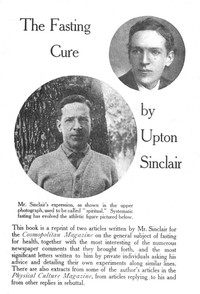
I have reproduced in the book several photographs of myself which appeared in the magazine articles. Ordinarily one does not print his picture in his own books; but when it comes to fasting there are many "doubting Thomases," and we are told that "seeing is believing." The two photographs of myself which appear as a frontispiece afford evidence of a really extraordinary physical recuperation; and the reader has my word for it that there was nothing in my way of life to account for it, except three fasts, of a total of thirty days.
There is one other matter to be referred to. Several years ago I published a book entitled "Good Health," written in collaboration with a friend. I could not express my own views fully in that book, and on certain points where I differed with my collaborator, I have come since to differ still more. The book contains a great deal of useful information; but later experience has convinced me that its views on the all-important subject of diet are erroneous. My present opinions I have given in this book. I am not saying this to apologize for an inconsistency, but to record a growth. In those days I believed something, because other people told me; to-day I know something else, because I have tried it upon myself.
My object in publishing this book is two-fold: first, to have something to which I can refer people, so that I will not have to answer half a dozen "fasting letters" every day for the rest of my life; and second, in the hope of attracting sufficient attention to the subject to interest some scientific men in making a real investigation of it. To-day we know certain facts about what is called "autointoxication"; we know them because Metchnikoff, Pawlow and others have made a thorough-going inquiry into the subject. I believe that the subject of fasting is one of just as great importance. I have stated facts in this book about myself; and I have quoted many letters which are genuine and beyond dispute. The cures which they record are altogether without precedent, I think. The reader will find in the course of the book (page 63) a tabulation of the results of 277 cases of fasting. In this number of desperate cases, there were only about half a dozen definite and unexplained failures reported. Surely it cannot be that medical men and scientists will continue for much longer to close their eyes to facts of such vital significance as this.
I do not pretend to be the discoverer of the fasting cure. The subject was discussed by Dr. E. H. Dewey in books which were published thirty or forty years ago. For the reader who cares to investigate further, I mention the following books, which I have read with interest and profit. I recommend them, although, needless to say, I do not agree with everything that is in them: "Fasting for the Cure of Disease," by Dr. L. B. Hazzard; "Perfect Health," by C. C. Haskell; "Fasting, Hydrotherapy and Exercise," by Bernarr Macfadden; "Fasting, Vitality and Nutrition," by Hereward Carrington. Also I will add that Mr. C. C. Haskell, of Norwich, Conn., conducts a correspondence-school dealing with the subject of fasting, and that fasting patients are taken charge of at Bernarr Macfadden's Healthatorium, 42d Street and Grand Boulevard, Chicago, Ill., and by Dr. Linda B. Hazzard, of Seattle, Washington.
Have you any conception of what the phrase means? Can you form any image of what would be your feeling if every organ in your body were functioning perfectly? Perhaps you can go back to some day in your youth, when you got up early in the morning and went for a walk, and the spirit of the sunrise got into your blood, and you walked faster, and took deep breaths, and laughed aloud for the sheer happiness of being alive in such a world of beauty. And now you are grown older--and what would you give for the secret of that glorious feeling? What would you say if you were told that you could bring it back and keep it, not only for mornings, but for afternoons and evenings, and not as something accidental and mysterious, but as something which you yourself have created, and of which you are completely master?
This is not an introduction to a new device in patent medicine advertising. I have nothing to sell, and no process patented. It is simply that for ten years I have been studying the ill health of myself and of the men and women around me. And I have found the cause and the remedy. I have not only found good health, but perfect health; I have found a new state of being, a new potentiality of life; a sense of lightness and cleanness and joyfulness, such as I did not know could exist in the human body. "I like to meet you on the street," said a friend the other day. "You walk as if it were such fun!"
I look about me in the world, and nearly everybody I know is sick. I could name one after another a hundred men and women, who are doing vital work for progress and carrying a cruel handicap of physical suffering. For instance, I am working for social justice, and I have comrades whose help is needed every hour, and they are ill! In one single week's newspapers last spring I read that one was dying of kidney trouble, that another was in hospital from nervous breakdown, and that a third was ill with ptomaine poisoning. And in my correspondence I am told that another of my dearest friends has only a year to live; that another heroic man is a nervous wreck, craving for death; and that a third is tortured by bilious headaches.[1] And there is not one of these people whom I could not cure if I had him alone for a couple of weeks; no one of them who would not in the end be walking down the street "as if it were such fun!"
I propose herein to tell the story of my discovery of health, and I shall not waste much time in apologizing for the intimate nature of the narrative. It is no pleasure for me to tell over the tale of my headaches or to discuss my unruly stomach. I cannot take any case but my own, because there is no case about which I can speak with such authority. To be sure, I might write about it in the abstract, and in veiled terms. But in that case the story would lose most of its convincingness, and so of its usefulness. I might tell it without signing my name to it. But there are a great many people who have read my books and will believe what I tell them, who would not take the trouble to read an article without a name. Mr. Horace Fletcher has set us all an example in this matter. He has written several volumes about his individual digestion, with the result that literally millions of people have been helped. In the same way I propose to put my case on record. The reader will find that it is a typical case, for I made about every mistake that a man could make, and tried every remedy, old and new, that anybody had to offer me.
I spent my boyhood in a well-to-do family, in which good eating was regarded as a social grace and the principal interest in life. We had a colored woman to prepare our food, and another to serve it. It was not considered fitting for children to drink liquor, but they had hot bread three times a day, and they were permitted to revel in fried chicken and rich gravies and pastries, fruit cake and candy and ice-cream. Every Sunday I would see my grandfather's table with a roast of beef at one end, and a couple of chickens at the other, and a cold ham at one side; at Christmas and Thanksgiving the energies of the whole establishment would be given up to the preparation of delicious foods. And later on, when I came to New York, I considered it necessary to have such food; even when I was a poor student, living on four dollars a week, I spent more than three of it on eatables.
I was an active and fairly healthy boy; at twenty I remember saying that I had not had a day's serious sickness in fourteen years. Then I wrote my first novel, working sixteen or eighteen hours a day for several months, camping out, and living mostly out of a frying-pan. At the end I found that I was seriously troubled with dyspepsia; and it was worse the next year, after the second book. I went to see a physician, who gave me some red liquid, which magically relieved the consequences of doing hard brain-work after eating. So I went on for a year or two more, and then I found that the artificially-digested food was not being eliminated from my system with sufficient regularity. So I went to another physician, who gave my malady another name, and gave me another medicine, and put off the time of reckoning a little while longer.
I have never in my life used tea or coffee, alcohol or tobacco; but for seven or eight years I worked under heavy pressure all the time, and ate very irregularly, and ate unwholesome food. So I began to have headaches once in a while, and to notice that I was abnormally sensitive to colds. I considered these maladies natural to mortals, and I would always attribute them to some specific accident. I would say, "I've been knocking about down town all day"; or, "I was out in the hot sun"; or, "I lay on the damp ground." I found that if I sat in a draught for even a minute I was certain to "catch a cold." I found also that I had sore throat and tonsilitis once or twice every winter; also, now and then, the grippe. There were times when I did not sleep well; and as all this got worse, I would have to drop all my work and try to rest. The first time I did this a week or two was sufficient; but later on a month or two was necessary, and then several months.
The book keeps going
Reading is free forever. Sign up and watch scenes appear while you read.



Scenes Storieta drew for other classics.


New illustrated classics
Once or twice a month: the latest books to get full character casts, scene art, and free comic editions. No account needed.