Public-domain ebook
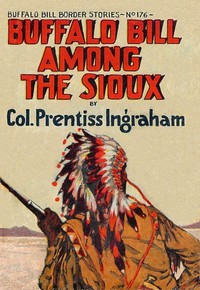
Buffalo Bill Among the Sioux; Or, The Fight in the Rapids
Language: en498 downloads on Project Gutenberg
Subjects
In: Historical Novels·Adventure·Novels
Public-domain ebook sourced from Project Gutenberg #63360.
Public-domain ebook
Language: en498 downloads on Project Gutenberg
Subjects
In: Historical Novels·Adventure·Novels
Public-domain ebook sourced from Project Gutenberg #63360.
The opening · free to read
(BUFFALO BILL).
It is now some generations since Josh Billings, Ned Buntline, and Colonel Prentiss Ingraham, intimate friends of Colonel William F. Cody, used to forgather in the office of Francis S. Smith, then proprietor of the New York Weekly. It was a dingy little office on Rose Street, New York, but the breath of the great outdoors stirred there when these old-timers got together. As a result of these conversations, Colonel Ingraham and Ned Buntline began to write of the adventures of Buffalo Bill for Street & Smith.
Colonel Cody was born in Scott County, Iowa, February 26, 1846. Before he had reached his teens, his father, Isaac Cody, with his mother and two sisters, migrated to Kansas, which at that time was little more than a wilderness.
When the elder Cody was killed shortly afterward in the Kansas “Border War,” young Bill assumed the difficult role of family breadwinner. During 1860, and until the outbreak of the Civil War, Cody lived the arduous life of a pony-express rider. Cody volunteered his services as government scout and guide and served throughout the Civil War with Generals McNeil and A. J. Smith. He was a distinguished member of the Seventh Kansas Cavalry.
During the Civil War, while riding through the streets of St. Louis, Cody rescued a frightened schoolgirl from a band of annoyers. In true romantic style, Cody and Louisa Federci, the girl, were married March 6, 1866.
In 1867 Cody was employed to furnish a specified amount of buffalo meat to the construction men at work on the Kansas Pacific Railroad. It was in this period that he received the sobriquet “Buffalo Bill.”
In 1868 and for four years thereafter Colonel Cody served as scout and guide in campaigns against the Sioux and Cheyenne Indians. It was General Sheridan who conferred on Cody the honor of chief of scouts of the command.
After completing a period of service in the Nebraska legislature, Cody joined the Fifth Cavalry in 1876, and was again appointed chief of scouts.
Colonel Cody’s fame had reached the East long before, and a great many New Yorkers went out to see him and join in his buffalo hunts, including such men as August Belmont, James Gordon Bennett, Anson Stager, and J. G. Heckscher. In entertaining these visitors at Fort McPherson, Cody was accustomed to arrange wild-West exhibitions. In return his friends invited him to visit New York. It was upon seeing his first play in the metropolis that Cody conceived the idea of going into the show business.
Assisted by Ned Buntline, novelist, and Colonel Ingraham, he started his “Wild West” show, which later developed and expanded into “A Congress of the Rough Riders of the World,” first presented at Omaha, Nebraska. In time it became a familiar yearly entertainment in the great cities of this country and Europe. Many famous personages attended the performances, and became his warm friends, including Mr. Gladstone, the Marquis of Lorne, King Edward, Queen Victoria, and the Prince of Wales, now King of England.
At the outbreak of the Sioux, in 1890 and 1891, Colonel Cody served at the head of the Nebraska National Guard. In 1895 Cody took up the development of Wyoming Valley by introducing irrigation. Not long afterward he became judge advocate general of the Wyoming National Guard.
Colonel Cody (Buffalo Bill) died in Denver, Colorado, on January 10, 1917. His legacy to a grateful world was a large share in the development of the West, and a multitude of achievements in horsemanship, marksmanship, and endurance that will live for ages. His life will continue to be a leading example of the manliness, courage, and devotion to duty that belonged to a picturesque phase of American life now passed, like the great patriot whose career it typified, into the Great Beyond.
BUFFALO BILL AMONG THE SIOUX.
One summer morning, in the sixties, when the Indians in the West and Southwest were still giving much trouble to Uncle Sam’s settlers and soldiers, and when the great railway lines were being pushed forward across the continent to the Pacific coast, a scout rode across country in Kansas from Fort Larned to another military post, about sixty miles distant.
He was carrying the military mail and dispatches from one fort to another, and his mission was an exceedingly dangerous one, for it was known that the Indians in Kansas and the neighboring territory were on the point of rising to attack the whites, if they had not already risen.
Many reports had been received from scouts familiar with the Indians which showed that an alliance was being arranged between several of the tribes with the object of going on the warpath in numbers strong enough, as they imagined, to enable them to bid defiance to Uncle Sam’s troopers, even though the latter were armed with the quick-firing “devil guns” so much feared by the redskins.
The scout who was riding across country was, with one exception, the most remarkable man of his class at that time in the West.
He was none other than our old friend Wild Bill, and it need hardly be added that the exception alluded to was his great friend and comrade, Colonel William F. Cody, better known as “Buffalo Bill,” the king of the scouts.
As he rode along, mounted upon a magnificent mustang, Wild Bill was a splendid, fearless figure that it would have done the heart of any brave man good merely to look upon.
In person he was about six feet one inch in height, and, as has been described by his friend, General George A. Custer, “straight as the straightest of the Indian warriors whose implacable foe he was.” He had broad shoulders, well-formed chest and limbs, and a face strikingly handsome. His sharp, clear blue eyes were used to looking any man straight in the face, whether that man were friend or foe. His nose was a fine aquiline, and his mouth well shaped, with lips partly concealed by a handsome mustache.
His hair and complexion were those of a perfect blond--fair as a Saxon viking. He wore the former in long, flowing ringlets, which fell carelessly over his powerfully formed shoulders. Riding his horse as if he were part of the animal, he looked a perfect type of physical manhood.
He had galloped for about twenty miles, when he stopped on a small hill overlooking a valley through which a river ran.
He cast a quick glance around the landscape to see if any foes were in sight, and his eyes immediately fell upon a band of about fifty Indians not more than a third of a mile away.
They saw him almost at the same moment, and immediately jumped on their horses, from which they had dismounted with the idea of watering them in the river, and gave chase.
Wild Bill waited until they came near enough to enable him to see what tribes they belonged to, and whether they were dressed in their war paint. When he had satisfied his doubts on those scores, and found out that they were really on the warpath, he hastily turned his mustang to make a ride for life. But before he galloped off, he lifted his rifle and shot the foremost of the Indians through the head.
As the brave tumbled from his horse, his comrades gave a yell of rage. Wild Bill responded by turning in the saddle and waving his sombrero toward them defiantly.
They fired a scattering volley, but the bullets whizzed harmlessly around him. Riding over uneven ground, the Indians could not take accurate aim.
The scout was riding a splendid mustang, and the gallant animal fully understood what was expected of him. He knew that it was a ride for life, and that he must put forth his greatest speed to save his master from death and himself from an Indian owner--a fate terrible to any decent horse.
He crossed a wide ravine and tore along the valley toward Fort Larned.
Reaching a ridge beyond, Wild Bill looked back for a moment and saw that the Indians were tearing after him. They rode at great speed, and many of them were evidently well mounted.
“Their own ponies can’t travel like that,” said the scout to himself. “They must have done some raiding before this, and got hold of some of the settlers’ animals. The rising we’ve been looking for has broken out, sure. Them folks at the fort must be put on their guard, whatever happens. I guess the whole country will be ablaze in a couple of days.”
If he had been mounted on a fresh horse, Wild Bill would have had no doubt of the outcome of the race; but his mustang, splendid animal though he was, had already ridden far, and showed signs of flagging.
The Indians began to gain on their quarry for a time, and then the mustang made a spurt and shot ahead again. But the effort was too great for him, and he could not keep up his speed for long.
When he had run about three miles farther, half a dozen of the Indians had crept up to within two or three hundred yards, while several of the other braves were not far behind.
Now and then they fired at him, but their rifles were of inferior quality and their aim was bad, so that neither the scout nor his horse was touched.
The Indians seemed to be shortening the distance from their prey at every stride, but Wild Bill bent over in his saddle and whispered to his mustang: “Get up, old man!”
It was the first effort he had made to urge the animal to greater speed, and immediately he exerted himself to the very utmost, drawing slowly away from the Indians for the next three or four miles.
But there was a limit to the mustang’s power of endurance, if not to his will.
The Indians were nearly as well mounted as Wild Bill, and their steeds were comparatively fresh. One of them in particular--a spotted animal--kept gaining all the time. The others were strung out behind in a long line for a distance of more than a mile, but they were all riding as hard as they knew how, for they wanted to be “in at the death.”
The brave riding the spotted horse was armed with a rifle, and as he drew within a hundred yards he occasionally sent a bullet whizzing unpleasantly close to Wild Bill.
The book keeps going
Reading is free forever. Sign up and watch scenes appear while you read.



Scenes Storieta drew for other classics.
New illustrated classics
Once or twice a month: the latest books to get full character casts, scene art, and free comic editions. No account needed.