Public-domain ebook
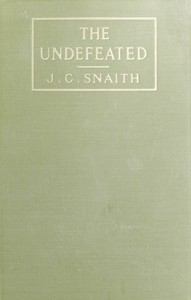
The Undefeated
by J. C. Snaith
Language: en383 downloads on Project Gutenberg
Subjects
Public-domain ebook sourced from Project Gutenberg #63546.
Public-domain ebook
by J. C. Snaith
Language: en383 downloads on Project Gutenberg
Subjects
Public-domain ebook sourced from Project Gutenberg #63546.
The opening · free to read
It was hot.
It was so hot that a certain Mr. William Hollis sitting on an old bacon box in the lee of a summerhouse in his lock-up garden had removed coat and waistcoat tie and collar, rolled up the sleeves of his shirt and loosened his braces. The presence of a neighbor's elbows on the party hedge forbade a complete return to nature, but the freedom of Old Man Adam from the restraints imposed by society was envied just now by one at least of his heirs.
By the side of Bill Hollis was a stone jar of Blackhampton ale, a famous brew, but even this could not save him from gasping like a carp. It was a scorcher and no mistake--thick, slab and hazy, the sort of heat you can almost cut with a knife.
Leaning gracefully across from the next plot was a large, rotund gentleman with the face of a well-nourished ferret. Draped in an artful festoon beneath an old straw hat, a wreath of burdock leaves defended him from the weather. "Mr. Hollis"--he addressed the man on the bacon box with conversational charm--"if you want my opinion they're putting in a bit of overtime in Hell."
"Mr. Goldman, you've got it." His neighbor, a man of somber imagination, was struck by the force of the image. First he glanced up to a sky of burnished copper and then he glanced down over the edge of sheer hillside upon which he and his friend were poised like a couple of black ants on the face of a hayrick. Below he saw a cauldron in which seethed more than a quarter of a million souls. Floating above the cauldron and its many thousands of chimneys was a haze of soot thick enough to conceal what in point of mere size was the fourteenth city of Great Britain. But speaking geographically, and Blackhampton's inhabitants were prone to do that, it was the exact center of England, of the United Kingdom, of the British Empire, and therefore--
Somewhere in the mind of William Hollis lurked a poet, a philosopher and an artist. He pointed over the dip of the hill into the middle of the cauldron. "Reminds me," he said, half to himself, for he was not consciously an artist, "of the Inferno of Dant, with Lustrations by Door."
Mr. Goldman frowned at the simile. What else could he do? He was a solid citizen, of a solid city, of a solid empire: he was not merely a Philistine, he was proud of being a Philistine. He suddenly remembered that his neighbor was a failure as a man of business. And in a flash Mr. Goldman knew why.
"Yes, Hollis--hot." The ferret-faced gentleman spoke with more caution and less charm. Commercially and socially he was secure, but the same could hardly be said for the man on the bacon box who spoke of the Inferno of Dant with Lustrations by Door--whatever the Inferno of Dant with Lustrations by Door might be.
"Hot enough, Mr. Goldman, to melt those three brass balls of yours." It was a graceful allusion to a trade symbol, yet a prosperous pawnbroker felt that in making it a semi-bankrupt greengrocer was verging upon the familiar. He had just reached that conclusion when a boy selling papers came along the narrow lane that ran past the end of the garden, and thrust a tousled head over the fence.
"Four o'clock, mister?"
Bill Hollis produced a halfpenny. A minute later he produced a note of disgust. "County's beat. Yorkshire won by an innings an' four runs. Funny thing, our chaps can't never play against Yorkshire--not for sour apples."
Mr. Goldman gave a slow deep grunt and then artistically readjusted his garland.
"Hirst six for twenty-two. Them Tykes can bahl a bit. Rhodes four for nineteen."
Mr. Goldman grunted again. And it was now clear by the look in his small eyes that disapproval was intended. The Inferno of Dant with Lustrations by Door was still in his mind. That was the key to his neighbor's financial failure, but this squandering of money, time and brain power on things of no value was just as significant.
"Cricket." The tone was very scornful. "One o' these days cricket is going to be the ruin of the country."
William Hollis stoutly dissented. "It's cricket that makes us what we are."
"It's business, Hollis, that makes a country." There was an accession of moral superiority in the pawnbroker's tone. "That's the thing that counts. All this sport is ruination--ruination, Hollis--the road to nowhere."
William Hollis was unconvinced, but a man so successful had him at a hopeless disadvantage. In theory he was sure that he was right, but the pawnbroker knew that he had just made a composition with his creditors, so that it didn't matter how sound the argument or how honest the cause, he was out of court. Truth doesn't matter. It is public opinion that matters. And public opinion is conditioned by many subtleties, among which a banking account is foremost.
Bill Hollis covered his retreat from a position that should have been impregnable, by turning to another part of the paper which was the Blackhampton Evening Star.
"Ultimatum to Serbia. Ugly situation. I don't think."
Mr. Goldman asked why he didn't.
"A dodge to sell the paper."
"I expect you're right," said the pawnbroker judicially. "They've always got some flam or other."
"Civil war in Ireland," announced Bill Hollis.
"I daresay. And next week we shall have the sea serpent and the giant gooseberry. And all for a halfpenny, mark you. We're living in great days, Hollis."
The little greengrocer was silent a moment and then he said thoughtfully, "I sometimes think, Mr. Goldman, what this country wants is a really good war."
Mr. Goldman smiled in a superior way. "Well, I don't mind telling you," he said, "that I've thought that for the last twenty years. Not this country only, but Europe, the whole world."
"You're right, Mr. Goldman." There was a grandeur in the conception that in spite of the weather almost moved his neighbor to enthusiasm.
"Stands to reason, my boy, and I'll tell you why. The world is overpoppylated. Look at this town of ours." With the finger of an Olympian the pawnbroker pointed down the hillside to the smoking cauldron below. "Poppylation two hundred and sixty odd thousand at the last census. And when I first set up in business, the year before the Franco-Prussian War, it was seventy-two thousand. And it's not only here, it's all over the world alike."
"That is so, Mr. Goldman. And they say that in America it's even worse. In fact, wherever you look the competition is cruel."
"Yes, Hollis, a real good war would do a power of good. We want Old Boney back again--then there might be breathing space for a bit. As it is this country is overrun with aliens."
William assented gloomily.
"This town of ours, my boy, is crawling with Germans. They come over here and take the bread out of our mouths. They work for nothing and they live on nothing. They learn all our trades and then they go back to the Fatherland, and undersell us."
Said Bill Hollis with the air of a prophet, "I reckon that sooner or later we'll be having a scrap with the Germans."
"Not likely." The pawnbroker's tone was a little contemptuous. "The Germans can get all they want without fighting. Peaceful penetration's their game. They are the cleverest nation in the world. In another twenty years they'll own it all."
Upon this last expression of his wisdom Mr. Goldman gave a final touch to his straw hat and its cool garland, waddled down a box-bordered path and out of the gate at the bottom of his garden.
The departure of Mr. Goldman left a void in the heart of Mr. William Hollis. He was a sociable man, with a craving for the company of his fellows, and although for quite a long time now his distinguished neighbor had been clearly labeled in his mind as "a pursy old pig," he was an interesting person to talk to when he was in the humor. He was not always in the humor, it was true, for he was a "warm" man, an owner of house property; therefore he was in the happy position of not having to be civil to anybody when he didn't feel like it. This afternoon, however, he had unbent.
The slowly receding form of Mr. Goldman waddled along by the hedge, turned into the lane, passed from view. In almost the same moment William Hollis felt a severe depression. He had reached the stage of life and fortune when he could not bear to be alone. With a kind of dull pain he realized that this was his forty-first birthday and that he had failed in life.
He was going down the hill. Unless he could take a pull on himself he was done. Already it might be too late. The best part of his life was behind him. A year ago that day, in this very garden, his only source of happiness, he had told himself that; two years ago, three years ago, five years ago, this had been the burden of his thoughts. But he was in a rut and there seemed to be no way out.
Twenty years ago he had felt it was in him to do something. He was an ambitious young fellow with a mind that looked forward to the day after to-morrow. Such a man ought to have done something. But now he knew that there had been a soft spot in him somewhere and that a moral and mental dry rot had already set in. He was a talker, a thinker, a dreamer; action was not his sphere. Unless he took a strong pull on himself he was out of the race.
The book keeps going
Reading is free forever. Sign up and watch scenes appear while you read.



Scenes Storieta drew for other classics.
New illustrated classics
Once or twice a month: the latest books to get full character casts, scene art, and free comic editions. No account needed.