Public-domain ebook
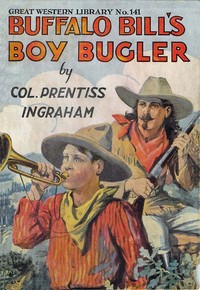
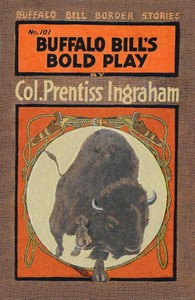
Buffalo Bill's Bold Play; Or, The Tiger of the Hills
English438 downloads on Project GutenbergDownload EPUB
Public-domain ebook sourced from Project Gutenberg #63705.
Public-domain ebook
English438 downloads on Project GutenbergDownload EPUB
Public-domain ebook sourced from Project Gutenberg #63705.
The opening · free to read
It is now some generations since Josh Billings, Ned Buntline, and Colonel Prentiss Ingraham, intimate friends of Colonel William F. Cody, used to forgather in the office of Francis S. Smith, then proprietor of the New York Weekly. It was a dingy little office on Rose Street, New York, but the breath of the great outdoors stirred there when these old-timers got together. As a result of these conversations, Colonel Ingraham and Ned Buntline began to write of the adventures of Buffalo Bill for Street & Smith.
Colonel Cody was born in Scott County, Iowa, February 26, 1846. Before he had reached his teens, his father, Isaac Cody, with his mother and two sisters, migrated to Kansas, which at that time was little more than a wilderness.
When the elder Cody was killed shortly afterward in the Kansas “Border War,” young Bill assumed the difficult rôle of family breadwinner. During 1860, and until the outbreak of the Civil War, Cody lived the arduous life of a pony-express rider. Cody volunteered his services as government scout and guide and served throughout the Civil War with Generals McNeil and A. J. Smith. He was a distinguished member of the Seventh Kansas Cavalry.
During the Civil War, while riding through the streets of St. Louis, Cody rescued a frightened schoolgirl from a band of annoyers. In true romantic style, Cody and Louisa Federci, the girl, were married March 6, 1866.
In 1867 Cody was employed to furnish a specified amount of buffalo meat to the construction men at work on the Kansas Pacific Railroad. It was in this period that he received the sobriquet “Buffalo Bill.”
In 1868 and for four years thereafter Colonel Cody served as scout and guide in campaigns against the Sioux and Cheyenne Indians. It was General Sheridan who conferred on Cody the honor of chief of scouts of the command.
After completing a period of service in the Nebraska legislature, Cody joined the Fifth Cavalry in 1876, and was again appointed chief of scouts.
Colonel Cody’s fame had reached the East long before, and a great many New Yorkers went out to see him and join in his buffalo hunts, including such men as August Belmont, James Gordon Bennett, Anson Stager, and J. G. Heckscher. In entertaining these visitors at Fort McPherson, Cody was accustomed to arrange wild-West exhibitions. In return his friends invited him to visit New York. It was upon seeing his first play in the metropolis that Cody conceived the idea of going into the show business.
Assisted by Ned Buntline, novelist, and Colonel Ingraham, he started his “Wild West” show, which later developed and expanded into “A Congress of the Rough Riders of the World,” first presented at Omaha, Nebraska. In time it became a familiar yearly entertainment in the great cities of this country and Europe. Many famous personages attended the performances, and became his warm friends, including Mr. Gladstone, the Marquis of Lorne, King Edward, Queen Victoria, and the Prince of Wales, now King of England.
At the outbreak of the Sioux, in 1890 and 1891, Colonel Cody served at the head of the Nebraska National Guard. In 1895 Cody took up the development of Wyoming Valley by introducing irrigation. Not long afterward he became judge advocate general of the Wyoming National Guard.
Colonel Cody (Buffalo Bill) died in Denver, Colorado, on January 10, 1917. His legacy to a grateful world was a large share in the development of the West, and a multitude of achievements in horsemanship, marksmanship, and endurance that will live for ages. His life will continue to be a leading example of the manliness, courage, and devotion to duty that belonged to a picturesque phase of American life now passed, like the great patriot whose career it typified, into the Great Beyond.
BUFFALO BILL’S BOLD PLAY.
When that wonderful invitation was read by the masculine element and the few women of Blossom Range, it created a sensation, announcing, as it did, that Juniper Joe’s jubilee was to consist of his marriage to a charming widow of the East, Mrs. Rafferty, followed by a dance and “refreshments.”
Stuck up in front of the post office, in none too legible handwriting, it invited the whole town.
“If you-all what sees this invitation dont come, you shore will miss the only first-class happenin that, so fur, has hit this hyer lively hamlet. I aint seen Mrs. Rafferty yit; but I have her photographt, an shes all to the good, jedgin by it. Anyway, I’m takin the risks. Every man what is goin to laff at me had better come armed; and every man what is goin to envy me my good fortune why he had better come armed, too. The ceremony will be performed strictly accordin to Hoyle, by our cellerbated feller townsmen an Jestis of the Peace Jedge Abercrombie Morris. After the weddin there will be a dance, and after the dance refreshments of the kind you-all can appreciate. The music aint goin to be no Wagnerian concert stuff, but somethin that has got a lively jump in it; furnished by that prince of fiddlers White-eyed Moses. And jokes about Moses’ eyes or nose will provoke a homicide. Likewise anybody callin’ his fiddle a violin will be shot on the spot. What the refreshments aire to consist of will depend on what sort of truck Gopher Gabe happens to have in stock behind his bar when the happy day arrives.”
The thing was signed by “Juniper Joe.”
What the fellow’s real name was few, if any, knew; some said it was Mason, some Morgan, some even slandered him by claiming that he walked about among men bearing the plebeian cognomen of John Jones, where he was better known.
Juniper Joe’s cabin--it was a big one--stood right at the edge of the camp of Blossom Range, on the east. The back of it burrowed into a hill; and in that hill was Juniper Joe’s mine. No one could get into the mine, it was claimed, unless he went through the house; and the house was always locked, when Juniper Joe was at work, or not receiving company.
The mine had gained great fame lately. Juniper Joe had struck “pockets” that were wonderfully rich, judging by Blossom Range standards. They were rather high standards, too; for other men, in other holes in the ground, were making good strikes, all round the town.
It was because he had been so phenomenally lucky that had induced Juniper Joe to seek a helpmate; he wanted a woman to share his joys and sorrows, and help him to spend his surplus cash. He might have got one even in Blossom Range, on account of the plutocratic reputation he had suddenly acquired; but he preferred to pass them by and seek in fields afar for the future partner of his bosom. So he said.
Juniper Joe’s invitations were a ten days’ sensation; they would have been a month’s sensation, if that time had intervened before the wedding and the dance.
When the stage came in from Calumet Springs, on the morning of the day fixed, every man who could be there was down at the stables, for it was known that the stage was bringing the bride.
Juniper Joe was there, of course, at the forefront, ready to welcome to this “garden spot of the mountains” the future Mrs. Joe. Also, he was arrayed regardless; in solemn black, with a shirt and collar as white as Mrs. Maginniss, the laundry lady, could make them; and by extra pay she had been spurred to do her best. Topping his head was a silk cady of the previous year’s vintage, which he had bought of the one Jew pawnbroker of the place. The pawnbroker had worn it the first day he came into the camp; there was still a dent in one side, where the brickbat had landed which expressed the town’s disapproval of that style of headgear. Israel Silverman, being by nature a wise man, had then laid the cady gently away in moth balls; only to resurrect it and sell it to Juniper Joe.
On this day no one took a shot with brickbat or stone at the shining hat. One reason was that Juniper Joe had a “hostyle” temper when he was aroused by what he considered an insult; the second reason was a double one, but like it; he had two revolvers belted to his manly waist, under the tails of his black broadcloth.
There was some disappointment when Mrs. Rafferty descended from the stage; she was veiled! It was a staggering blow to the curiosity of Blossom Range. But she recognized Juniper Joe, when he rushed to meet her; and the envious crowd was permitted to see her walk away, with her arm hooked through his, to the “hack” he had ordered.
He escorted her, in the hack, to the best hotel in Blossom Range, where he left her for the time being.
One other circumstance must be mentioned, in connection with that arrival, which created almost as much curiosity as the coming of the Widow Rafferty.
Out of the same stage coach stepped a tall man, of handsome carriage and almost military bearing; a small, oldish man, with a seamed face and whitening hair; and a round-bodied man, whose legs were thin as pipe stems. They, too, took their way to the self-same hotel; but they walked.
When they had been in the town less than an hour, it became known, or noised about, that the three men were Buffalo Bill and his two pards, Nick Nomad and Baron Schnitzenhauser.
But what were they there for?
Nobody could answer the question, and few people thought of them long. Time could not be wasted on people, even so prominent, when every one in town had to think all the while of the coming “jubilee.”
Yet the three were not wholly forgotten; for along in the afternoon a copy of that queer invitation found its way to the men mentioned.
“Mrs. Rafferty says that as you-all was so pleasant to her while she was with ye in the stage from Calumet Springs, that she thinks highly of ye, and has suggested that it would be ther proper caper if, though bein strangers, you was invited. Tharfore it’s hopin that you-all will feel free to look on at the weddin, fling a heel in the dancin, and sample the refreshments all ye like. In this I am gladly jinin Mrs. Rafferty; though, at the same time, acknowledgin that hers is the gentle hand at present on the tiller of the bark matrimonyul. So here’s again hopin you-all will come.”
This, too, was signed “Juniper Joe.”
It is almost needless to say that the trio went.
The fiddle of White-eyed Moses was scraping, and thudding feet shook the rafters at the time of the arrival of Buffalo Bill and his pards at Jubilee Joe’s cabin. But the wedding ceremony had not yet taken place. The premature dancing was due to certain men so hilariously inclined that they had “tipped” the fiddler, and set him to going ahead of time, because they could not wait.
But this ended, when Abercrombie Morris came into the room and asked for quiet, announcing that the momentous moment had arrived.
“Honored as we aire this evening,” said “Judge” Morris, “we aire under obligations to conduct ourselves as ladies and gents, and lend a listenin’ ear to the sollum words which is goin’ to bind this man and woman together in the holy bonds o’ matrimony.”
He was “sollum” enough himself, in his black clothing, his fat, florid face clean-shaven, his hair plastered down tight against his scalp with pomade; he was the only “legal light” in Blossom Range, and appraised himself accordingly.
The book keeps going
Reading is free forever. Sign up and watch scenes appear while you read.



Scenes Storieta drew for other classics.
New illustrated classics
Once or twice a month: the latest books to get full character casts, scene art, and free comic editions. No account needed.