Public-domain ebook
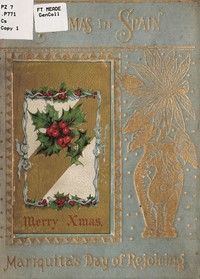
Christmas in Spain; or, Mariquita's Day of Rejoicing
Language: en342 downloads on Project Gutenberg
Subjects
In: Children & Young Adult Reading·Novels
Public-domain ebook sourced from Project Gutenberg #64108.
Public-domain ebook
Language: en342 downloads on Project Gutenberg
Subjects
In: Children & Young Adult Reading·Novels
Public-domain ebook sourced from Project Gutenberg #64108.
The opening · free to read
“If your mother is willing, I will take you for a walk with me,” said Señor Vasquez, smiling indulgently at his twin son and daughter. Anitia clapped her hands in delight as she ran after Antonio in search of their mother. They found her in the despensa, the store-house of many delicious dainties, as she was busy giving out the supplies for the holiday supper that evening. She followed them into the patio, however, and gave them the desired permission. “It’s such a busy day,” she said to their father, “that I am quite willing to spare them for the afternoon and a walk with you will be a great treat.”
They made a pretty picture as they went down the narrow street, stopping once to wave their hands to the dark-eyed young mother who watched them from behind the barred windows of their quaint old house. More than one passer-by glanced after them half-enviously, for the erect young military man with his little son and daughter on either side was good to look upon, and their merry laughter was contagious.
To tell the truth light hearts were not plentiful in old Seville that December day, for within the year the war with America had drained the resources of Spain and many people mourned for soldiers dead ’neath Cuban skies.
But there was great rejoicing in the home of Señor Vasquez, for the father of the household had gone through the fierce campaign without injury, and although his term of service was not completed, his regiment had already landed in Spain and he had obtained a two weeks’ leave of absence for the holidays.
Antonio and Anitia were wild with delight when their father came home and had scarcely let him out of their sight since his arrival. Antonio was constantly begging for stories of the war, and Anitia listened too, vaguely fascinated, although she shuddered sometimes when she thought of the pale, sick soldiers she had seen brought home from those same battle-fields. Her brother was always talking of the time when he should grow up and enter the army. Anitia couldn’t understand his eagerness; and she wondered if he would have been as anxious, if he had helped her mother make bandages and hospital supplies. She hadn’t forgotten the long hours when she had worked patiently, proud to be able to help the soldiers a little, while Antonio was marching and counter-marching with his boy friends. But the war was over now--Anitia drew a sigh of relief as she realized it and clung more tightly to her father’s hand.
It was the afternoon of the day before Christmas and the sunny plazas and busy market-places were gay with holiday wares. It seemed as if the whole city were in the streets, for the laborers had all left their work at twelve and a good-natured throng jostled the little party of three.
The children asked for a story this afternoon, so their father turned in the direction of the river and they walked away from the busy crowd towards the Triana bridge. From there they could look up and down the yellow Guadalquivir and fancy they could see again the stately galleons which rode there of old. They were familiar with the traditions of these ships and the cargoes they had brought from over the seas in the days when Seville was a busy port, but they loved to hear them again from their father’s lips.
“Where shall we go next?” asked their father when they had spent some moments on the bridge. “I’ll give you each a wish. What shall we do, Anitia?”
The little girl answered rather shyly. “I was just thinking,” she said, “how much I would like to carry some good things for the holiday to the poor sick soldiers in the hospitals.”
“Well spoken, my dear, it’s a thought worthy of a soldier’s daughter,” said Señor Vasquez. “And what is your wish, my son?” he asked.
“When we have been to the hospital, may we buy something for Mariquita?” asked Antonio.
“Indeed you may, you shall take her whatever you think will make her most happy,” answered their father.
“Oh, I’m so glad,” cried Anitia. “It was good you thought of it, Antonio. Mariquita was so kind to help me make my nacimento,” she explained to her father. “It certainly was splendid,” said Señor Vasquez. Anitia, pleased with his praise, thought gratefully of the many hours her mother’s friend had spent helping her make the plaster representation of the birth of Christ which every Spanish child prepares at Christmas time. Thanks to Mariquita’s deft fingers, the little figures of the Baby, St. Joseph and the Blessed Virgin had been fashioned most artistically and Anitia might well be proud of her nacimento.
“First, we will buy whatever you wish to take to the hospital,” said Señor Vasquez. They had left the river behind them and were back in the city streets again. Soon they paused in a busy market-place where swarthy peasants were displaying their wares and a crowd of purchasers were buying holiday dainties.
There was such a bewildering display of good things that it was hard to make a selection. The luscious golden oranges of Andalusia were piled high in pyramids and Anitia said she wanted some for the soldiers. Antonio suggested that they add some nuts from Granada and the market-man displayed some fresh dates from Tangiers which their father added to their store.
Both children looked longingly at the various sweetmeats, dried and candied, which were shown so invitingly, but their father told them they would not be good for sick people. He bought some turmi, however, and laughed with the salesman at the children’s delight when he had the parcel of this favorite Christmas candy wrapped separately for their own use.
The shops were decorated with ribbons and streamers, while all kinds of wares were given a holiday air by their decorations. Even the sausages were gaily displayed and the folds of red and yellow serge which the peasant women buy gave an added note of color.
There was laughter and gay talk. Sometimes a dark-eyed girl danced gracefully while she tossed her tambourine, and in other places the low monotonous scraping of the zambomba
accompanied the strains of the Christmas hymn with its familiar old refrain.
“This night is the good night, And therefore is no night of rest.”
Soon they came to the hospital where the children had frequently been with their mother. The portress who opened the door for them seemed to know their errand without being told and held out her hands for their gifts. The children could see many baskets of fruit and flowers in the corridor behind her. She recognized them at once and told Señor Vasquez that she had just sent a messenger for him. A sick soldier had been asking for him and would like to see him at once.
Antonio and his sister were told to wait for their father in the courtyard, and he immediately followed a sweet-faced nun down the long corridor to the wards.
Left alone, the children amused themselves by watching the doorway, for the portress was kept busy admitting visitors. Some had come to visit their sick friends, but many people came to leave fruit and gifts as the children had done.
“What shall we buy for Mariquita?” said Antonio suddenly.
Anitia shook her head doubtfully. “I am afraid there is nothing she cares for very much except to have Don Francisco back again,” she said. “What do you suppose has become of him?”
“I don’t wonder Mariquita is sad,” answered her brother. “It is so long since she has had any word from him.”
They were both very fond of the young girl who had been “_en deposito_” with their mother for several months, and they were greatly interested in her sad love-story which was no secret in the family. They knew that Mariquita’s lover, Don Francisco, had gone to Cuba with his regiment, and that in his absence her parents had tried to force her to marry an old man who was very rich but whom Mariquita hated.
So she had taken advantage of the Spanish law and, having signed a document stating the facts, had been placed by the magistrate “_en deposito_” with Señora Vasquez. It was that good lady’s duty to care for her and protect her until her parents had time to relent. If they did not agree to allow her to marry Don Francisco at the end of the appointed time, she was free to do so without her parents’ consent according to Spanish law.
Señora Vasquez had found Mariquita a great comfort while her husband was away, and the children had grown to love her dearly, but the poor girl was often sad. She had heard nothing from Don Francisco for many weeks, and her parents had tried to convince her that he was dead. Still she refused to believe them and would not return home or marry as they wished.
“If only Don Francisco would come back for Christmas,” cried Anitia. “I can think of nothing which would make Mariquita happy except that.”
“What do you suppose the sick soldier wanted?” said Antonio, to change the subject, for tender-hearted Anitia’s eyes were filled with tears of sympathy.
“He wanted to tell me some news that will help us to make Mariquita happy,” answered their father’s voice. He had come up behind them and had heard both questions.
“Come with me quickly, for we have no time to lose.” The children questioned him eagerly as they hurried along together, and he told them all the soldier had said.
The sick man had been in Don Francisco’s regiment, and many nights, by the side of the camp-fire, they had exchanged stories of their home and loved ones. Don Francisco had confided to him how he longed to return to Spain and marry his Mariquita, but the weeks had lengthened into months and still their orders
to return had been delayed. When, at length, they landed at Cadiz Don Francisco had heard of Mariquita’s plight and, impatient of the endless formalities and delays which were more than a lover’s impatience could endure, he had left the army without leave and started for Seville. But he had been captured and imprisoned, for such an infringement of military discipline was always severely punished.
His comrade had sent for Señor Vasquez and told him the story, thinking that the news of her lover’s whereabouts might cheer Mariquita.
“But you must not tell her, children,” cautioned their father. “She would be distressed to know that he is in prison. Do not let her know that we have heard any news for a little time. Meanwhile, I will see what I can do.”
He had just finished speaking, when they stopped at an imposing-looking building which their father said was the headquarters of the military governor. The guard at the entrance saluted, as they passed, and none of the soldiers prevented their advance. Antonio felt very proud of this evidence of their father’s importance, for even the door-keeper at the governor’s office seemed to recognize that the handsome young officer was a person of authority and, very soon, they had permission to enter.
The governor greeted Señor Vasquez most cordially and spoke pleasantly to the children when their father explained that his business was so urgent that he had been unable to take them home, before making his call.
Antonio’s eyes were fastened admiringly on his splendid uniform, but Anitia saw that his eyes were kind, and she felt sure that he would help Mariquita, when he knew about her trouble.
The book keeps going
Reading is free forever. Sign up and watch scenes appear while you read.



Scenes Storieta drew for other classics.
New illustrated classics
Once or twice a month: the latest books to get full character casts, scene art, and free comic editions. No account needed.