Public-domain ebook
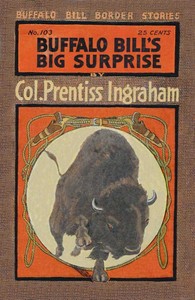
Buffalo Bill's Big Surprise; Or, The Biggest Stampede on Record
Language: en405 downloads on Project Gutenberg
Subjects
In: Adventure·Novels·American Literature
Public-domain ebook sourced from Project Gutenberg #64262.
Public-domain ebook
Language: en405 downloads on Project Gutenberg
Subjects
In: Adventure·Novels·American Literature
Public-domain ebook sourced from Project Gutenberg #64262.
The opening · free to read
(BUFFALO BILL).
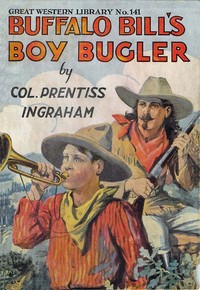
It is now some generations since Josh Billings, Ned Buntline, and Colonel Prentiss Ingraham, intimate friends of Colonel William F. Cody, used to forgather in the office of Francis S. Smith, then proprietor of the New York Weekly. It was a dingy little office on Rose Street, New York, but the breath of the great outdoors stirred there when these old-timers got together. As a result of these conversations, Colonel Ingraham and Ned Buntline began to write of the adventures of Buffalo Bill for Street & Smith.
Colonel Cody was born in Scott County, Iowa, February 26, 1846. Before he had reached his teens, his father, Isaac Cody, with his mother and two sisters, migrated to Kansas, which at that time was little more than a wilderness.
When the elder Cody was killed shortly afterward in the Kansas “Border War,” young Bill assumed the difficult rôle of family breadwinner. During 1860, and until the outbreak of the Civil War, Cody lived the arduous life of a pony-express rider. Cody volunteered his services as government scout and guide and served throughout the Civil War with Generals McNeil and A. J. Smith. He was a distinguished member of the Seventh Kansas Cavalry.
During the Civil War, while riding through the streets of St. Louis, Cody rescued a frightened schoolgirl from a band of annoyers. In true romantic style, Cody and Louisa Federci, the girl, were married March 6, 1866.
In 1867 Cody was employed to furnish a specified amount of buffalo meat to the construction men at work on the Kansas Pacific Railroad. It was in this period that he received the sobriquet “Buffalo Bill.”
In 1868 and for four years thereafter Colonel Cody served as scout and guide in campaigns against the Sioux and Cheyenne Indians. It was General Sheridan who conferred on Cody the honor of chief of scouts of the command.
After completing a period of service in the Nebraska legislature, Cody joined the Fifth Cavalry in 1876, and was again appointed chief of scouts.
Colonel Cody’s fame had reached the East long before, and a great many New Yorkers went out to see him and join in his buffalo hunts, including such men as August Belmont, James Gordon Bennett, Anson Stager, and J. G. Heckscher. In entertaining these visitors at Fort McPherson, Cody was accustomed to arrange wild-West exhibitions. In return his friends invited him to visit New York. It was upon seeing his first play in the metropolis that Cody conceived the idea of going into the show business.
Assisted by Ned Buntline, novelist, and Colonel Ingraham, he started his “Wild West” show, which later developed and expanded into “A Congress of the Rough Riders of the World,” first presented at Omaha, Nebraska. In time it became a familiar yearly entertainment in the great cities of this country and Europe. Many famous personages attended the performances, and became his warm friends, including Mr. Gladstone, the Marquis of Lorne, King Edward, Queen Victoria, and the Prince of Wales, now King of England.
At the outbreak of the Sioux, in 1890 and 1891, Colonel Cody served at the head of the Nebraska National Guard. In 1895 Cody took up the development of Wyoming Valley by introducing irrigation. Not long afterward he became judge advocate general of the Wyoming National Guard.
Colonel Cody (Buffalo Bill) died in Denver, Colorado, on January 10, 1917. His legacy to a grateful world was a large share in the development of the West, and a multitude of achievements in horsemanship, marksmanship, and endurance that will live for ages. His life will continue to be a leading example of the manliness, courage, and devotion to duty that belonged to a picturesque phase of American life now passed, like the great patriot whose career it typified, into the Great Beyond.
BUFFALO BILL’S BIG SURPRISE.
It was at Fort Advance, one of the smaller frontier posts on the Indian border, just about the hour of sunset. Buffalo Bill and Colonel Carr, the commandant of the fort, were chatting together when suddenly Buffalo Bill raised his hands and pointed across the plains.
A horseman could be seen in the distance, and he was approaching at a furious gallop.
Buffalo Bill scanned the figure for a moment in silence.
“It is Hugh Hardin, the oldest of my scouts,” he said, “and I am willing to bet a few cigars that he brings news of a fresh Indian uprising.”
It was, indeed, Hugh Hardin, and a moment later he had pulled up his steed before Buffalo Bill and Colonel Carr, and, after saluting his superior officers, was making his report.
It was to the effect that the Indians to the number of several thousands were on the warpath, under command of Death Face and several other of their chiefs.
“I scouted near their camp,” said Hugh Hardin, “and I know that there is at least one white man in their number. I saw him. He is Eagle, a well-known outlaw. He was formerly chief of the band known as the Renegade Red Riders, which you broke up, Buffalo Bill, not long ago.”
“What! Eagle, the outlaw chief!” exclaimed the colonel. “I thought you killed him, Cody?”
“I followed him and drove him off a precipice into Rapid River--man and horse,” said Cody; “but it looks as if he had escaped by swimming, and joined the redskins, now that his own band is wiped out. Are you sure that he is with the Indians?”
“Perfectly,” said Hugh Hardin.
“That man must be captured at all hazards,” said the colonel. “I shall immediately order out a troop of cavalry, as well as a battery of infantry, and send them on to oppose the Indians.”
An hour later the detachment of cavalry and artillery, under command of Lieutenant Worth, one of the most popular young officers in the post, was starting for Rapid River.
Two other commands of artillery and cavalry were dispatched immediately afterward.
Buffalo Bill headed the column, of course, and when, early the next day, after a hard night ride, they were within a few miles of the river, he advised the lieutenant to call a halt.
“I will go forward myself on a scout,” he said, “before the Indians discover that there is a body of soldiers in the vicinity.”
“I suggest that you take one of the men in my troop, Sergeant Fallon, as an assistant. He has lived with the Indians for years, and can disguise himself perfectly as one, and speak the language well. Besides, they say that he has powerful friends among the Sioux chiefs. He can enter the camp in disguise, perhaps.”
Sergeant Fallon, a tall, lean, dark-faced man, stepped forward at the command of Lieutenant Worth, and, after a few words with Buffalo Bill, went off to disguise himself as an Indian, a complete disguise having been brought along with the artillery equipments by command of Lieutenant Worth.
“He is a mysterious man, evidently well educated,” said the lieutenant to Buffalo Bill, “and no one knows why he entered the army, as he is reputed to be very wealthy. He has good cause to wish to be revenged on Eagle, the outlaw chief. Eagle captured his daughter, Lucille Fallon, when she was on her way West, to hold her for ransom, and it was you yourself who rescued her when you wiped out Eagle’s band.”
“I remember the occasion,” said the great scout; “but here comes the man, and he looks like an Indian, indeed.”
Sergeant Fallon’s disguise was perfect, and an hour later the scout and he set out.
When they reached Rapid River, Fallon decided to swim his horse across and enter the Indian camp disguised as he was, and Buffalo Bill, knowing from what he had seen and heard of the man that he could thoroughly trust him, allowed him to do so.
Buffalo Bill accompanied him as far as the river, and watched him across. He lost his form after he had got halfway across, but waited until he was sure that Fallon had reached the other side and found the Indian guards.
So saying, the scout gazed in silence for a while over the weird, wild scene, lit up by the moonlight into picturesque beauty, and then, turning his horse, rode back to his camp for the night.
The sergeant, meanwhile, had crossed the river, been met by the guards, and then rode to the camp beyond the ridge.
To his surprise, he found there over a hundred Indian braves, and about a camp fire built out of sight up in a niche of the cliff stood several forms, upon whom his eyes were at once riveted.
Fighting Bird, an old Sioux chief, was there, and near him stood the young chief, Death Face, while, seated upon a rock near, was a splendid type of a redskin leader, a man of almost herculean proportions, robed in gorgeous costume of tanned doeskin heavily embroidered with wampum, and wearing a war bonnet of barbaric splendor. His face was bold, rugged, crafty, intelligent, and merciless.
That countenance was furrowed with age, silver threads streaked his raven locks, but he was still the mighty leader of his people, the grand old fighter, plotter, good general, merciless foe of the palefaces, Iron Eyes, the head chief of his tribe.
The book keeps going
Reading is free forever. Sign up and watch scenes appear while you read.



Scenes Storieta drew for other classics.
New illustrated classics
Once or twice a month: the latest books to get full character casts, scene art, and free comic editions. No account needed.