Public-domain ebook
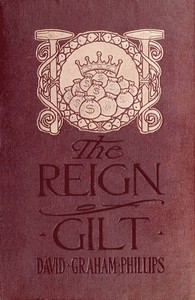
The Reign of Gilt
Language: en499 downloads on Project Gutenberg
Subjects
In: Novels·American Literature
Public-domain ebook sourced from Project Gutenberg #64402.
Public-domain ebook
Language: en499 downloads on Project Gutenberg
Subjects
In: Novels·American Literature
Public-domain ebook sourced from Project Gutenberg #64402.
The opening · free to read
“If the first comers to these shores were to come back to-day and see the houses, the dress and the manners of their descendants, they would think themselves in London in the time of Charles, or in Versailles in the time of the Louises.”
When he went on to urge the rich “to illustrate in their habit of life simplicity of attire, inexpensiveness in the appointments and chasteness in the aspect, proportions, furniture and decorations of their dwellings,” he could have meant only that he finds the Americans whom he knows best for the most part ostentatious and extravagant in dress, prodigal and vulgar and ignorantly profuse in their dwellings. And when he charged them with having “the buying of legislatures as their highest distinction” and with “appropriating the achievements of the scholar, the inventor, the pioneer in commerce or the arts, without rewarding them for the products of their genius,” he framed an indictment not on belief but on knowledge which becomes tremendous in view of the conservative character of his mind and his training, the dignity and responsibility of his position and the unequalled opportunity that is his to know whereof he speaks.
Lord Methuen, felled in a trifling engagement in the Boer war by one of those flesh wounds that are most painful but not serious, telegraphed home, “This is the bloodiest battle in history.” His point of view was rather too personal. And somewhat so must it have been with the Bishop when he concluded his survey of the encompassing plutocracy with this wild, despairing cry:
“The whole people are corrupted and corrupting! Moloch is god and his shrine is in almost every household in the republic!”
Fifth avenue and Wall street are not all of Manhattan Island: Manhattan Island is not all of New York City; New York City is not the only city in America; and outside the cities in every direction stretch vast areas of American soil not without its population. The plutocracy is a phase, not the whole. If the distinguished Bishop were as competent to speak of the American people as he is of the plutocracy, we might well feel that it is all over with the republic--that we Americans have bartered our birthright for a few handfuls of yellow earth and richly deserve our fate of social, political and industrial serfdom.
It is as exact a truth as any in chemistry or mechanics that Aristocracy is the natural, the inevitable sequence of widespread ignorance, and Democracy the natural, the inevitable sequence of widespread intelligence.
An intelligent few may be, as in Russia to-day, crushed down by an unintelligent mass wielded by a tyrant or group of tyrants. An unintelligent mass may for a time get, as in modern England, some measure of liberty through the mutual jealousies of intelligent upper classes warring one with another for supremacy. But let intelligence be diffused, let the sluices be opened so that it flows through the social soil in every direction and the tendency toward Democracy becomes irresistible. Monarchs may plot. Venerable and long-venerated institutions of princely and priestly and property caste and privilege may thunder, “Thus far and no farther!” Schools and colleges may give an education of half-truths and prejudices. Philosophers may deplore and warn, may project subtle and alluring schemes for maintaining or rehabilitating the old tyrannies in a new form. New conditions may produce new and subtle tyrannies that seem stronger than the old. All in vain. As well might a concourse of parliaments and tongues resolve that the heat of the sun be reduced one-half.
In face of any and all obstacles, in face even of the determination of a whole people, confused by false education, refusing to be free and rallying to the defense of some beloved tradition of caste, Democracy marches on hardly more hindered than an epidemic by the incantations of a “medicine man.”
Inertia is characteristic of the great mass of human beings, whatever their stage of development. And if the combat against the instinctive, all but universal reluctance to change had no stronger weapons than the tongues and pens of “reformers,” men would still be huddled in caves, gnawing bones. It is by no effort of its own that a race or a nation moves. It is in obedience to conditions that cannot be resisted and that now gently and now rudely compel man to readjust himself or to perish.
Democracy does not appreciably advance by the energy and enthusiasm of those who believe in it any more than it greatly lags because of the machinations of those who secretly or openly oppose it. Energy and enthusiasm may hasten its formal recognition, its formal embodiment in written laws. On the other hand, adroitness may obtain a lease of formal existence for the outgrown institutions. But in neither case is the great essential fact of the progress of Democracy altered. This progress depends upon the diffusion of intelligence; and intelligence is not a matter of individual choice or even of formal education. If the eyes and the ears are open, if the mental faculties are normal, then wherever intelligence is diffusing, there the mind must be drinking it in. A sponge thrown into the water must become saturated. When intelligence permeates the masses, then out of the action and reaction of the common and the conflicting interests of an ever-increasing multitude of intelligent men there must begin to issue a democratic compromise self-government.
Thus Democracy is not a “cult” to rise and rage and perish. It is not a theory that may some day be discovered false. It is not a plant to be carefully watched and watered lest peradventure it die. It is a condition, an environment, an atmosphere. A force as irresistible as that which keeps the stars a-swinging is behind it. The story of history, rightly written, would be the story of the march of Democracy, now patiently wearing away obstacles, accelerated there, now sweeping along upon the surface, again flowing for centuries underground, but always in action, always the one continuous, inevitable force. There never has been any more danger of its defeat than there has been danger that the human brain would be smoothed of its thought-bearing convolutions and set in retreat through the stages of evolution back to protoplasm.
Until this last half-century it was extremely difficult to study the operations of any great world-principle. But discovery and invention have now given us sight far more penetrating than that of the fabled giant who could see the grass grow. The difficulty now is to avoid seeing and knowing. And to shut out all but some relatively unimportant phenomenon--suddenly and suspiciously acquired wealth here, a corrupt and extravagant or degraded public administration there, a strike or a riot or a momentary moral convulsion yonder--and from it to predict the approach of chaos with tyranny upon its back, is as childish as the fantastic alarms of a tribe of savages during an eclipse or a thunder storm.
That any in America should thus shut the eyes, say “It is night,” and grope and tremble, is more discreditable than a similar folly among Englishmen or Frenchmen or Germans. Democracy has been our familiar from the very beginning, and self-government and the absence of rule are as old as our oldest settlements.
Those miserable first settlers, with minds as small and mean as their cabins, had no conception either of freedom or self-government. The tyrannies theological and tyrannies political which they set up to make life as hateful as it was squalid show that they had brought their European ideas with them. But fate was against them. They were of about the same low social rank. They were poor--and poverty is as potent a leveller as death itself. They were isolated. They had to shift each man for himself. So, deprived of rulers and forced to be free, since none cared to bind them, they began to govern each man himself. And they took the material tools which the civilization then current in Europe forced into their hands and, to save themselves from starvation, they set about the conquest of the land, not for a State as they imagined, but for themselves and their children.
Freedom is not the American’s because constitutions or statutes assert it. The constitutions, the statutes are merely written records of a truth no more dependent upon them than the proportions in which elements combine are dependent upon the text-books of chemistry. Besides, constitutions and laws avail only through their interpreters. And interpretation varies with the honesty or open-mindedness of official interpreters, with the spirit of the time, with the caprice of the moment even--a popular outburst, an impulse of bad courage in the public administrations, a greedy fear or desire in some powerful class. Legal enactments affect the surface of a society more or less and for periods of varying brevity; but the society itself is formed by conditions over which man has no greater control than he has over his heart-action. Those conditions constitute what the religious call “God in history” and the unreligious call fate or destiny or natural evolution.
America will remain in the highway to freedom because printing presses are whirling, because railway trains are moving, because news is streaming along the telegraph wires, because schools and colleges and libraries are open--because intelligence is diffused and is ever more widely diffusing. Rights may be and constantly are assailed in isolated instances. But each instance remains and must remain isolated. None has become or can become a precedent. And there must be precedent or there can be no tyranny. Prejudice, even wilful prejudice, still thrives; truth and error have not yet been divorced from their unholy alliance which seduces honest men to the purposes of rascals; passion still rules the heart and the heart still rules the reason. But America must be free, however hard it may struggle against freedom; Intelligence is striking off the shackles. It can no more be stopped or stayed than the law of gravitation can be suspended.
The European, or the American returning from a visit to Europe, is always disagreeably impressed by the evidences of haste, of imperfection in detail, by “the ragged ends sticking out.” But after a moment’s consideration of the reasons for this slovenliness wise criticism is disarmed. In the busiest hundred years the world has ever seen the Americans have had to shape out of a trackless wilderness a complete civilization containing as many as possible of the good ideas of the world’s past and having also all the latest improvements. There has been no time to “gather up loose ends.” The filling in of gaps, the replacing of makeshifts with permanent structures, the finishing and the polishing, have been perforce left to posterity. And, thanks to the passing and the present generations, posterity will have the leisure and the resources, and also the finer qualifications, necessary to that part of the task of civilization-building.
The book keeps going
Reading is free forever. Sign up and watch scenes appear while you read.



Scenes Storieta drew for other classics.
New illustrated classics
Once or twice a month: the latest books to get full character casts, scene art, and free comic editions. No account needed.