Public-domain ebook
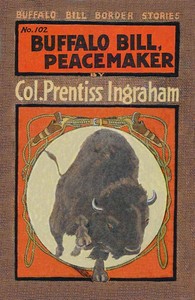
Buffalo Bill, Peacemaker; Or, On a Troublesome Trail
Language: en516 downloads on Project Gutenberg
Subjects
In: Adventure·Novels·American Literature
Public-domain ebook sourced from Project Gutenberg #64446.
Public-domain ebook
Language: en516 downloads on Project Gutenberg
Subjects
In: Adventure·Novels·American Literature
Public-domain ebook sourced from Project Gutenberg #64446.
The opening · free to read
(BUFFALO BILL).
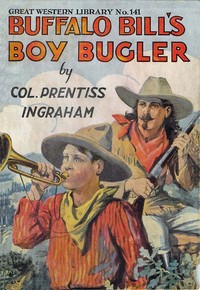
It is now some generations since Josh Billings, Ned Buntline, and Colonel Prentiss Ingraham, intimate friends of Colonel William F. Cody, used to forgather in the office of Francis S. Smith, then proprietor of the New York Weekly. It was a dingy little office on Rose Street, New York, but the breath of the great outdoors stirred there when these old-timers got together. As a result of these conversations, Colonel Ingraham and Ned Buntline began to write of the adventures of Buffalo Bill for Street & Smith.
Colonel Cody was born in Scott County, Iowa, February 26, 1846. Before he had reached his teens, his father, Isaac Cody, with his mother and two sisters, migrated to Kansas, which at that time was little more than a wilderness.
When the elder Cody was killed shortly afterward in the Kansas “Border War,” young Bill assumed the difficult rôle of family breadwinner. During 1860, and until the outbreak of the Civil War, Cody lived the arduous life of a pony-express rider. Cody volunteered his services as government scout and guide and served throughout the Civil War with Generals McNeil and A. J. Smith. He was a distinguished member of the Seventh Kansas Cavalry.
During the Civil War, while riding through the streets of St. Louis, Cody rescued a frightened schoolgirl from a band of annoyers. In true romantic style, Cody and Louisa Federci, the girl, were married March 6, 1866.
In 1867 Cody was employed to furnish a specified amount of buffalo meat to the construction men at work on the Kansas Pacific Railroad. It was in this period that he received the sobriquet “Buffalo Bill.”
In 1868 and for four years thereafter Colonel Cody served as scout and guide in campaigns against the Sioux and Cheyenne Indians. It was General Sheridan who conferred on Cody the honor of chief of scouts of the command.
After completing a period of service in the Nebraska legislature, Cody joined the Fifth Cavalry in 1876, and was again appointed chief of scouts.
Colonel Cody’s fame had reached the East long before, and a great many New Yorkers went out to see him and join in his buffalo hunts, including such men as August Belmont, James Gordon Bennett, Anson Stager, and J. G. Heckscher. In entertaining these visitors at Fort McPherson, Cody was accustomed to arrange wild-West exhibitions. In return his friends invited him to visit New York. It was upon seeing his first play in the metropolis that Cody conceived the idea of going into the show business.
Assisted by Ned Buntline, novelist, and Colonel Ingraham, he started his “Wild West” show, which later developed and expanded into “A Congress of the Rough Riders of the World,” first presented at Omaha, Nebraska. In time it became a familiar yearly entertainment in the great cities of this country and Europe. Many famous personages attended the performances, and became his warm friends, including Mr. Gladstone, the Marquis of Lorne, King Edward, Queen Victoria, and the Prince of Wales, now King of England.
At the outbreak of the Sioux, in 1890 and 1891, Colonel Cody served at the head of the Nebraska National Guard. In 1895 Cody took up the development of Wyoming Valley by introducing irrigation. Not long afterward he became judge advocate general of the Wyoming National Guard.
Colonel Cody (Buffalo Bill) died in Denver, Colorado, on January 10, 1917. His legacy to a grateful world was a large share in the development of the West, and a multitude of achievements in horsemanship, marksmanship, and endurance that will live for ages. His life will continue to be a leading example of the manliness, courage, and devotion to duty that belonged to a picturesque phase of American life now passed, like the great patriot whose career it typified, into the Great Beyond.
BUFFALO BILL, PEACEMAKER.
Fate was in a very capricious mood when Buffalo Bill and his pards carried their activities into the Lone Star State. They galloped over the plains and plunged full tilt into one of the most surprising misplays ever made by that arrant gamester--Chance.
There was a triangle of blunders, and it so happened that there was a pard in each corner, ready to take advantage of what came his way and turn misfortune into fortune for Cattleman Perry, his daughter Hattie, and a worthy cowboy of the name of Dunbar. The powerful clique of cattle barons were beaten at their own game of freeze out--and for this they had the scout and his pards to thank.
Buffalo Bill dropped into his corner of the complication on the wide grazing grounds, en route to the town of Hackamore, where he was to join Wild Bill, old Nomad, the trapper, who had shared many dangers with the scout, Baron von Schuitzenhauser, his Dutch pard, and Little Cayuse, his Indian trailer. And when it is said that he “dropped” into the complication, the statement is to be taken literally.
It was a night, a night made brilliant by moon and stars. The scout was two days from Portales, New Mexico, having diverged from the trail taken by his pards in order to halt for half a day in the town of Texico.
Buffalo Bill was off the trail, a plainsman having shown him a short cut that was to save many miles of saddle work. As Bear Paw forged ahead at a slow, steady gallop, the scout rocked gently in his saddle, half dozing.
He did not see the stovepipe that rose out of the ground in front of him, nor did he see the little ridgelike lifting of the earth adjacent to the stovepipe.
Bear Paw saw the pipe, however, and to evade it attempted to cross the small elevation. Intelligent horse though he was, how was he to know that elevation was not solid earth?
The black charger was in for a surprise. It was sprung with demoralizing suddenness.
Two strides carried Bear Paw over the high point of the ridge; a third stride brought a crash under his rear hoofs, and the after part of his body slumped downward.
A startled yell, seemingly coming out of the very earth, smote on the scout’s ears.
Caught at a disadvantage by the accident, Buffalo Bill was thrown backward out of his saddle and clear of the struggling horse.
Bear Paw’s front hoofs were on solid ground and, with a prodigious effort, he saved himself from sinking and clambered to safety beyond the deceptive ridge. But the scout dropped through the breach, grabbed at a log rafter, missed it, and fell in a huddle for a distance of ten feet.
He brought up on all fours, jarred through and through and blinking in a cloud of dust and a flood of lamplight. A clutter of dirt and broken poles lay around him.
The transformation from an easy gallop over the cool, open plain to this underground hole with its light and dust, had been so abrupt that the scout was taken at a loss.
But he was not the only one taken at a loss. In front of him, as the flurry of dust was wafted aside, he saw a strapping figure in hickory shirt, homespun trousers and cowhide boots--a figure topped with a mop of red hair, under which was a lean, leathery face.
The face of the figure was blank. Two washed-out blue eyes stared at the scout; and the scout, on hands and knees, stared back.
“Who in blazes are ye?” demanded the red-headed man, all at once finding his voice.
“A stranger and a traveler,” answered the scout, the ludicrous nature of the situation gradually appealing to him. “A man who--er--a-tchoo!”
“What d’ye mean by knockin’ a hole in the roof an’ slammin’ in on me like this?” went on the other, coming out of his surprise with a manner distinctly hostile.
The scout picked himself up slowly, felt of his bruises, and gave vent to a grewsome laugh.
“If you think, amigo, that I meant to knock a hole in your roof,” said he, “you’ve another guess coming. If I had planned to pay you a visit I wouldn’t have gone about it like this, would I?”
“How do I know who ye are, or what ye’d do?” fumed the other, far and away more savage than the scout thought the mishap warranted. “I don’t want no truck with ye, anyways. If ye didn’t allow ter pay me a visit, an’ if ye ain’t here from ch’ice, then yore next move is ter git out as quick as ye come in. Them’s the stairs”--he waved a hand toward a ladder that led upward to a flat door in the roof--“an’ at the same time we says hello, we also says good-by. Start yerself.”
“I’m not inclined to stay here any longer than you want to have me,” answered the scout, “but I landed with something of a jolt. If it’s all the same to you, I’ll just catch my breath before I try the stairs.”
“It ain’t all the same ter me,” barked the man. “I want ye ter go, an’ I want ye ter go ter oncet! With this ter back up the invite, I reckon ye won’t stand none on the order ter hike.”
The red-haired man made a swipe at his belt and lifted a hairy hand with a six-shooter. Buffalo Bill looked him in the eye and then coolly sat down on a two-legged stool that happened to be handy.
“I’ve heard a good deal about Texas hospitality,” said he, “but you’re giving it a hardware twist that I don’t like. And when I don’t like a thing,” he added significantly, “I’m apt to make it pretty plain.”
“Ye kain’t run in any rannikaboo on me,” snorted the red-haired person, jabbing the air with the point of his gun. “Ye say yer drappin’ in was a accident. I’m lettin’ it go at that, an’ givin’ ye a chance ter depart without any fireworks. An’ I ain’t sayin’ nothin’ about the damage ye done ter the dugout, nuther. Pick up yore hat an’ scatter. I’ll count three. When I say ‘one,’ ye’ll reach fer the hat; when I say ‘two,’ ye’ll be on the stairs; an’ when I say ‘three,’ ye’ll either be through that door in the roof or I’ll drop ye in yer tracks.”
The book keeps going
Reading is free forever. Sign up and watch scenes appear while you read.



Scenes Storieta drew for other classics.
New illustrated classics
Once or twice a month: the latest books to get full character casts, scene art, and free comic editions. No account needed.