Public-domain ebook
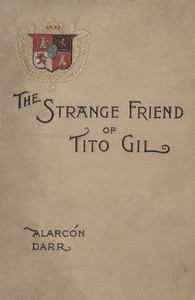
The Strange Friend of Tito Gil
Language: en475 downloads on Project Gutenberg
Subjects
In: Novels
Public-domain ebook sourced from Project Gutenberg #64456.
Public-domain ebook
Language: en475 downloads on Project Gutenberg
Subjects
In: Novels
Public-domain ebook sourced from Project Gutenberg #64456.
The opening · free to read
REWARDS AND SERVICES.
Tito Gil was a poor boy, tall, thin and sallow, with great black eyes, and a frank, open face; badly dressed and awkward, but possessed of a bright happy disposition.
At the time our story opens, he was about nineteen years of age; the son, nephew, grand-nephew, cousin and Heaven knows what more, to the best of the old Court shoemakers.
His mother, Crispina Lopez, died in giving him birth, and her husband, Juan Gil, did not regard the child with much affection until he learned that he might be left a widower, from which it may be inferred that the poor shoemaker and Crispina Lopez were an example of brief but bad marriages.
Nevertheless, and judging only from appearances Crispina Lopez deserved to be more sincerely mourned by her husband; for when she left the paternal roof, she brought him as “dot,” an almost exceptional beauty, abundance of clothes and house-linen and,—a very wealthy customer, nothing less than a Count, the Count of Rionuevo, who for some months had had the extraordinary caprice of covering his small delicate feet with the good Juan’s rough work.
This naturally caused gossip, which however at present has nothing to do with my story; but what is important for us to know is, that at the age of fourteen, on discovering Tito to be a good cobbler, the noble Count of Rionuevo, either pitying his orphanhood, or attracted by his winning ways (no one really understood exactly why), brought him to his own palace as page after much opposition on the part of the Countess, who had heard of the child born to Crispina Lopez.
Tito had received some instruction in reading, writing, arithmetic and Christian doctrine, so that he was soon able to commence the study of Latin under a friar who was a frequent visitor at the Count’s home.
It may truly be said that these years were the happiest of his life, not because he lacked troubles (for the Countess took pains to remind him constantly of the shoemaker’s awl and strap), but because he accompanied his protector every evening to the palace of the aged Duke of Monteclaro, whose daughter, sole heiress to all his vast possessions, was extremely beautiful, although the child of a very ugly and ungainly father.
Elena had seen but twelve summers when she first met Tito; and as the poor page passed for the son of a noble, but ruined family (pitiful lie of Count Rionuevo), the aristocratic girl did not disdain to engage in childish games with him, playfully calling him “fiancé,” and perhaps sometimes allowing an embrace, when her twelve years had changed to fourteen, and his fourteen to sixteen.
So passed three years. The shoemaker’s son lived in an atmosphere of luxury and pleasure; went to Court, conversed with the nobility, acquired an elegant manner, delighted in a smattering of French (then very fashionable), and in fact learned to ride, to dance, to fence, something of chess and a little of necromancy.
Then came death for the third time, but now with less pity than before, to dash the poor boy’s future to the ground. The Count of Rionuevo died intestate, and the widowed Countess, cordially hating his “protégé,” hastened to tell him, with tears of feigned sorrow in her eyes, and hidden venom in her heart, that he must leave the palace without delay, as his presence only saddened her by reminding her of her husband.
Feeling as though waking from a beautiful dream, or as if the victim of a horrible nightmare, Tito, weeping bitterly, gathered together what clothes were left him, and abandoned the no longer hospitable roof. Poor, without family, and no home to shelter him, he suddenly remembered that in a certain alley of the Vistillas quarter, he owned a cobbler’s stall, and some shoemaker’s tools, which had been left in charge of an old woman of the neighborhood, in whose humble home he had found a tender welcome and even sweet-meats, during the life of the virtuous Juan Gil.
He went there; the old woman still lived; the tools were in good condition, and during those years, the rent of the stall had brought in some seven doubloons: these the good woman gave him, not without having previously moistened them with tears of joy.
Tito decided to remain there, to devote himself to his trade, to forget completely the riding, the fencing, the dancing and the chess, but by no means Elena de Monteclaro. This last would have been impossible, although he fully appreciated that he was dead to her, or that she was to him; but before drawing the funeral veil of hopelessness over that inextinguishable love, he wished to say a last “adieu,” to her who had been for so long the very soul of his soul. One evening therefore he dressed himself carefully, and set out for the Duke’s palace.
A travelling coach, drawn by four mules, was before the door. Elena, followed by her father, entered it.
“Tito!”—she exclaimed, sweetly, on seeing him.
“Drive on!”—shouted the Duke to the coachman, without hearing Elena, or seeing Rionuevo’s former page.
The mules dashed off.
The unhappy boy extended his arms towards his love without having a chance to even say “good-bye.”
“Good night!” growled the porter—“I must close the doors!”
“Are they going away?”—asked Tito, recovering from his bewilderment.
“Yes, sir,—to France,”—replied the porter dryly, shutting the door in his face.
The ex-page went home, more downhearted than ever, took off and carefully laid away his fine clothes, donned the worst he had, cut off his long curls, and shaved a youthful mustache that had just commenced to appear. The next day he took possession of the rickety chair which Juan Gil had occupied for forty years, surrounded by lasts, scissors, straps and wax.
Thus we find him at the beginning of this tale, which, as I have already said, is called, “The Strange Friend of Tito Gil.”
The month of June, 1724, was drawing to a close. Tito had been a shoemaker two years; but it must not be imagined that he was resigned to his fate. He was obliged to work night and day to gain a living, and regretted hourly the consequent injury to his hands. When he lacked customers, he spent his time reading, never by any chance throughout the entire week, crossing the threshold of his secluded retreat. There he lived alone, taciturn, hypochondriacal, without other diversion than that of hearing his old friend praise the beauty of Crispina Lopez, or the generosity of the Count of Rionuevo.
On Sundays, however, his life completely changed. He would then dress in his old costume of page (carefully laid away during the rest of the week), and go to the steps of the cathedral of San Millán, close by the palace of Monteclaro, where in former days his loved Elena attended mass.
He persevered in this for two years without seeing her. Instead, he met students and pages whom he had known as a child, who now kept him posted in regard to all affairs of the higher circles which he no longer frequented. From them he learned that Elena was still in France. Of course none of them suspected that at home Tito was a cobbler. All believed him to be the beneficiary of a legacy from the Count of Rionuevo, who had manifested too much affection for him in life, for them to suppose that he had neglected to provide for his future.
So time passed, and one feast day, on the date mentioned at the beginning of the chapter, he was waiting at the door of the cathedral. He saw two elegantly dressed ladies arrive with a grand retinue of servants, who passed so close to him, that in one of them he was able to recognize his bitter enemy, the Countess of Rionuevo. He was about to conceal himself in the crowd of spectators, when her companion raised her veil, and—oh happiness!—he recognized his beloved Elena, the sweet cause of his bitter sorrows. The poor boy approached her, uttering a frantic cry of joy.
Elena, recognizing him at once, exclaimed with the same tenderness as of old:
“Tito!”
But the Countess, grasping her arm, turned toward Tito, and said in a low voice, “I told you that I was satisfied with my present shoemaker. Leave me in peace!”
Tito, turning deathly white, fell senseless to the stone floor, as Elena and the Countess entered the church.
Two or three students who had witnessed the scene, laughed uproariously, without thoroughly understanding it.
He was carried home, there to suffer another blow; his old friend, who constituted his entire family, had died of old age during his absence. He was seized with an attack of brain fever which brought him to the very jaws of death. When he returned to consciousness, he found that a neighbor, poorer even than himself, had taken entire charge of him during his long illness; but had been obliged to sell his furniture, his tools, his books, his home, and even his holiday attire, to pay for his medicines and physician.
At the end of two months, covered with rags, hungry, weakened by illness, penniless, and without family or friends, without even that old friend who had loved him as a mother, and, worse than all, without the hope of ever approaching his dreamed of and blessed Elena, Tito abandoned his home (already the property of another shoemaker), and took by chance the first road, without knowing where he was going, what to do, to whom to apply, how to work or how to live.
It was raining: one of those gloomy afternoons, when even the sad ringing of bells seems to give warning of the approach of death; when the sky is covered with clouds and the earth with mud; when the damp and piercing air smothers all hope in the human breast; when the poor are hungry, the orphans cold, and the unhappy envious of those already dead.
Night fell, and Tito, who still had some fever, crouched down in the corner of a dark doorway, giving way to bitter tears.... The idea of death then presented itself to his fevered imagination, not as a horror or fearful possibility, but pleasantly, as something welcome and longed for.
The unfortunate boy folded his arms across his breast, as if to guard that sweet image which brought him so much rest, consolation and happiness; and in making this movement, his hand touched some hard object in the pocket of his miserable coat.
The reaction was quick; the idea of life, and of its preservation, was now uppermost in his brain; he grasped with all his strength that unexpected succor which came to him on the very brink of the grave.
Hope breathed in his ear a thousand seductive promises, which induced him to wonder if that hard thing he touched could be money, an enormous precious stone, or a talisman; something, in fact, which might bring him life, fortune, happiness and fame (all of which to him meant the love of Elena de Monteclaro); and putting his hand in his pocket he whispered to death:—“Wait!”
The book keeps going
Reading is free forever. Sign up and watch scenes appear while you read.



Scenes Storieta drew for other classics.
New illustrated classics
Once or twice a month: the latest books to get full character casts, scene art, and free comic editions. No account needed.