Public-domain ebook
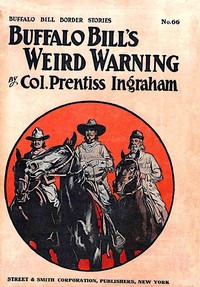
Buffalo Bill's Weird Warning; Or, Dauntless Dell's Rival
Language: en524 downloads on Project Gutenberg
Subjects
Public-domain ebook sourced from Project Gutenberg #64613.
Public-domain ebook
Language: en524 downloads on Project Gutenberg
Subjects
Public-domain ebook sourced from Project Gutenberg #64613.
The opening · free to read
(BUFFALO BILL).
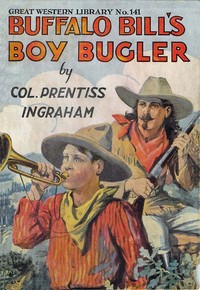
It is now some generations since Josh Billings, Ned Buntline, and Colonel Prentiss Ingraham, intimate friends of Colonel William F. Cody, used to forgather in the office of Francis S. Smith, then proprietor of the New York Weekly. It was a dingy little office on Rose Street, New York, but the breath of the great outdoors stirred there when these old-timers got together. As a result of these conversations, Colonel Ingraham and Ned Buntline began to write of the adventures of Buffalo Bill for Street & Smith.
Colonel Cody was born in Scott County, Iowa, February 26, 1846. Before he had reached his teens, his father, Isaac Cody, with his mother and two sisters, migrated to Kansas, which at that time was little more than a wilderness.
When the elder Cody was killed shortly afterward in the Kansas “Border War,” young Bill assumed the difficult rôle of family breadwinner. During 1860, and until the outbreak of the Civil War, Cody lived the arduous life of a pony-express rider. Cody volunteered his services as government scout and guide and served throughout the Civil War with Generals McNeil and A. J. Smith. He was a distinguished member of the Seventh Kansas Cavalry.
During the Civil War, while riding through the streets of St. Louis, Cody rescued a frightened schoolgirl from a band of annoyers. In true romantic style, Cody and Louisa Federci, the girl, were married March 6, 1866.
In 1867 Cody was employed to furnish a specified amount of buffalo meat to the construction men at work on the Kansas Pacific Railroad. It was in this period that he received the sobriquet “Buffalo Bill.”
In 1868 and for four years thereafter Colonel Cody served as scout and guide in campaigns against the Sioux and Cheyenne Indians. It was General Sheridan who conferred on Cody the honor of chief of scouts of the command.
After completing a period of service in the Nebraska legislature, Cody joined the Fifth Cavalry in 1876, and was again appointed chief of scouts.
Colonel Cody’s fame had reached the East long before, and a great many New Yorkers went out to see him and join in his buffalo hunts, including such men as August Belmont, James Gordon Bennett, Anson Stager, and J. G. Heckscher. In entertaining these visitors at Fort McPherson, Cody was accustomed to arrange wild-West exhibitions. In return his friends invited him to visit New York. It was upon seeing his first play in the metropolis that Cody conceived the idea of going into the show business.
Assisted by Ned Buntline, novelist, and Colonel Ingraham, he started his “Wild West” show, which later developed and expanded into “A Congress of the Rough Riders of the World,” first presented at Omaha, Nebraska. In time it became a familiar yearly entertainment in the great cities of this country and Europe. Many famous personages attended the performances, and became his warm friends, including Mr. Gladstone, the Marquis of Lorne, King Edward, Queen Victoria, and the Prince of Wales, now King of England.
At the outbreak of the Sioux, in 1890 and 1891, Colonel Cody served at the head of the Nebraska National Guard. In 1895 Cody took up the development of Wyoming Valley by introducing irrigation. Not long afterward he became judge advocate general of the Wyoming National Guard.
Colonel Cody (Buffalo Bill) died in Denver, Colorado, on January 10, 1917. His legacy to a grateful world was a large share in the development of the West, and a multitude of achievements in horsemanship, marksmanship, and endurance that will live for ages. His life will continue to be a leading example of the manliness, courage, and devotion to duty that belonged to a picturesque phase of American life now passed, like the great patriot whose career it typified, into the Great Beyond.
BUFFALO BILL’S WEIRD WARNING.
Two horsemen were riding along a bleak, desolate-looking cañon, on route to the mining-camp known as Sun Dance. One was a white man, and the other an Indian. The white rider was William Hickok, of Laramie, better known as “Wild Bill,” and his companion was a Ponca warrior.
Both Wild Bill and Crawling Bear had keen ears, and the muffled report of the rifle came to them distinctly--not from right or left, from ahead or behind, or above, but seemingly from the ground under their horses’ hoofs.
Another report reached them, coming from the same place as the first, and Wild Bill, with a puzzled look, drew rein and rubbed his hand over his forehead.
“Am I locoed, or what?” he muttered. “It’s a trick of the echoes, I reckon. Somebody is having a little gun-play in this vicinity, and the bottom of the gulch picks up the sound and throws it back to us.”
The Indian made no response, although from his actions it seemed quite clear that he did not accept the white man’s explanation.
Wild Bill rode on, and a sharp turn in the cañon brought him upon something which led to a revision of his theory concerning the rifle-shots.
What he saw was an ore-dump, off at one side of the cañon. The mound of broken rocks was surmounted by a plank platform. Five horses were hitched to bushes, not far from the ore-dump, but their riders were not in evidence.
Wild Bill halted his horse, once more, and looked from the ore-dump to the horses, and then around the cañon. While his eyes were busy, there came a third rifle-shot.
“By gorry!” he exclaimed, and gave a low laugh. “This thing begins to clear up a little, Crawling Bear. There’s a mine here, and probably the mine has a drift running down the gulch. The shots we heard really came from under us, but they came from the bottom of the mine.”
“Ugh!” grunted the Ponca. “Why Yellow Eyes make um shoot in mine? No got um game in mine.”
“Now you’re shouting, my redskin friend. What there is to shoot at, in that mine, is a conundrum that your Uncle William is going to work out. Maybe there’s no game to shoot at down there, but there’s a game being pulled off that needs looking into.”
Wild Bill tossed his bridle-reins to the Ponca and slipped down from the saddle.
“You go down in mine, huh?” queried Crawling Bear.
“That’s my intention,” was the answer.
“Five ponies, five Yellow Eyes down in mine. Mebbyso Crawling Bear better go with Wild Bill.”
A smile curled about Wild Bill’s lips.
“Any old day the odds of five to one make me take a back seat,” said he, “I hope some friend will hand me a good one and tell me to wake up. I’m going to hide my hand, Crawling Bear. This is a case of find out what’s doing, and then make a get-away on the q. t.--in case I can’t help some unfortunate in distress. You look out for the horses; and, if I can’t take care of myself, then I’m ready to be planted, for it will be high time.”
With that, Wild Bill stepped to the foot of the ore-dump and climbed carefully to the plank platform.
An empty ox-hide bucket stood on the platform, off to one side, but there was no windlass for hoisting the bucket, and there did not seem to be any ladders for getting down into the shaft. All this contributed still further to Wild Bill’s perplexity, and at the same time increased his determination to investigate.
But, if there were no ladders for getting into the mine, there was a rope. The upper end of the rope was made fast to the edge of the opening in the middle of the platform.
The Laramie man peered down into the shaft. The blackness was intense, and he could see nothing, not even the gleam of a candle.
“Can’t tell whether the shaft is fifty feet deep or five hundred,” he muttered, “but it’s a cinch that none of the men who came here on those five horses are anywheres around the foot of the shaft. If they were, they’d jump a piece of lead at me. With my head over the hole, like this, I’m a good target. Now to go down.”
For an instant Wild Bill sat on the platform, his feet dangling over the abyss; then, slowly letting himself down, he grabbed the rope and began to slide.
The shooting continued, the echoes booming louder in Wild Bill’s ears and increasing his curiosity. Wild Bill was down fifty feet before he touched bottom. The shaft was not so deep, after all.
Leaving the lower end of the rope, he groped his way around the shaft wall until he found the opening of the level. In traversing the level, he dropped to his hands and knees, and crawled.
The level crooked to right and left, and, after Wild Bill had covered something like fifty feet of it, he began to hear voices, and to see a glow of light in the distance.
Pushing his head and shoulders around a turn, he suddenly beheld a queer scene, right at the end of the level.
The book keeps going
Reading is free forever. Sign up and watch scenes appear while you read.



Scenes Storieta drew for other classics.
New illustrated classics
Once or twice a month: the latest books to get full character casts, scene art, and free comic editions. No account needed.