Public-domain ebook
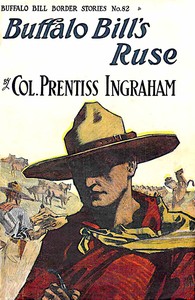
Buffalo Bill's Ruse; Or, Won by Sheer Nerve
Language: en493 downloads on Project Gutenberg
Subjects
In: Crime, Thrillers and Mystery·Adventure·Novels
Public-domain ebook sourced from Project Gutenberg #64664.
Public-domain ebook
Language: en493 downloads on Project Gutenberg
Subjects
In: Crime, Thrillers and Mystery·Adventure·Novels
Public-domain ebook sourced from Project Gutenberg #64664.
The opening · free to read
(BUFFALO BILL).
It is now some generations since Josh Billings, Ned Buntline, and Colonel Prentiss Ingraham, intimate friends of Colonel William F. Cody, used to forgather in the office of Francis S. Smith, then proprietor of the New York Weekly. It was a dingy little office on Rose Street, New York, but the breath of the great outdoors stirred there when these old-timers got together. As a result of these conversations, Colonel Ingraham and Ned Buntline began to write of the adventures of Buffalo Bill for Street & Smith.
Colonel Cody was born in Scott County, Iowa, February 26, 1846. Before he had reached his teens, his father, Isaac Cody, with his mother and two sisters, migrated to Kansas, which at that time was little more than a wilderness.
When the elder Cody was killed shortly afterward in the Kansas “Border War,” young Bill assumed the difficult rôle of family breadwinner. During 1860, and until the outbreak of the Civil War, Cody lived the arduous life of a pony-express rider. Cody volunteered his services as government scout and guide and served throughout the Civil War with Generals McNeil and A. J. Smith. He was a distinguished member of the Seventh Kansas Cavalry.
During the Civil War, while riding through the streets of St. Louis, Cody rescued a frightened schoolgirl from a band of annoyers. In true romantic style, Cody and Louisa Federci, the girl, were married March 6, 1866.
In 1867 Cody was employed to furnish a specified amount of buffalo meat to the construction men at work on the Kansas Pacific Railroad. It was in this period that he received the sobriquet “Buffalo Bill.”
In 1868 and for four years thereafter Colonel Cody served as scout and guide in campaigns against the Sioux and Cheyenne Indians. It was General Sheridan who conferred on Cody the honor of chief of scouts of the command.
After completing a period of service in the Nebraska legislature, Cody joined the Fifth Cavalry in 1876, and was again appointed chief of scouts.
Colonel Cody’s fame had reached the East long before, and a great many New Yorkers went out to see him and join in his buffalo hunts, including such men as August Belmont, James Gordon Bennett, Anson Stager, and J. G. Heckscher. In entertaining these visitors at Fort McPherson, Cody was accustomed to arrange wild-West exhibitions. In return his friends invited him to visit New York. It was upon seeing his first play in the metropolis that Cody conceived the idea of going into the show business.
Assisted by Ned Buntline, novelist, and Colonel Ingraham, he started his “Wild West” show, which later developed and expanded into “A Congress of the Rough Riders of the World,” first presented at Omaha, Nebraska. In time it became a familiar yearly entertainment in the great cities of this country and Europe. Many famous personages attended the performances, and became his warm friends, including Mr. Gladstone, the Marquis of Lorne, King Edward, Queen Victoria, and the Prince of Wales, now King of England.
At the outbreak of the Sioux, in 1890 and 1891, Colonel Cody served at the head of the Nebraska National Guard. In 1895 Cody took up the development of Wyoming Valley by introducing irrigation. Not long afterward he became judge advocate general of the Wyoming National Guard.
Colonel Cody (Buffalo Bill) died in Denver, Colorado, on January 10, 1917. His legacy to a grateful world was a large share in the development of the West, and a multitude of achievements in horsemanship, marksmanship, and endurance that will live for ages. His life will continue to be a leading example of the manliness, courage, and devotion to duty that belonged to a picturesque phase of American life now passed, like the great patriot whose career it typified, into the Great Beyond.
BUFFALO BILL’S RUSE.
The ungainly female who came roaring into Eldorado in search of the husband who “run away” from her contrived to draw a crowd about her in a remarkably short time.
“I’m Pizen Kate, from Kansas City!” she yelled. “Git out of my way, er I’ll jab yer eye out with my umbreller. I’m lookin’ fer my husband, and you ain’t him. Think I’d take up with a weasel-faced, bow-legged speciment like you? Not on your tintype. I wouldn’t! So, git out o’ my way!”
The man had tried to “chaff” her and had roused her ire, but he fell back before the angry jabs of her “umbreller.”
She looked about, glaring.
She was “homely as sin.” Her features were not only irregular; they were twisted, gnarled, and seamed. A few thin hairs of an attempted beard floated from a mole on her chin, and on her upper lip there was a faint trace of a mustache. She was dressed in a soiled cotton garment, and on her head was a shapeless hat, with a faded red rose for ornament. In her muscular right hand she flourished an ancient umbrella.
“I heard my husband had come here, and I’m lookin’ fer him,” she declared. “He run away from me in Kansas City, and I set out to foller him; and I’ll foller him to the end o’ the earth but that I git him.”
“I’m bettin’ on you, all right!” called out some irreverent individual.
She fixed him with a glassy stare.
“Was I ’specially directin’ my langwidge to you?” she demanded. “I hate to hear a horse bray out that way. It’s sickenin’.”
“And I hate to hear the blather of a nanny goat!”
She lifted her umbrella.
“Say that ag’in, you red-headed son of a scarecrow, and I’ll ram this umbreller down yer neck and open it up inside of ye! I’d have you know that I’m a lady, and don’t allow no back talk.”
“What kind o’ lookin’ feller is your husband?” another asked.
“Well, he’s better-lookin’ than them that slanders him, if he is little and runty! He’s a small man, slim as a blacksnake, and wiry as a watch spring, and he’s a bit oldish. He was in this town less’n a week ago.”
“Kate, I reckon we ain’t met up with him.”
“Wot’s his name?” said another.
“What’s that got to do with it, if ye ain’t seen him?” she demanded.
She fixed her eyes on a man who had, a moment before, descended the steps of the Golconda Hotel, and who came now toward the crowd that hedged her in.
The man was Buffalo Bill; handsome, muscular, dressed in his border costume, and towering a full head over the other men in the street.
“That’s him, I reckon, Katie--there comes yer husband, I’m bettin’. You said he was little and runty, slim as a blacksnake, and wiry as a watch spring. I guess you hit his trail here, all right.”
It was the sort of humor this crowd could understand, and they roared hilariously.
Pizen Kate ignored them with fine scorn, and moved toward the great scout, the men falling back before her jabbing umbrella and giving her ample room. She pranced thus up in front of Buffalo Bill, and stood eying him, umbrella in one hand and the other hand on her hip.
“I think I seen you onct,” she announced, as the scout politely lifted his big hat to her.
“Possibly,” he said, smiling.
“You’re Persimmon Pete, the gazeboo what run away with my old man.”
The crowd snickered, and then roared again.
“Hardly,” said Buffalo Bill.
The book keeps going
Reading is free forever. Sign up and watch scenes appear while you read.



Scenes Storieta drew for other classics.
New illustrated classics
Once or twice a month: the latest books to get full character casts, scene art, and free comic editions. No account needed.