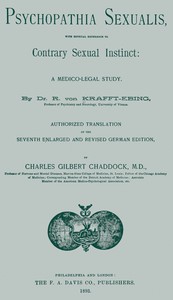
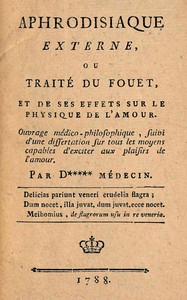
What Schopenhauer and, after him, the Philosopher of the Unconscious, E. v. Hartmann, philosophized concerning the sexual relations is so imperfect, and in its consequences so distasteful, that, aside from the treatment in the works of Michelet (“L’amour”) and Mantegazza (“Physiology of Love”), which are to be considered more as brilliant discussions than as scientific treatises, the empirical psychology and metaphysics of the sexual side of human existence rest upon a foundation which is scientifically almost puerile.
The poets may be better psychologists than the psychologists and philosophers; but they are men of feeling rather than of understanding, and at least one-sided in their consideration of the subject. They cannot see the deep shadow behind the light and sunny warmth of that from which they draw their inspiration. The poetry of all times and nations would furnish inexhaustible material for a monograph on the psychology of love; but the great problem can be solved only with the help of Science, and especially with the aid of Medicine, which studies the psychological subject at its anatomical and physiological source, and views it from all sides.
Perhaps it will be possible for medical science to gain a stand-point of philosophical knowledge midway between the despairing views of philosophers like Schopenhauer and Hartmann[2] and the gay, näive views of the poets.
It is not the intention of the author to lay the foundation of a psychology of the sexual life, though without doubt psychopathology would furnish many important sources of knowledge to psychology.
The purpose of this treatise is a description of the pathological manifestations of the sexual life and an attempt to refer them to their underlying conditions. The task is a difficult one, and, in spite of years of experience as alienist and medical jurist, I am well aware that what I can offer must be incomplete.
The importance of the subject for the welfare of society, especially forensically, demands, however, that it should be examined scientifically. Only he who, as a medico-legal expert, has been in a position where he has been compelled to pass judgment upon his fellow-men, where life, freedom, and honor were at stake, and realized painfully the incompleteness of our knowledge concerning the pathology of the sexual life, can fully understand the significance of an attempt to gain definite views concerning it.
Even at the present time, in the domain of sexual criminality, the most erroneous opinions are expressed and the most unjust sentences pronounced, influencing laws and public opinion.
He who makes the psychopathology of sexual life the object of scientific study sees himself placed on a dark side of human life and misery, in the shadows of which the godlike creations of the poet become hideous masks, and morals and æsthetics seem out of place in the “image of God.”
It is the sad province of Medicine, and especially of Psychiatry, to constantly regard the reverse side of life,—human weakness and misery.
Perhaps in this difficult calling some consolation may be gained, and extended to the moralist, if it be possible to refer to morbid conditions much that offends ethical and æsthetic feeling. Thus Medicine undertakes to save the honor of mankind before the Court of Morality, and individuals from judges and their fellow-men. The duty and right of medical science in these studies belong to it by reason of the high aim of all human inquiry after truth.
The author would take to himself the words of Tardieu (“Des attentats aux moeurs”): “Aucune misère physique ou morale, aucune plaie, quelque corrompue qu’elle soit, ne doit effrayer celui qui s’est voué a la science de l’homme et le ministère sacré du médecin, en l’obligeant à tout voir, lui permet aussi de tout dire.”[3]
The following pages are addressed to earnest investigators in the domain of natural science and jurisprudence. In order that unqualified persons should not become readers, the author saw himself compelled to choose a title understood only by the learned, and also, where possible, to express himself in terminis technicis. It seemed necessary also to give certain particularly revolting portions in Latin[4] rather than in German.
It is hoped that this attempt to present to physician and jurist facts from an important sphere of life will receive kindly acceptance and fill an actual hiatus in literature; for, with the exception of certain single descriptions and cases, the literature presents only the writings of Moreau and Tarnowsky, which cover but a portion of the field.[5]
TRANSLATOR’S PREFACE.
The distinguished author of “Psychopathia Sexualis” speaks for himself and his work in its preface; but there are not wanting others to speak for him.
Dr. A. von Schrenck-Notzing, of Munich, writes[6]:—
“It may be questioned whether it is justifiable to discuss the anomalies of the sexual instinct apart, instead of treating of them in their proper place in psychiatry. As a rule, they are certainly only symptoms of a constitutional malady, or of a weakened state of the brain, which manifest themselves in the various forms of sexual perversion.
“Moreover, attention has been directed to the baneful influence possibly exerted by such publications as ‘Psychopathia Sexualis.’ To be sure, the appearance of seven editions of that work could not be accounted for were its circulation confined to scientific readers. Therefore, it cannot be denied that a pornographic interest on the part of the public is accountable for a part of the wide circulation of the book. But, in spite of this disadvantage, the injury done by implanting knowledge of sexual pathology in unqualified persons is not to be compared with the good accomplished. History shows that uranism was very wide-spread long before the appearance of ‘Psychopathia Sexualis.’ The courts have constantly to deal with sexual crimes in which the responsibility of the accused comes in question.
“For the physician himself, sexual anomalies, treated as they are in a distant manner in text-books on psychiatry, are in greater part a terra incognita. Exact knowledge of the causes and conditions of development of sexual aberrations, and of the influence on them of hereditary constitution, education, the impressions of every-day life, and modern refined civilization, is the prerequisite for a rational prophylaxis of sexual aberrations, and for a correct sexual education. Without careful study of the circumstances which attend the development of sexual anomalies, we should never be in a position to use effectual therapeusis. The majority of these unfortunates—Krafft-Ebing calls them Nature’s step-children—are devoid of insight into their malady; like insane patients destitute of understanding of the ethical development of man, they are happy in their abnormal instinctive tendency. For this reason, in spite of the great prevalence of uranism, very few of its subjects seek medical treatment. While the terminal forms of sexual aberrations end in asylums for the insane, the doubtful cases, in which incompleteness of development or apparent viciousness render correct diagnosis difficult, make up the majority. But a thorough knowledge of the aberrations of the sexual instinct is absolutely indispensable to the jurist. The reasons given are thus sufficiently important to demonstrate the need of a hand-book on ‘psychopathia sexualis.’”
These words also hold true for English-speaking physicians and jurists,—who can scarcely fail to welcome the translation of a work so systematic and comprehensive as “Psychopathia Sexualis”; a work conceived and executed in the highest scientific and humane spirit; a work which not only broadens and systematizes our knowledge of psycho-sexual phenomena, but also demonstrates, in the results of hypnotic suggestion, how important mental therapeusis must ultimately become in the hands of the physician; a work which is a trustworthy guide in the study of the concrete case of sexual crime, and a philosophical treatise on the inter-relations of sexual criminality, disease, and criminal anthropology.
The difficulties of translation have not been slight; but minor errors cannot destroy the author’s meaning.
For much encouragement in the work of translation my gratitude to Dr. James G. Kiernan and Dr. G. Frank Lydston, of Chicago, both well-known investigators in this domain of psychopathology, is here expressed; and to Dr. William A. Stone, Assistant Superintendent at the Michigan Asylum, Kalamazoo, I am greatly indebted for assistance in the preparation of the manuscript.
CHARLES GILBERT CHADDOCK.
ST. LOUIS, MO., November, 1892.
TABLE OF CONTENTS.
PAGE I. FRAGMENT OF A PSYCHOLOGY OF THE SEXUAL LIFE, 1