Public-domain ebook
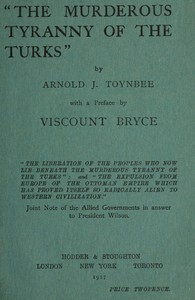
"The Murderous Tyranny of the Turks"
Language: en502 downloads on Project Gutenberg
Subjects
In: History - Other·History - European·History - Modern (1750+)
Public-domain ebook sourced from Project Gutenberg #65248.
Public-domain ebook
Language: en502 downloads on Project Gutenberg
Subjects
In: History - Other·History - European·History - Modern (1750+)
Public-domain ebook sourced from Project Gutenberg #65248.
The opening · free to read
“Let the Turks now carry away their abuses in the only possible manner, namely, by carrying away themselves. Their Zaptiehs and their Mudirs, their Bimbashis and their Yuzbashis, their Kaimakams and their Pashas, one and all, bag and baggage, shall I hope clear out from the province they have desolated and profaned.”
GLADSTONE.
“A near future will, it is to be hoped, blot out the scandal that such heathendom should ever have established itself on European soil. What has this Turkish Empire done in three entire centuries? It has done nothing but destroy.”
TREITSCHKE.
PREFACE.
No one who has studied the history of the Near East for the last five centuries will be surprised that the Allied Powers have declared their purpose to put an end to the rule of the Turk in Europe, and still less will he dissent from their determination to deliver the Christian population of what is called the Turkish Empire, whether in Asia or in Europe, from a Government which during those five centuries has done nothing but oppress them. These changes are indeed long overdue. They ought to have come more than a century ago, because it had then already become manifest that the Turk was hopelessly unfit to govern, with any approach to justice, subject races of a different religion. The Turk has never been of any use for any purpose except fighting. He cannot administer, though in his earlier days he had the sense to employ intelligent Christian administrators. He cannot secure justice. As a governing power, he has always shown himself incapable, corrupt and cruel. He has always destroyed; he has never created.
Those whom we call the Turks are not a nation at all in the proper sense of the word. The Ottoman Turks were a small conquering tribe from Central Asia, ruled during the first two centuries of their conquests by a succession of singularly able and unscrupulous Sultans, who subjugated the Christian populations of Asia Minor and South-Eastern Europe, compelling part of these populations to embrace Mohammedanism, and supporting their own power by seizing the children of the rest, forcibly converting them to Islam, and making out of them an efficient standing army, the Janizaries, by whose valour and discipline the Turkish wars of conquest were carried on from early in the fifteenth down into the nineteenth century. As a famous English historian wrote, the Turks are nothing but a robber band, encamped in the countries they have desolated. As Edmund Burke wrote, the Turks are savages, with whom no civilised Christian nation ought to form any alliance.
Turkish rule ought to be ended in Europe, because, even in that small part of it which the Sultan still holds, it is an alien power, which has in that region been, and is now, oppressing or massacring, slaughtering or driving from their homes, the Christian population of Greek or Bulgarian stock. It ought to be turned out of the western coast regions of Asia Minor for a like reason. The people there are largely, perhaps mostly, Greek-speaking Christians. So ought it to be turned out of Constantinople, a city of incomparable commercial and political importance, with the guardianship of which it is unfit to be trusted. So ought it to be turned out of Armenia and Cilicia, and Syria, where within the last two years it has been destroying its Christian subjects, the most peaceful and industrious and intelligent part of the population.
If a Turkish Sultanate is to be left in being at all, it may, with least injury to the world, be suffered to exist in Central and Northern Asia Minor, where the population is mainly Mussulman, and there are comparatively few Christians—and those only in the cities—to suffer from its misgovernment. Even there one would be sorry for its subjects, Mussulman as well as Christian, but a weak Turkish State, such as it would then be, could not venture on the crimes of which it has been guilty when it was comparatively strong.
That the faults of Turkish government are incurable, has been most clearly shown by the fact that the Young Turkish gang who gained power when they had deposed Abd-ul-Hamid, have surpassed even that monster of cruelty in their slaughter of the unoffending Armenians. The “Committee of Union and Progress” began by promising equal rights to all races and faiths. This was “Union.” It proceeded forthwith not only to expel the Greek-speaking inhabitants of Western Asia Minor, and to exterminate the Armenians, but to attempt to Turkify the Albanians (Muslims as well as Christians) and to proscribe their language. This is what “Union” has in fact meant. What “Progress” has meant in the hands of ruffians like Enver and Talaat, Prussianised Muslims worse than the old Turkish pashas, we have all seen within the last three years. The Muslim peasant of Asia Minor is an honest, kindly fellow when not roused by fanaticism, but the Turk, as a Governing Power, is irreclaimable, and the Allied Powers would have been false to all the principles of Right and Humanity for which they are fighting if they had not proclaimed that no Turkish Government shall hereafter be permitted to tyrannize over subjects of another faith.
BRYCE.
“THE MURDEROUS TYRANNY OF THE TURKS.”
THE AIMS OF THE ALLIES.
President Wilson, in his note to all the belligerent governments, called upon both parties to state in the full light of day the aims they have set themselves in prosecuting the War. The Allied Nations, in their joint response made public on January 11th, 1917, explain that they find no difficulty in meeting this request, and make good their words by stating a series of definite conditions. Among them are:—
“_The liberation of the peoples who now lie beneath the murderous tyranny of the Turks; and_
“_The expulsion from Europe of the Ottoman Empire, which has proved itself so radically alien to Western Civilisation._”
The plan of the Allies for the settlement of Turkey is thus communicated to the world without reserve, and it is worth examining what it involves, and why it is right.
THE SUBJECT PEOPLES OF TURKEY.
Who are the peoples in Turkey whom the Allies are determined to liberate? The Ottoman Empire contains somewhat more than 20,000,000 inhabitants, and of these only about 8,000,000—less than 40 per cent. of the whole—are Turks.[1] There are 7,000,000 Arabs; there are 2,000,000 Armenians (or, rather, there were, before the atrocities of 1915); the Greeks, too, number little short of 2,000,000, and there are probably the same number of non-Turkish mountaineers—Kurds, Nestorians, Druses, Maronites and so on. The non-Turkish peoples thus amount to more than 60 per cent. of the population of Turkey. They were all of them settled in the country before the Turks arrived—the Turks conquered Asia Minor about the time the Normans conquered England, while several of the conquered races have lived there from time immemorial—and all these races have been at their lowest ebb since and so long as they have been under Turkish Government.
The Greeks were leaders of civilisation in the Ancient World and in the Middle Ages, till the Greek Empire of Constantinople was conquered by the Turks in 1453. From that moment they dropped out till the War of Liberation, a century ago, restored part of the Greek nation to independence. The Greeks who have remained under Turkish government have also remained cut off from Greek national life.
The Armenians were the first people to make Christianity their national religion. They are an intellectual people, clever and industrious in practical affairs and in the life of the spirit. When they possessed an independent kingdom they produced a fine literature and architecture, which Turkish conquest destroyed. Since then the Turks have repressed all symptoms of Armenian revival by massacres, the most terrible of which was perpetrated last year.
The Arabs created a wonderful civilisation at the time when Medieval Europe was in its darkest age. Their discoveries in mathematics, astronomy, chemistry, medicine, are the foundations of modern science, as is witnessed by the Arabic words in our scientific vocabulary. This Arabic civilisation was swamped by the Turkish migrations from Central Asia in the 11th century, and blotted out by the Mongols, who followed in the wake of the Turks and sacked Baghdad, the Arab capital, in the 13th century. The Arabs are still the most progressive race in the Islamic world; they are almost as numerous as the Turks in the population of the Ottoman Empire, and they are not divided from the Turks by difference of religion. Yet the Turkish government excludes them from all share of control, and has thwarted their revival as persistently as it has thwarted that of the Armenians and Greeks. They too have been massacred and exiled during the present War.
The Kurds, also, were there before the Turks, but they have not the same tradition as the other three races behind them. In their case the Turks have not destroyed an existing civilisation, but have prevented them acquiring civilisation when they showed inclination to do so. The Kurd has been a lawless mountain shepherd for many centuries, but he becomes a hard-working, peaceable cultivator when he comes down into the plains. The Turkish government deliberately checked this tendency, which began to show itself in the Kurds about half a century ago, by serving out arms to them and licensing them to harry their Armenian neighbours.
THE MURDEROUS TYRANNY OF THE TURKS: THE FIRST STAGE.
This maiming and warping of more gifted peoples is in itself a capital indictment of Turkish domination, but the wrong is made infinitely worse by the outrageous methods by which it has been carried out. These methods are justly described as a “_murderous tyranny_” in the Allies’ Response to President Wilson’s question.
There are three stages in the history of Ottoman tyranny, and the worst stage is the present. The Ottoman State has been a purely military State from beginning to end. Osman, its founder, from whom the Osmanli Turks take their name, was the hereditary chief of a wandering band of Turkish freebooters from Central Asia, whose father was licensed by Turkish Sultans already established in Asia Minor to carve out a principality for himself at the expense of the neighbouring Christians, just as the Teutonic knights carved out the principality of Prussia at the expense of the original native population. This Ottoman dominion, which started thus in the 13th century with a few square miles of territory in North-Western Asia Minor, expanded during the next three hundred years till it stretched from within a few miles of Vienna to Mecca and Baghdad. It destroyed the Ancient Empire of Constantinople, which had preserved Greek learning during the Middle Ages; the free Christian kingdoms of Bulgaria, Serbia, Bosnia, Wallachia, Moldavia and Hungary; and the independent Moslem states of Western Asia. Such a career of destructive conquest was a disaster to civilisation, and it was only made possible by a ruthless militarism.
The book keeps going
Reading is free forever. Sign up and watch scenes appear while you read.



Scenes Storieta drew for other classics.
New illustrated classics
Once or twice a month: the latest books to get full character casts, scene art, and free comic editions. No account needed.