The opening · free to read
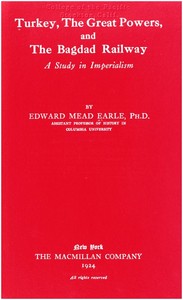
The Chester concessions and the Anglo-American controversy regarding the Mesopotamian oilfields are but two conspicuous instances of the rapid development of American activity in the Near East. Turkey, already an important market for American goods, gives promise of becoming a valuable source of raw materials for American factories and a fertile field for the investment of American capital. Thus American religious interests in the Holy Land, American educational interests in Anatolia and Syria, and American humanitarian interests in Armenia, are now supplemented by substantial American economic interests in the natural resources of Asia Minor. Political stability and economic progress in Turkey no longer are matters of indifference to business men and politicians in the United States; therefore the Eastern Question—so often a cause of war—assumes a new importance to Americans. This book will have served a useful purpose if—in discussing the conflicting political, cultural, and economic policies of the Great Powers in the Near East during the past three decades—it contributes to a sympathetic understanding of a very complicated problem and suggests to the reader some dangers which American statesmanship would do well to avoid. Students of history and international relations will find in the story of the Bagdad Railway a laboratory full of rich materials for an analysis of modern economic imperialism and its far-reaching consequences.
The assistance of many persons who have been intimately associated with the Bagdad Railway has enabled the author to examine records and documents not heretofore available to the historian. To these persons the author is glad to assign a large measure of any credit which may accrue to this book as an authoritative and definitive account of German railway enterprises in the Near East. He wishes especially to mention: Dr. Arthur von Gwinner, of the Deutsche Bank, president of the Anatolian and Bagdad Railway Companies; Dr. Karl Helfferich, formerly Imperial German Minister of Finance, erstwhile managing director of the Deutsche Bank, and at present a member of the Reichstag; Sir Henry Babington Smith, an associate of the late Sir Ernest Cassel, a director of the Bank of England, president of the National Bank of Turkey, and at one time representative of the British bondholders on the Ottoman Public Debt Administration; Djavid Bey, Ottoman Minister of Finance during the régime of the Young Turks, an economic expert at the first Lausanne Conference, and at present Turkish representative on the Ottoman Public Debt Administration; Mr. Ernest Rechnitzer, a banker of Paris and London, a competitor for the Bagdad Railway concession in 1898–1899; Rear Admiral Colby M. Chester, of the United States Navy (retired), beneficiary of the “Chester concessions.”
Valuable assistance in the collection and preparation of material has been rendered, also, by the following persons, to whom the author expresses his grateful appreciation: Sir Charles P. Lucas, director, and Mr. Evans Lewin, librarian, of the Royal Colonial Institute; Sir John Cadman, director of His Majesty’s Petroleum Department; Professor George Young, of the University of London, formerly attaché of the British embassy at Constantinople; Mr. Charles V. Sheehan, sub-manager in London of the National City Bank of New York; Mr. M. Zekeria, chief of the Turkish Information Service in the United States; Mr. René A. Wormser, an American attorney who assisted the author in research work in Germany during the summer of 1922. Dr. Gottlieb Betz, of Columbia University, and Dr. John Mez, American correspondent of the Frankfurter Zeitung, have aided in the translation of important documents.
Professors Carlton J. H. Hayes and William R. Shepherd, of Columbia University, have been patient advisers and judicious critics of the author during the preparation of his manuscript. To them he owes much, as teachers who stimulated his interest in international relations, and as colleagues who cheerfully coöperate in any useful enterprise. Professor Parker Thomas Moon, of Columbia University, also has read the manuscript and offered many valuable suggestions.
The book keeps going
Keep reading, and see it illustrated
Reading is free forever. Sign up and watch scenes appear while you read.
Scenes Storieta drew for other classics.