Public-domain ebook
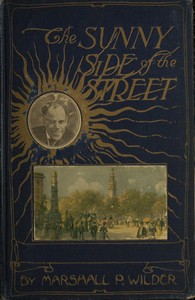
The Sunny Side of the Street
Language: en1,279 downloads on Project Gutenberg
Subjects
In: Humour·Biographies
Public-domain ebook sourced from Project Gutenberg #65520.
Public-domain ebook
Language: en1,279 downloads on Project Gutenberg
Subjects
In: Humour·Biographies
Public-domain ebook sourced from Project Gutenberg #65520.
Marshall P. Wilder’s The Sunny Side of the Street is a sprawling anthology of wit, anecdote, and personal reminiscence. The work opens with a lively inventory of performers, playwrights, and public figures, “Joe” Jefferson, W. S. Gilbert, Henry Irving, and the like, followed by a series of titled sketches that range from “Some Aspects of Philadelphia” to “The Art of Entertaining.” From the first page, the reader is invited into a scrapbook of humorous episodes, each anchored in the author’s own experiences as a diminutive entertainer who has “jested to millions of sovereigns.” The book’s structure is episodic rather than narrative, offering bite‑size vignettes that celebrate the power of a joke to disarm, amuse, and connect people across continents and classes.
The tone is conversational and self‑deprecating, marked by the brisk, colloquial cadence of a turn‑of‑the‑century raconteur. Wilder’s prose mixes swaggering confidence with modesty, often slipping into witty asides and playful exaggerations that reflect the theatrical milieu of the late 1800s. Readers who enjoy the lively banter of Mark Twain, the backstage gossip of theatrical memoirs, or any collection that revels in the quirks of famous personalities will find this book a rewarding diversion.
The opening · free to read
All of Them Full of Humor at All Times.—“Joe” Jefferson.—J. K. Emmett.—Fay Templeton.—Willie Collier.—An Actor’s Portrait on a Church Wall.—“Gus” Thomas, the Playwright.—Stuart Robson.—Henry Dixey.—Evans and Hoey.—Charles Hoyt.—Wilson Barrett.—W. S. Gilbert.—Henry Irving.
Actors are the most incessant jokers alive. Whether rich or poor, obscure or prominent, drunk or sober, prosperous or not knowing where the next meal is to come from, or whether there will be any next meal, they have always something funny at the tips of their tongues, and managers and dramatic authors as a rule are full of humorous explosives that clear the dull air and let in the sunshine. They are masters at repartee, yet as willing to turn a joke on themselves as on one another, and they can work a pun most brilliantly.
Joseph Jefferson one day called on President Cleveland with General Sherman, and carried a small package with him. All his friends know that dear old “Joe” is forgetful, so when the visitors were going the general called attention to the package and asked: “Jefferson, isn’t this yours?”
“Great Cæsar, Sherman,” Jefferson replied, “you have saved my life!” The “life” referred to was the manuscript of his then uncompleted biography. Jefferson delights in telling of a new playmate of one of his sons, who asked another boy who young Jefferson was, and was told:
“Oh, his father works in a theatre somewhere.”
“Pete” Dailey, while enjoying a short vacation, visited a New York theatre when business was dull. Being asked afterward how large the audience was, he replied: “I could lick all three of them.”
On meeting a friend who was “fleshing up,” he exclaimed: “You are getting so stout that I thought some one was with you.”
J. K. Emmett tells of a heathenish old farmer and his wife who strayed into a church and heard the minister say: “Jesus died for sinners.” The old man nudged his wife, and whispered:
“Serves us right for not knowin’ it, Marthey. We hain’t took a newspaper in thirty year.”
Fay Templeton tells of a colored girl, whose mother shouted: “Mandy, your heel’s on fire!” and the girl replied: “Which one, mother?” The girl was so untruthful that her discouraged mother said: “When you die, dey’s going to say: ‘Here lies Mandy Hopkins, and de trufe never came out of her when she was alive.’”
I have been the subject of some actors’ jokes, and enjoyed the fun as much as any one. May Irwin had two sons, who early in life were susceptible to the seductive cigarette, against which she cautioned them earnestly. I entered a restaurant one day where she and her sons were dining, and she called me over and gave me an opportunity to become acquainted with the little fellows. After I left them, one turned to his mother and asked:
“What makes that little man so short?”
“Smoking cigarettes,” she replied. And they never smoked again.
Willie Collier invited me one summer to his beautiful home at St. James, Long Island. He was out when I arrived, and when he returned, Mrs. Collier said to him:
“You’re going to have Marshall P. Wilder for dinner,” and Willie replied:
“I’d rather have lamb.”
There is a colony of theatrical people near Collier, and they have a small theatre in which a dazzling array of talent sometimes appears, although the performances are impromptu affairs. On Sundays this theatre serves as a church for the Catholics of the vicinity. At one side hangs a large lithograph of Willie Collier, concerning which the following conversation between the two Irishmen was overheard:
“I wint into the church this mornin’ airly, while it was pretty dark, an’ I see a picture hanging there, an’ thinkin’ it must be one av the saints I wint down on me knees an’ said me prayers before it. When I opened me eyes they’d got used to the dark, an’ if I didn’t see it was a picture av that actor-man beyant that they call Willie Collier!”
“An’ what did’ you do?” asked the other Irishman.
“Sure, I tuk’ back as much av me prayers as I cud.”
Augustus Thomas, the playwright, who is always “Gus” except on the back of an envelop or the bottom of his own check, was chairman of a Lambs’ Club dinner at which I was to speak. When I began, he joked me on my shortness by saying:
“Mr. Wilder will please rise when making a speech.”
I was able to retort by saying: “I will; but you won’t believe it.”
When an acquaintance said to him after being wearied by a play: “That was the slowest performance I ever saw. Strange, too, for it had a run of a hundred nights in London!” Thomas replied:
“That’s the trouble. It’s exhausted its speed.”
He was standing behind the scenes one night with Miss Georgia Busbey, who while waiting for her cue, said: “Tell me a story, Mr. Thomas, before I go on.”
“It must be a quick witty one then, Miss Busbey.”
“I know it, but I’ve come to the right place for it.”
Stuart Robson was present at a Lambs’ Club dinner of which Mr. Thomas was chairman; but he endeavored to hide when called on for a speech. Thousands of successful appearances on the stage never cured him of his constitutional bashfulness.
Thomas said: “Is Mr. Robson here? If he has not gone, we should like to hear from him.”
Robson said: “Mr. Thomas, will you kindly consider that I have gone?”
Thomas replied: “While the drama lasts, Mr. Robson can never go.”
Robson had been a close neighbor and friend for many years to Lawrence Barrett. His bosom friend Marshall Lewis fell in love with Barrett’s charming daughter Millie, and Robson pretended to think it was the greatest joke in the world.
“Why don’t you go in, and win and marry her, Marshall?” he used to say in the squeaky voice which was not for the stage alone. “I’ll tell you what I’ll do—the day you marry Millie Barrett I’ll give you five thousand dollars.”
This went on for some time, until to Robson’s astonishment and chagrin Miss Barrett accepted Lewis.
By the way, when Barrett learned of it he exclaimed: “My dear boy, you don’t know what you’re doing. You are robbing me out of my only remaining daughter.”
“Not at all,” Lewis replied, with a slap on the back of his father-in-law elect. “I’m merely giving you another son.”
When the marriage day came Robson did not attend the ceremony; but he sent his daughter Alicia in his place, and gave her a check for five thousand dollars, drawn to Lewis’ order, but with emphatic orders not to part from it until Lewis and Miss Barrett were pronounced man and wife. When Alicia returned her father asked her if she had given Lewis the check.
The girl replied: “Yes, father.”
“What did he do and say?” Robson inquired impatiently.
The book keeps going
Reading is free forever. Sign up and watch scenes appear while you read.



Scenes Storieta drew for other classics.
New illustrated classics
Once or twice a month: the latest books to get full character casts, scene art, and free comic editions. No account needed.