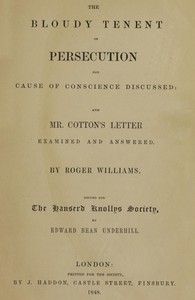
They were not, however, destitute of learning. Most of the early Baptists had had an university education: and if this privilege was not enjoyed by their successors, it was because the national seats of learning denied it to them. The names of Bampfield, Canne, Cornwell, Danvers, Delaune, Du Veil, Denne, Grantham, Jessey, Knollys, Smyth, and Tombes, are sufficient to prove that the Baptist churches were not destitute of able and learned expounders of their sentiments, eminent for their attainments in both classical and divine knowledge.
The historical value of the works which it is proposed to reproduce, is very great. Their authors exercised no mean influence on the course of national affairs during the period of Cromwell’s protectorate, and they became in subsequent reigns, as they had been in times preceding the Commonwealth, the especial objects of ecclesiastical and political persecution. Some of the works which it is desired to publish will also embrace the period of the Reformation, and illustrate the sufferings endured, by the baptists of that eventful period, for conscience sake.
As theological writers they are characterized by fervour of spirit; deep study of the word of God; great facility of application of divine truths to passing events; a holy attachment to “the truth as it is in Jesus;” clear and pungent exhibitions of the word of life; an uncompromising adherence to the scriptures as the rule of doctrine, practice, and ecclesiastical organization and discipline; and finally, a fearless following of their convictions, derived from the divine oracles.
Works of this kind are also wanting for our congregational and family libraries. It is to be feared that too many of us are ignorant of our own history, and of the great and good men who lost all in the maintenance of our principles.
The series of proposed volumes will include the works of both General and Particular Baptists; Records and Manuscripts relating to the rise and progress of Baptist churches; Translations of such works as may illustrate the sufferings of the Baptists and the extension of their principles, together with such Documents as are to be found only in large historical collections, or may not yet have appeared in an accessible form. On the Baptismal controversy only those treatises will be given, which are of acknowledged worth or historic value. The whole will be accompanied with biographical notices of the authors, and with such notes and illustrations as may be essential to their completeness.
The publications will consist of works produced before the close of the seventeenth century. The following list comprises the names of some of the authors whose works are intended to form part of the series;—Bampfield, Blackwood, Bunyan, Canne, Collier, Collins, Cornwall, Danvers, Delaune, Denne, Du Veil, Drapes, Grantham, Griffith, Helwys, How, Jeffrey, Jessey, Keach, Kiffin, King, Knollys, Lawrence, Palmer, Powell, Pendarves, Smyth, Stennett, Tombes, Roger Williams, &c.
Terms of Subscription.
1. Every subscriber of ten shillings and sixpence annually will be entitled to one copy of every work issued during the year of his subscription. Two volumes at least will be published for the 10s. 6d.
2. Subscriptions will be considered due, in advance on the first of January of every year.
3. Ministers and Sunday Schools obtaining each ten subscribers annually, will be entitled to one copy of every work published in the year for which such subscriptions are paid.
4. Books will be delivered, free of expense, in London, Edinburgh, and Dublin, from which places they will be sent at the cost of the subscriber by any channel he may appoint.
Subscriptions will be received by the Treasurer, at Vassall Road, Kennington; by the Honorary Secretaries, Mr. UNDERHILL, of Newmarket House, Nailsworth; Rev. W. Jones, at Stepney College; or by any member of the Council; also by Mr. G. OFFOR, jun., Secretary, Baptist Mission House, Moorgate Street, London, to whom all communications for the Society should be addressed, or at the Depository, B. L. GREEN’S, 68, Paternoster Row.
A Biographical Introduction
It was on the 1st day of December, in the year 1630, that Mr. Roger Williams, with his wife, embarked at Bristol for America, in the ship Lyon, Captain William Pierce.
Two years and a half before, a number of eminent and enthusiastic men had gone forth, animated by religious principles and purposes, to seek a home and a refuge from persecution on the wild and untenanted shores of Massachusetts Bay. Charles I. had announced his design of ruling the English people by arbitrary power, only a few days before a patent for the Company of Massachusetts Bay passed the seals.[1] No provision was made in this document for the exercise of religious liberty. The emigrants were puritans, and although they had suffered long for conscience’ sake, on this subject their views were as contracted as those of their brethren who in Elizabeth’s reign sought the overthrow of England’s hierarchy.[2] The patent secured to them, however, to a great extent, a legislative independence of the mother country; but they soon employed that power to persecute differing consciences.
The emigrants landed at Salem at the end of June, 1629. A few mud hovels alone marked the place of their future abode. On their passage they arranged the order of their government, and bound themselves by solemn covenant to each other and the Lord. As religion was the cause of their abandonment of their native land, so was its establishment their first care. At their request a few of the settlers at Plymouth, where in 1620 a colony had been established by the members of Mr. John Robinson’s church, came over to assist and advise on the arrangement of their church polity. After several conferences, the order determined on was the congregational, and measures were immediately taken for the choice of elders and deacons. A day of fasting and prayer was appointed, and thirty persons covenanted together to walk in the ways of God. Mr. Skelton was chosen pastor, Mr. Higginson teacher, both puritan clergymen of celebrity, and Mr. Houghton ruling elder. They agreed with the church at Plymouth, “That the children of the faithful are church members with their parents, and that their baptism is a seal of their being so.”[3]
The church was thus self-constituted. It owned no allegiance to bishop, priest, or king. It recognized but one authority—the King of saints: but one rule—the word of God. The new system did not, however, meet with the approbation of all this little company. Some still fondly clung to the episcopacy of their native land, and to the more imposing rites of their mother church. The main body of the emigrants did not altogether refuse to have communion with the church which had so unnaturally driven them away; but, as they said, they separated from her corruptions, and rejected the human inventions in worship which they discovered in her fold. Not so all. Liberty of worship they desired indeed, but not a new form of polity. Two brothers, John and Samuel Browne, the one a lawyer, the other a merchant, were the leaders of this little band. They wished the continuance of the Common Prayer, of the ceremonies usually observed in the administration of baptism and the Lord’s Supper, and a wider door for the entrance of members into a church state. Dissatisfied with the new order of things, they set up a separate assembly. This was a mutiny against the state, as well as against the church; and proving incorrigible, the brothers were sent home in “the Lyon’s Whelp.”[4]
In the year 1630, a large addition was made to the pilgrim band, on the arrival of Governor Winthrop. Not less than 1500 persons accompanied him, to escape the bigotry and persecuting spirit of Laud. Several new settlements were formed, and the seat of the colonial government was fixed at Boston. Though sincere in their attachment to true religion, and desirous of practising its duties unmolested by episcopal tyranny, they thought not of toleration for others. No such idea had dawned upon them. They were prepared to practise over other consciences the like tyranny to that from which they had fled.
With nobler views than these did Mr. Williams disembark at Boston, after a very tempestuous voyage, on the 5th of February in the year 1631. The infant colony had suffered very much during the winter from the severity of the weather, and the scarcity of provisions. The arrival of the Lyon was welcomed with gratitude, as the friendly interposition of the hand of God.[5]
Roger Williams was at this time little more than thirty years of age—“a young minister, godly and zealous, having precious gifts.”[6] Tradition tells us, that he was born in Wales: that he was in some way related to Cromwell: that his parents were in humble life: and that he owed his education to Sir Edward Coke, who, accidentally observing his attention at public worship, and ascertaining the accuracy of the notes he took of the sermon, sent him to the University of Oxford. All this may or may not be true; but it is evident that his education was liberal, and that he had a good acquaintance with the classics and the original languages of the scriptures.
He himself informs us, that in his early years his heart was imbued with spiritual life. “From my childhood, the Father of lights and mercies touched my soul with a love to himself, to his only begotten, the true Lord Jesus, to his holy scriptures.”[7] At this time he must have been about twelve years old. His first studies were directed to the law, probably at the suggestion of his patron. He became early attached to those democratic principles which are so ably stated in the “Bloudy Tenent,” and to those rights of liberty which found so able a defender in the aged Coke. Subsequently, however, he turned his attention to theology, and assumed the charge of a parish. It was during this period that he became acquainted with the leading emigrants to America; and he appears to have been the most decided amongst them in their opposition to the liturgy, ceremonies, and hierarchy of the English church.[8] It is probable that it was upon the subject of the grievances they endured, he had the interview with King James of which he speaks in a letter written late in life.[9]
It was a notable year, both in Old and in New England, in which Williams sought a refuge for conscience amid the wilds of America. Autocratic rule was decided upon by the infatuated Charles, and the utterance of the most arbitrary principles from the pulpits of the court clergy was encouraged. Doctrines subversive of popular rights were taught, and the sermons containing them published at the king’s special command. Laud assumed a similar authority in ecclesiastical affairs. With unscrupulous zeal and severity he sought to extirpate puritanism from the church. The Calvinistic interpretation of the articles was condemned, and Bishop Davenant was rebuked for a sermon which he preached upon the 17th. The puritans were to a man Calvinists, the Laudean party were Arminians. And as if to give the former practical proof of the lengths to which Laud was prepared to go, and to shut them up either to silence or to voluntary banishment, Leighton, for his “Plea against Prelacy,” was this year committed to prison for life, fined £10,000, degraded from his ministry, whipped, pilloried, his ears cut off, his nose slit, and his face branded with a hot iron. From this tyranny over thought and conscience Williams fled, only to bear his testimony against similar outrages upon conscience and human rights in the New World—to find the same principles in active operation among the very men who like him had suffered, and who like him sought relief on that distant shore.