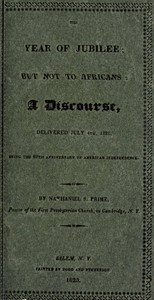
SALEM, N. Y.
PRINTED BY DODD AND STEVENSON.
1825.
------------------------------------------------------------------------
TO THE READER.
Though no apology for the present publication, or for the form in which it appears, will be attempted, yet it may not be improper or uninteresting to state a few facts relating to its origin.
The author has been in the habit, for a number of years past, of celebrating the anniversary of our Independence with public worship in his own congregation. Previous to the last 4th of July, notice to that effect was given, and at the same time it was stated that the subject of discourse would be—not American Liberty, but—American Slavery: in connexion with which, the object and operations of “_The American Colonization Society_” would be brought into view, and its claims upon publick patronage defended and urged. A similar notice was sent to the other congregations in this place with an invitation to attend.
To a very respectable audience, thus convened, the following discourse was delivered, and a contribution taken up in aid of the Colonization Society.
At the close of the service, a meeting was organized, of which the following are the minutes:
“_The Hon._ John M’Lean was chosen Chairman, and Gerrit Wendell, Secretary.
“_The following resolutions were then unanimously adopted._
“Resolved, That it is expedient and proper, in the view of this meeting, hereafter to celebrate the anniversary of our National Independence with religious exercises.
“Resolved, That Messrs. John Ashton, Sidney Wells and Dr. Matthew Stevenson be a committee to make arrangements for the next anniversary, by designating the place of meeting, and procuring a speaker for the occasion.”
“_On motion of Mr._ Ashton, seconded by Sidney Wells,—Resolved that the Rev. Mr. Prime be requested to furnish for the press, a copy of the Address delivered by him this day, and that the above mentioned committee be authorized to adopt the necessary measures to procure its publication.”
Although the proposal of the last resolution was totally unexpected to the author, yet he is willing frankly to acknowledge that its adoption was extremely grateful to his feelings; not only as an explicit approval of the sentiments which had been delivered, expressed by many of his own congregation and others, whose judgment he highly reveres; but also as affording the sanction of their authority in proclaiming them to the world. And, that it might have the full influence of that authority, the address is printed, with the exception of a few verbal corrections, and the addition of two notes, precisely as it was delivered.
The author cannot say that the views exhibited are the result of any new convictions in his own mind. Though he was familiar with slavery from his birth, yet from his earliest recollection, it was revolting to his feelings; and the first emotion of humanity that left an indelible impression on his memory, was that of commisseration for the degraded condition of a negro child about two years younger than himself; and from that moment, he never felt at rest on the subject, till the last vestige of the evil was removed from his parental dwelling. The same sentiments with respect to the universal guilt, and consequent danger of the American people, he has entertained ever since he became acquainted with the institutions of his country, and has occasionally exhibited them; but he acknowledges himself highly censurable in not having more frequently and pointedly urged them. He therefore presents this address to the publick, not only in compliance with the wishes of those whom he cannot refuse, but as a small atonement for having so often neglected to employ his pen, and raise his voice against an evil so extensive in its operation, and so alarming in its consequences.
Cambridge, July 5th, 1825.
------------------------------------------------------------------------
A DISCOURSE, &c.
THE words from which I propose to address you, on this occasion, you will find recorded in “The DECLARATION of the INDEPENDENCE of the UNITED STATES of AMERICA;”—the first clause after the preamble.
Man, considered as a rational and social being, occupies a variety of important relations in the universe of God. In the first place he stands related to that great and glorious Being who gave him existence, and he is under the most solemn and indissoluble obligations, to the exercise of eternal reverence, love and gratitude. However indifferent he may feel, in his present fallen state, to the demands of heaven, and however negligent he may be of the duties which result from those demands, it is an incontrovertible truth, that the service of God has the first and highest claim. Hence, the first and greatest commandment of the law is declared, by the divine Saviour to be this; “_Thou shalt love the Lord thy God with all thy heart, and with all thy soul, and with all thy mind, and with all thy strength._” Mark xii. 30. An immediate and constant compliance with this precept should be the first object of every human being.
But although this is the first, it is not the only duty of man. He occupies other relations, and, of course, is subjected to the authority of other duties. Passing over all the other subordinate connexions of man, as foreign from our present purpose, I shall here notice only his relation to his own species, and the obligations which result from that relation. All men are formed by the same hand, born into the same world, under the same circumstances, and are bound by considerations both of duty and interest to respect each other’s rights, and to promote each other’s happiness. These duties are next in importance to those which relate to God. Therefore, our blessed Lord, after declaring the precept already quoted to be the first commandment of the law, adds, “And the second is like” to it, “_Thou shall love thy neighbour as thyself_.” He then declares, with respect to both, “There is no commandment greater than these.” Here then we have a concise, but complete exposition of man’s duty in relation to his own species. It is applicable to all the possible circumstances of life; and at the same time, so plain, that the smallest share of intellect is sufficient to understand and apply it. It accords precisely with that golden rule which the Saviour delivered, in his sermon on the mount; “_All things whatsoever ye would that men should do to you, do ye even so to them; for this is the law and the prophets._” Matthew vii. 12. That is, all the duties which God has ever required of man in relation to his own species, either in the law or the prophets, are comprehended in this single precept, Do to others just as you would wish them to do to you. Did this principle regulate the conduct of all men, the earth would instantly resume the first bloom of Eden. Not only would war, and murder and rapine cease to desolate the earth, but animosities and contention and oppression of every kind and degree would instantly disappear. Adventitious circumstances might still produce distinctions in the relative situations of men; but pride, that fiend of hell and enemy of happiness, would be banished from the human breast; and one more prospered of heaven than his fellows, would look down upon them, not to despise their poverty, nor to rejoice in their misery, nor to deprive them of their liberty; (the last earthly blessing that man can lose;) but to compassionate their necessities, to console them under adversity, and to administer to their relief. The whole human family would be bound together by the sense of a common nature, and the bonds of sincere affection: in a word, they would feel that they were bone of each other’s bone; and flesh of each other’s flesh; and in all cases, and under all circumstances, they would act like brethren.
From these remarks, you will perceive that the words of my text, although they are not a part of the inspired volume, contain sentiments in perfect accordance with the divine declarations. This consideration therefore is sufficient to entitle them to the highest respect. But, in this favoured land, they do not need this argument to give them authority. They are the words of our fathers; not spoken by the fireside, or in the closet, while they rested quietly in the midst of their domestick circles, without a witness of their declarations; but proclaimed and published to the whole world, while they stood in jeopardy of their lives and all that they held dear on earth; and with a solemn appeal to the SUPREME JUDGE of the world for the rectitude of [their] intentions. Nay, more; some of them sealed this declaration with their own blood, and voluntarily laid down their lives, to deliver their posterity from tyranny and oppression, and to procure for them the blessings of liberty and self-government. Confining ourselves to this view of the subject, we should pronounce that native American unworthy of his parentage and the name which he bears, who would not revere the words of his father, uttered under such circumstances. Nay, that man, let him be who he will, and let his circumstances be what they may, is unworthy to tread American soil and breathe American air, who does not cheerfully and sincerely adopt the words of my text, as containing the sentiments of his heart, “_All men are created equal, and are endowed by their Creator with certain unalienable rights, among which are life, liberty and the pursuit of happiness._”
When this declaration, particularly this clause of it, was reported in heaven, (and I presume to believe that the sun had not set on the fourth of July, 1776, before the transactions of the American Congress were published to the celestial hosts,) what think you were the expectations of angels and the spirits of just men made perfect, with respect to the state of things which would succeed in this nation? Doubtless, the former, in whose respective ranks liberty and equality are not only professed but practised, expected, upon their first mission to this lower world, to see the American people, without distinction of complexion or circumstances, enjoying the blessings of freedom. And with equal probability may we imagine, that those happy souls who had been redeemed from the earth, and who had here witnessed, with their own eyes, the oppressions of man exercised upon his own species; some of whom had, perhaps, themselves been personally guilty in this matter, and had found, from their own experience, that the last pollution, from which a Saviour’s blood can wash the human soul, is the sweat or blood of a black man’s body; I say, we may safely imagine, that, among these, there was one universal shout of joy. They rejoiced to hear, that, in one nation at least of this fallen world, after the lapse of almost 6000 years, THE RIGHTS OF MAN were at last understood, and a solemn resolution to respect them had been unanimously adopted: that universal emancipation had been proclaimed to three millions of the human family.
In view of these considerations, could angels and redeemed souls have reasonably expected or believed, if there is any sincerity in man, that from the benefits of this solemn declaration, adopted under all the solemn circumstances just mentioned, and with the most solemn appeal to heaven, every sixth man was excluded, and doomed to perpetual slavery; and that, for no other reason, than because the God of nature had caused them to be born in a torrid clime, where the sun had burnt their skin and crisped their hair, and they had been transported against their will, to a land inhabited by white men?