Public-domain ebook
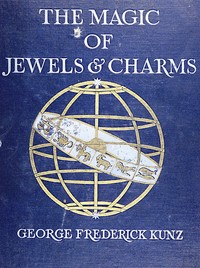
The magic of jewels and charms
Language: en11,027 downloads on Project Gutenberg
Subjects
In: Mythology, Legends & Folklore·History - Other·Archaeology & Anthropology
Public-domain ebook sourced from Project Gutenberg #66583.
Public-domain ebook
Language: en11,027 downloads on Project Gutenberg
Subjects
In: Mythology, Legends & Folklore·History - Other·Archaeology & Anthropology
Public-domain ebook sourced from Project Gutenberg #66583.
The work is a scholarly survey of the folklore, superstition, and alleged magical properties attached to gems, minerals and related curiosities. It opens with a broad observation on how the visual allure of stones has long guided both primitive adornment and tribal reverence, segueing into a discussion of how the desire for protection and healing gave rise to amulets and spirit‑linked charms. From this foundation the author launches into a series of essays that blend ethnographic anecdotes, historical references and scientific commentary, covering topics as varied as meteorites, “musical stones,” and the supposed medicinal effects of amber and pearls. The introductory passage also lists an extensive network of contemporary scholars and museum curators whose contributions underpin the book’s extensive documentation.
Written in the polished, didactic prose of the early twentieth‑century naturalist, the text reflects the voice of a learned gem‑dealer and mineralogist who balances anecdotal narrative with meticulous citation. Its style is erudite yet accessible, peppered with literary allusions and a measured optimism about the value of belief. Readers who enjoy the intersection of cultural history, mineral science, and the romantic allure of ancient lore, particularly those with an interest in anthropology, archaeology or the history of medicine, will find this volume a rewarding exploration of how humanity has imbued stone with meaning.
The opening · free to read
Beauty of color or lustre in a stone or some quaint form attracts the eye of the savage, and his choice of material for ornament or adornment is also conditioned by the toughness of some stones as compared with the facility with which others can be chipped or polished.
Whereas a gem might be prized for its beauty by a single individual owner, a stone of curious and suggestive form sometimes claimed the reverence of an entire tribe, since it was thought to be the abode or the chosen instrument of some spirit or genius.
Just as the appeal to higher powers for present help in pressing emergencies preceded the development of a formal religious faith, so this never-failing need of protectors or healers eventually led to the attribution of powers of protection to the spirits of men and women who had led holy lives and about whose history legend had woven a web of pious imaginations at a time when poetic fancy reigned instead of historic record. The writer still holds that true sentiment, the antithesis of superstitious dread, is good for all mankind—sentiment meaning optimism as truly as superstition stands for pessimism—and that even the fancies generated by sentiment are helpful to us and make us happier; and surely happiness often means health, and happiness and health combined aid to evolve that other member of the triumvirate, wealth. Do we not often wish for the union of these three supreme blessings?
At all times and in all periods there have been optimists and pessimists, the former animated by the life-bringing sentiment of hope, and the latter oppressed by the death-dealing sense of fear. Let us always choose a happy medium between a foolish excess of hope and an unreasonable apprehension of future troubles. The world’s history and our own experience show us that it is the optimist who has caused the world to progress, and we should trust and believe that the sentiment of hope and faith will always animate humanity.
We know that for centuries it has been believed that amber necklaces protect children from cold. May we not also now add that to pearls the same qualities are attributed? There must be a reason for this. May not this belief be ascribed to the circumstance that in the wearing of either of these gems their virtue consists in the fact that the necklaces do not cover the neck? In other words, they are worn on the bare throat and the opinion prevails that an exposed neck means less liability to cold. For, where the neck is never overheated and then suddenly chilled, a normal temperature being maintained, there should be protection from colds and from the many ills resulting from them. As to pearls, this might serve to illustrate the poetic fancy that these sea-gems are tears by angels shed to bring mortals joy.
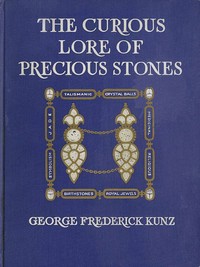
Having collected a large mass of material, ethnological, historical and legendary, in the course of personal observations and study, it was decided that the companion volume, the twin sister of “The Curious Lore of Precious Stones,” need not treat of gems alone.
For courtesies, information and illustrations I am indebted to the following to whom my sincere thanks are due: Prof. T. Wada, of Tokyo, Japan; Dr. G. O. Clerc, President of the Societe Curalienne des Amis des Sciences Naturelles, Ekaterineburg, Russia; Dr. Charles Braddock, late Medical Inspector to the King of Siam; Sir Charles Hercules Reed, Curator of Archæology, British Museum, London; A. W. Feavearyear, London; Dr. Peter Jessen, Librarian of the Kunstegewerbe Museum of Berlin; Miss Belle DaCosta Green; Dr. Berthold Laufer, Oriental Archæologist, Field Museum of Natural History, Chicago; Dr. Oliver P. Farrington, Field Museum of Natural History, Chicago; Hereward Carrington, Psychist, New York; Dr. W. Hayes Ward, Archæologist and Babylonian Scholar; Mrs. Henry Draper, New York; W. W. Blake, Mexico City, who has done so much to encourage Mexican archæological investigation; Dr. Edward Forrester Sutton, New York; Dr. W. H. Holmes of the United States Bureau of Ethnology, Washington; Mr. McNeil M. Judd, Archæologist, United States National Museum; Dr. Arthur Fairbanks, Director of the Boston Museum of Fine Arts; Tan Sien Ko, Government Archæologist of Burma; Dr. Charles C. Abbott, Archæologist, Trenton, N. J.; Edgar T. Willson, of the Jewelers’ Circular Publishing Co.; Dr. Edward H. Thompson, Archæologist, of Progreso, Yucatan, Mexico, and Cambridge, Mass.; Rev. Charles Sadleir of Aurcaria, Chile; Mrs. Nona Lebour of Corbridge-on-Tyne, England; and Dr. Charles P. Fagnani, Union Theological Seminary, New York City.
G. F. K.
The book keeps going
Reading is free forever. Sign up and watch scenes appear while you read.



Scenes Storieta drew for other classics.
New illustrated classics
Once or twice a month: the latest books to get full character casts, scene art, and free comic editions. No account needed.