Public-domain ebook
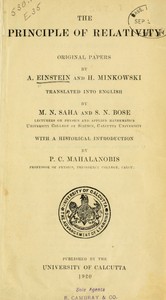
The Principle of Relativity
by Einstein, Albert; Minkowski, H.
Language: en1,334 downloads on Project Gutenberg
Subjects
Public-domain ebook sourced from Project Gutenberg #66944.
Public-domain ebook
by Einstein, Albert; Minkowski, H.
Language: en1,334 downloads on Project Gutenberg
Subjects
Public-domain ebook sourced from Project Gutenberg #66944.
The work is a scholarly treatise on the development of the theory of relativity, authored by Albert Einstein in collaboration with Hermann Minkowski. It opens with a technical preface that warns readers of the dense mathematical notation that pervades the text, from simple inline formulas to elaborate TeX‑rendered expressions. The opening historical introduction traces the nineteenth‑century “ether” paradigm, citing Lord Kelvin’s 1893 preface to Hertz’s research, the experimental failures of Arago, Airy, and Michelson‑Morley, and the theoretical attempts of Fresnel, Stokes, and Maxwell to reconcile optics with a stationary or viscous medium. By juxtaposing these experiments with Einstein’s 1905 declaration that the ether is superfluous, the book sets the stage for a systematic review of how relativistic ideas supplanted the ether hypothesis.
Written in the formal, lecture‑style prose of early twentieth‑century physics, the book combines rigorous derivations with extensive historical commentary. Its voice is that of a scientist addressing peers, assuming familiarity with classical mechanics, electromagnetism, and the mathematical symbols used throughout. Readers who enjoy detailed historical analyses of scientific revolutions, as well as those comfortable with complex algebraic and differential expressions, will find this volume rewarding. It appeals especially to scholars of physics, historians of science, and graduate‑level students seeking a deep, source‑based account of how relativity emerged from the ether debates.
The plain text version of this ebook includes complex mathematical formulas. Some are simple in-line expressions like k = 1 - 1/μ^2. They may include special notations such as x^y for x to the power of y, x_{y} for x with a subscript of y, [=a] for an 'a' with a bar across the top, [.a] for an 'a' with a dot over it, [..a] for an 'a' with two dots over it. Others are more complex “ASCII Art” like this: …
Keep reading free · start reading with no account
New illustrated classics
Once or twice a month: the latest books to get full character casts, scene art, and free comic editions. No account needed.