Public-domain ebook
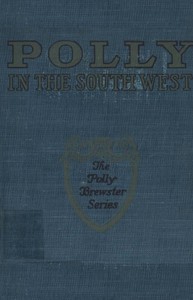
Polly in the Southwest
Language: en434 downloads on Project Gutenberg
Subjects
In: Children & Young Adult Reading·Adventure·Novels
Public-domain ebook sourced from Project Gutenberg #67057.
Public-domain ebook
Language: en434 downloads on Project Gutenberg
Subjects
In: Children & Young Adult Reading·Adventure·Novels
Public-domain ebook sourced from Project Gutenberg #67057.
The opening · free to read
Mr. Dalken’s southern cruise had come to an end, much to Polly’s and Eleanor’s regret. Though there had been discomforts and many unlooked for incidents throughout the voyage to the West Indies, and to both coasts of South America, the entire yachting party had thoroughly enjoyed the long pleasure trip.
Now they were back in prosaic, old New York, with its eternal clatter and bang of hustling affairs, and the crush and rush of the mobs of strangers or the workers at recess hours; but they seemed to be tense and nervous at such metropolitan confusion. Mr. Dalken laughed, as he escorted his party from the White Crest, upon its arrival at the dock of the Yacht Club—every one seemed irritable and displeased with the city.
“What an awful din!” exclaimed Eleanor, closing her ears with her forefingers.
“I only wish we were back in Buenos Aires—they never make such a deafening racket there,” added Jack, frowning, as a pushcart owner bawled his wares directly back of the young dandy’s ear.
Jack’s friends laughed appreciatively at the foreigner’s timely shout, and Jack scowled at the unconscious offender. Then, as if to provide still more amusement for the members of the party,—excepting Jack, of course,—the Italian tried to avoid a mud-puddle in the asphalt, just as the young New Yorker sprang lightly over it. The result was Jack collided with the rickety cart, which was filled with over-ripe bananas and lemons.
The unexpected blow from the corner of the cart sent Jack sprawling upon the street, and the pyramid of fruit descended instantaneously upon him, then bounced in every direction, giving the ever-present street urchins an unusual treat.
Eleanor, the irrepressible, began to sing: “Yes, we have no bananas,” but this ridiculous ditty failed to calm Jack’s annoyance. The laughter from not only his friends, but from every one who had witnessed the funny episode, made him turn upon the outraged vendor.
“What do you mean, by running me down like that?” demanded Jack, glaring at the still petrified foreigner. As though this demand loosed the pent-up torrent of the man’s grief, he deluged the cosmos with his heart-wrung lamentations. Mr. Dalken and Mrs. Courtney understood Italian, and they could sympathize with the poor man, whose tale of woe might have melted a stone image. Even Jack could not cope with the volubility of the peddler.
Finally, Mr. Dalken stepped over and took out his wallet. Instantly, the bereaved man’s face changed its expression, and his voice died down to a murmur of anticipation.
“Here’s a ten dollar bill, my man. See to it that your eleven children, now dependent upon your fruit-sales, are comfortably fed to-day. You say they have had nothing to eat for three days—not even such bad fruit as you have on sale—so I am sending this to them.” As he handed the money to the vendor, the Italian broke forth in a new strain—one of heaping blessings upon the great monseigneur, the bounteous gentleman!
“I just know he will pick up every lemon and black banana he can find the moment we are out of sight!” declared Nancy Fabian, smiling as she touched upon the truth.
“_I_ wouldn’t have been so easy, Dalky,” grumbled Jack, trying to remove some of the dirt from his coat.
“I wasn’t spending my money, Jack—don’t worry over that! I thought, seeing that you caused the trouble, that I would apply a part of your quarterly income to assuage the misery of the father of eleven little New Americans,” explained Mr. Dalken.
The blank look of disgust upon Jack’s face brought forth another ripple of laughter at his expense.
Thus teasing the young man in the party, and laughing or talking eagerly of everything they saw, the four girls followed their elders to the subway station.
But I anticipate: perhaps you are not acquainted with these happy young friends, who just came from the beautiful private yacht, the White Crest! In order to introduce you, before the girls proceed to Mr. Dalken’s apartment where they were to have luncheon that day, I will leave them for a short time during their ride on the subway.
Polly Brewster, the favorite in Mr. Dalken’s group of young friends, had been born and raised in Colorado. Her home, a great ranch located in the crater of an extinct volcano known upon the map as “The Devil’s Grave,” had been renamed by Rancher Brewster, “Pebbly Pit,” because of the marvelous Rainbow Cliffs which formed one of the boundary walls of the crater. These cliffs were composed of great masses of colored stones, which were readily broken from the towering wall. All about the foot of the cliffs were scattered tons of these shining pebbles. At the back of the wall ran the queer formations of lava which took grotesque forms, such as statues of men and animals. This undulating stretch of hardened lava became known to the surrounding ranchers as “The Imps” and the “Devil’s Causeway.”
Since Polly had left her western home to study a course of interior decorating in New York City, the Rainbow Cliffs and the mass of hardened lava which extended far back of the colored, pebbly wall had been transformed by modern machinery set up on the grounds, to cut the lava-jewels into marketable gems. This work, started after the group of wide-awake financiers headed by Mr. Dalken had seen the great possibilities in the stones, now provided most of the income by which Polly, as well as some of her friends, found it possible to travel luxuriously wherever inclination invited them.
This powerful company might never have been formed, had not circumstances developed from that first meeting of Eleanor Maynard and Polly Brewster, at the Colorado ranch where Eleanor went to spend the summer. But, then, you must read that story called “Polly of Pebbly Pit,” if you would know how Anne Stewart, the teacher, took Eleanor and her sister Barbara out of their society atmosphere in Chicago, and suddenly transported them to the simple but wholesome life of a ranch. And then, how Polly took her new friends for a trip to Grizzly Slide, where they encountered the terrific blizzard which was instrumental in leading them willy-nilly into a gold-mine.
The gold-mine, so thrillingly discovered, eventually founded the beginning of Polly and Eleanor’s introduction to the world—a world of New York adventures, European travels, business experiences, and touring or cruising with their millionaire, self-appointed guardian, “Dalky,” in company with other chosen friends.
The last tour Mr. Dalken had planned and carried out very successfully was the Southern Cruise, with the Fabians, the Ashbys, John Baxter,—always called “Jack”—and the two girls, Polly and Eleanor, with their intimate friend and chaperon, Mrs. Courtney. Nancy Fabian and Ruth Ashby had been members of Polly and Eleanor’s party in Europe, hence they seemed very much like girls in one family—so intimately acquainted had they all become with each other.
We left Polly and her circle of friends on board the White Crest, just after it had resumed its homeward voyage from Cayenne, and now, in this present book of adventures, we meet the girls after landing in New York City. They may have been glad to get home, to replenish a limited wardrobe such as they had been advised to take on board the yacht, when she sailed from New York for the South American tour; but they also felt poignant regret at having to say good-by to the good times they had had.
Consequently, the four girls, to say nothing of Jack, sat about Mr. Dalken’s large dining-table, after their elders had left the room to discuss politics and current events of New York City. They were wondering whether Dalky would feel disposed to invite them again on board his yacht, should he return to Colombia, in company with Mr. Fuzzier, to inspect the plans of the great railroad and canal system which the group of financiers had developed during their voyage between Cayenne and New York.
“Well, now, girls,” ventured Jack Baxter, “I’ll promise you this much—if Dalky will consent to my sharing an interest in this new project of his, I will move heaven and earth to include you in the prospecting party. But there must be no frills or furbelows, understand? In fact, I’m sure you’ll have to travel minus cold cream and beauty make-up, on such a tramp to the interior—it will mean riding-breeches and such, to facilitate progress through the Amazon jungle, no doubt.”
Since no one took Jack seriously, the girls now laughed at his grave expression and businesslike tone. It was not compatible with their knowledge of Jack, to believe him in earnest about this new mining scheme of the group of capitalists—a scheme that meant hard work and many sacrifices of luxuries and comforts. Jack had never been known to give up his lazy self-indulgences, hence the girls’ laughter.
A short time after the older members in the party had left the luncheon table, Mr. Dalken returned with a great sheaf of letters in his hand. In the other hand he held an open sheet of paper, which he had been reading just before entering the dining-room.
“Well, children, here’s news, all right! I had my mail for the past week held here to await my return to the city; and now, with other letters which had not been forwarded since we left Cayenne, I find a letter from Ebeneezer Alexander—Dodo’s father, you know.”
“Oh, yes!” was the chorus to this announcement, and the four girls, as well as Jack, expressed eager interest in the contents of the letter.
“He writes me a few personal bits of information regarding certain mining interests we have in common in Arizona, and then he goes on to report favorably on the gold mine at Choko’s Find. He seems to have solved the problem of getting at the vein without starting a landslide every time one winks at the peak. He is enthusiastic and tremendously interested in the possible outcome of his investigations and makes expert miner’s suggestions to John Brewster and Tom Latimer. If the tests he now has under way, prove to be reliable experiments, our troubles over the Lost Claim may be buried and forgotten. That leaves us free for new troubles.”
Mr. Dalken smiled as he explained this much of the letter, and, finding his audience about to storm him with questions, he held up a hand for silence, and anticipated some of the queries about to be made.
“I know—you all want to know about Dodo! Is she with her Dad at the ranch in Colorado? or is she home with her mother? Is she as enthusiastic over interior decorating as ever—or has she deserted the ranks, for a beau? Is she willing to join an expedition to the North Pole, or will she prefer to spend her millions in eating bon bons and growing obese like her mother? All of which I cannot answer, but which you girls may have the opportunity to ask personally very soon, provided you can be induced to turn your backs upon New York’s charm, and give your enlivening company to a sear, old man like me.”
“What do you mean, Dalky?” demanded Nancy Fabian.
“Is this an invitation to go somewhere?” asked Ruth Ashby.
“Dalky—are we off for another adventure?” exclaimed Eleanor Maynard, eagerly.
The book keeps going
Reading is free forever. Sign up and watch scenes appear while you read.



Scenes Storieta drew for other classics.
New illustrated classics
Once or twice a month: the latest books to get full character casts, scene art, and free comic editions. No account needed.