Public-domain ebook
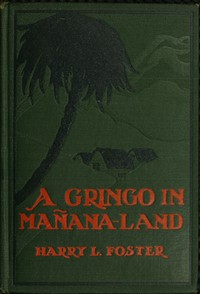
A Gringo in Mañana-Land
Language: en609 downloads on Project Gutenberg
Subjects
In: Humour·Travel Writing
Public-domain ebook sourced from Project Gutenberg #67200.
Public-domain ebook
Language: en609 downloads on Project Gutenberg
Subjects
In: Humour·Travel Writing
Public-domain ebook sourced from Project Gutenberg #67200.
The opening · free to read
It was my original plan to ride from Arizona to Panama by automobile.
In fact, I even went so far as to purchase the automobile. It had been newly painted, and the second-hand dealer assured me that no car in all the border country had a greater reputation.
This proved to be the truth. The first stranger I met grinned at my new prize with an air of pleased recognition.
“Well! Well!” he exclaimed. “Do you own it now?”
So did the second stranger, and the third. I had acquired not only an automobile, but a definite standing in the community. People who had hitherto passed me without a glance now smiled at me. There was even some discussion of organizing a club, of which I was to be the president, my term of office to continue until I could sell the car to some one else.
When I announced that I meant to drive to Panama--down through Mexico, Guatemala, Salvador, Honduras, Nicaragua, Costa Rica and any other republics which I might discover along the way--every one who heard of the idea offered encouragement:
“You’ve got the right car for that trip, my boy. Since you’ll find no roads down there, you’ll need a companion to walk ahead and chop down the cactus or level off the mountains, and if you step hard on the gas, you’ll just about be able to keep up with him.”
I was rather young, however, at the time of that first venture at foreign travel. It was only a few months after the Armistice, and I felt disinclined to return to cub-reporting on a daily newspaper. I elected myself to the loftier-sounding profession of Free-Lance Newspaper Correspondent. I purchased a palm-beach suit and an automatic pistol. I was going south into the land of romance--of tropical moons glimpsed through whispering palm-trees--of tinkling guitars echoing through Moorish _patios_--of black-eyed señoritas and red-nosed soldiers of fortune--of all the many things beyond the ken of mere cub-reporters.
Despite the encouragement, I tacked my banner to the back of my car, and set out upon a round of farewells.
Men shook hands with an air of finality. Two or three girls kissed me good-by with conventional little pecks that seemed to say, “I’ll never see the poor devil again, so I may as well waste some osculation on him.”
I had made the entire circuit, until there remained only a couple of village school-marms, who happened--most unfortunately--to live on top of the highest hill in town. Half-way to the summit, I perceived that my car was never destined to climb that hill. It slackened speed. It stopped. It commenced to roll backward. I was forced to throw it into reverse, just as the school-marms appeared in their doorway. The situation was humiliating. I became slightly flustered. I meant to step on the brake, but I stepped on the gas.
Wherefore, after some one had picked me out of the débris, I started southward by train.
In the manner of a Gringo who first passes the Mexican frontier, I walked cautiously, glancing behind me from time to time, anticipating hostility, if not actual violence.
In the dusk of early morning the low, flat-roofed adobe city of Nogales assumed all the forbidding qualities of the fictional Mexico. But the leisurely immigration official was polite. The customs’ inspector waved me through all formalities with one graceful gesture. No one knifed me in the back. And somewhere ahead, beyond the dim line of railway coaches, an engineer tolled his bell. The train, as though to shatter all foreign misconceptions of the country, was about to depart on scheduled time!
A native gentleman was there before me. He also was buying passage, but since he was personally acquainted with the agent, it behooved him--according to the dictates of Spanish etiquette--to converse pleasantly for the next half hour.
“And your señora?”
“_Gracias! Gracias!_ She enjoys the perfect health! And your own most estimable señora?”
“Also salubrious, thanks to God!”
“I am gratified! Profoundly gratified! And the little ones? When last I had the pleasure to see you, the chiquitita was suffering from--”
The engineer blew his whistle. A conductor called, “_Vamonos!_” I jumped up and down with Gringo impatience. The Mexican gentleman gave no indication of haste. The engineer might be so rude as to depart without him, but he would not be hurried into any omission of the proper courtesies. His dialogue was closing, it is true, but closing elaborately, still according to the dictates of Spanish etiquette, in a handshake through the ticket window, in an expression of mutual esteem and admiration, in eloquent wishes to be remembered to everybody in Hermosillo--enumerated by name until it sounded like a census--in another handshake, and finally in a long-repeated series of “_Adios!_” and “_Que le vaya bien!_”
What mattered it if all the passengers missed the train? Would there not be another one to-morrow? This, despite the railway schedule, was the land of “_Mañana_.”
As it happened, the dialogue ceased at the right moment. Every one caught the train. Another polite Mexican gentleman cleared a seat for me, and I settled myself just as Nogales disappeared in a cloud of dust, wondering why any train should start at such an unearthly hour of the morning.
The reason soon became obvious. The time-table had been so arranged in order that the engineer could maintain a comfortable speed of six miles an hour, stop with characteristic Mexican sociability at each group of mud huts along the way, linger there indefinitely as though fearful of giving offense by too abrupt a departure, and still be able to reach his destination--about a hundred miles distant--before dark.
In those days--the last days of the Carranza régime--trains did not venture to run at night, and certainly not across the Yaqui desert. It was a forbidding country--an endless expanse of brownish sand relieved only by scraggly mesquite. Torrents from a long-past rainy season had seamed it with innumerable gullies, but a semi-tropic sun had left them dry and parched, and the gnarled greasewood upon their banks drooped brown and leafless. Even the mountains along the horizon were gray and bleak and barren save for an occasional giant cactus that loomed in skeleton relief against a hot sky.
This was the State of Sonora, one of the richest in Mexico, but its wealth--like the wealth of all Mexico--was not apparent to the eye of the tourist. The villages at which we stopped were but groups of low adobe hovels. The dogs that slunk about each habitation, being of the Mexican hairless breed, were strangely in harmony with the desert itself. And the _peons_--dark-faced semi-Indians, mostly barefoot, and clad in tattered rags--seemed to have no occupation except that of frying a few beans and selling them to railway passengers.
At each infrequent station they were awaiting us. Aged beggars stumbled along the side of the coach, led by tiny children, to plead in whining voices for “_un centavito_”--“a little penny”--“for the love of God!” Women with bedraggled shawls over the head scurried from window to window, offering strange edibles for sale--baskets of cactus fruit resembling fresh figs--_frijoles_ wrapped in pan-cake-like tortillas of cornmeal--legs of chicken floating in a yellow grease--while the passengers leaned from the car to bargain with them.
“What? Fifteen centavos for that stuff? _Carramba!_”
“Ten cents then?”
“No!”
“How much will you give?”
Both parties seemed to enjoy this play of wits, and when, with a Gringo’s disinclination to haggle, I bought anything at the price first stated, the venders seemed a trifle disappointed. Everybody bought something at each stopping-place, and ate constantly between stations, as though eager to consume the purchases in time to repeat the bargaining at the next town. The journey became a picnic, and there was a child-like quality about the Mexicans that made it strangely resemble a Sunday-school outing at home.
Although an escort of Carranzista soldiers occupied a freight car ahead as a precaution against the bandits which infested Mexico in those days, the passengers appeared blandly unconcerned.
Each removed his coat, and lighted a cigarette. From the car wall a notice screamed the Spanish equivalent of “No Smoking,” but the conductor, stumbling into the coach over a family of peons who had crowded in from the second-class compartment, merely paused to glance at the smokers, and to borrow a light himself. Every one, with the friendliness for which the Latin-American is unsurpassed, engaged his neighbor in conversation. The portly gentleman who had cleared a seat for me inquired the object of my visit to Mexico, and listened politely while I slaughtered his language. The conductor bowed and thanked me for my ticket. When the peon children in the aisle pointed at me and whispered, “_Gringo_,” their mother ceased feeding a baby to “Shush!” them, their father kicked them surreptitiously with a loose-flapping sandal, and both parents smiled in response to my amused grin.
There was something pleasant and carefree about this Mexico that proved infectious. Atop the freight cars ahead, the escort of federal troops laid aside their Mausers, removed their criss-crossed cartridge-belts, and settled themselves for a siesta. As the desert sun rose higher, inducing a spirit of coma, the passengers also settled themselves for a nap. The babble of the morning gave place to silence--to silence broken only by the fretting cry of an infant and the steady click of the wheels as we crawled southward, hour after hour, through the empty wastes of mesquite.
And then, as always in Mexico, the unexpected happened.
The silence was punctured by the staccato roar of a machine-gun!
Whether or not the shooting came from the Carranzista escort or from some gang of bandits hidden in the brush, no one waited to ascertain. Not a person screamed. Yet, as though trained by previous experience, every one ducked beneath the level of the windows, the women sheltering their children, the men whipping out their long, pearl-handled revolvers. The only man who showed any sign of agitation was my portly friend. His immense purple sombrero had tumbled over the back-rest onto another seat, and he was frantic until he recovered it.
After the first roar of the machine-gun, all was quiet. The fatalistic calm of the Mexicans served only to heighten the suspense. The train had stopped. When, a few months earlier, Yaqui Indians had raided another express on this same line, the guard had cut loose with the engine, leaving the passengers to their Fate--a Fate somewhat gruesomely advertised by a few scraps of rotted clothing half-embedded in the desert sand. The thought that history had repeated itself was uppermost in my mind, and the peon on the floor beside me voiced it also, in a fatalistic muttering of:
“_Dios!_ They have left us! We are so good as dead!”
We waited grimly--waited interminably. With a crash, the door opened. A dozen revolvers covered the man who entered. A dozen fingers tightened upon a trigger. But it was only the conductor.
The book keeps going
Reading is free forever. Sign up and watch scenes appear while you read.



Scenes Storieta drew for other classics.
New illustrated classics
Once or twice a month: the latest books to get full character casts, scene art, and free comic editions. No account needed.