Public-domain ebook
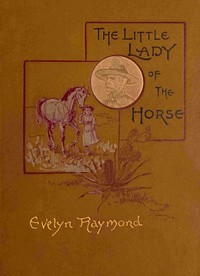
The Little Lady of the Horse
Language: en473 downloads on Project Gutenberg
Subjects
In: Children & Young Adult Reading·Novels
Public-domain ebook sourced from Project Gutenberg #67567.
Public-domain ebook
Language: en473 downloads on Project Gutenberg
Subjects
In: Children & Young Adult Reading·Novels
Public-domain ebook sourced from Project Gutenberg #67567.
The opening · free to read
Old Sutro and young Steenie were where they might have been found on almost every day at the same hour,--down on the beach, where the great cañon cut through the mesa to the sea.
A group of rocks, roughly piled, and a few evergreen shrubs clustering about them, made a pleasant break in a long, monotonous stretch of coast, and the coolness of the spot was always refreshing after their canter in the sunshine. Their horses had been unsaddled and set free to browse upon the herbage up the cañon; and these moved here and there, lazily, as if--like the old caballero himself--they felt the languor of that midday hour.
“Sutro, what makes the water so bluey-green?” asked the little girl, who had been sitting silent for full one minute and gazing dreamily at the shining waves.
“_Caramba!_ How can I tell?”
“But you should know, shouldn’t you? Doesn’t everybody keep learning things all the time? If I were a’most a hundred, like you, I should know everything, I think. In verity, I should be able to answer a simple question such as that. And so I tell you.”
“_Si?_ Thou wouldst find thou knew nothing at all, maybe; and thou wouldst not trouble if it were so. Because, if the good Dios wished to make us wise He would put wisdom into our heads without labor to us, wouldn’t he? Why not?”
“Fie, my Sutro! Do I learn reading that way? But no. I should wait a long time first, my father says. Well, then, if you do not know what makes the water green, I s’pose, at least, you can tell what lies beyond the water?”
“Ah, that I can! Beyond the water lies the sky. Thou canst see that for thyself,” answered the old man, with a chuckle of delight, and pointing to the horizon, where, in truth, the sky and ocean seemed to blend.
“No, that is a mistake, begging your pardon, dear Sutro, though it looks so. For my father says that it is only seeming; and that if I were to sail ’way, ’way over ever so far, it would be just as it is here,--the water so low down and the sky so high up above my reach. But, dearie me, I s’pose you will never tell me anything, Sutro! I must find out all things for myself. I wish my father wasn’t so busy. I wish my mother hadn’t died when I was a baby. I wish I knew what makes the road-runners such silly birds. Why should they keep always in front of one in a chase after them? Why don’t they fly up out of the way? But, of course, you can’t tell. And I wish--I wish--What makes people grow wrinkley when they get old? You can’t help being wrinkley, I know that, dear Sutro, but what makes it?”
“_En verdad!_ It may be answering thy idle questions, Little Un; yet there is one thing I would have thee know, and remember it. My soul! if thou dost not, I will be--”
“Not angry, please, Sutro!” cried Steenie, in sudden alarm.
“Maybe no. Not angry, truly. But wilt thou remember? I cannot be a hundred till the Natividad (Christmas) comes round five-and-ten times more. When I am a hundred years, thou wilt be a woman. This I know, because I asked Father Antonio when I was last at his house. My father was a hundred and ten when he died; and his father even more than that. The Vives’ family lives long in this world, and--_Guay!_ wouldst thou lie down without thy blanket?”
For Steenie had thrown herself full length on the mass of sea-pink vines, and would have been asleep in another moment; but kind old Sutro spread his gay Navajo blanket further up, under the shelter of the rocks, and, after the child had curled herself upon it, arranged with utmost care the branches of the chaparral till she was wholly screened from sunlight. Next, he whistled for the horses, who came obediently back to the mouth of the cañon; and then he went speedily to sleep, as Steenie had done. But for himself he made no screen, save his arm across his eyes, nor any bed softer than the warm sand.
During the next half hour these two odd comrades slumbered so peacefully that the teal in the pool beyond the rocks, and the sand-pipers in the rushes, went on about their business as fearlessly as if no human intruders were near; but when the half-hour was up, the girl awoke as suddenly as she had slept. Sitting on her blanket, she pushed her brown curls from her blue eyes, and looked mischievously around at old Sutro, whom she began to pelt with the crimson-rayed pinks, aiming so deftly that one gold-hearted blossom landed plump in the open mouth of the sleeper. “_Hola! hola!_ that was well sent!” shouted she.
Sputtering the flower from his lips, the Spaniard retorted, “In verity, I--”
But if he meant to scold his darling he was not allowed; for she leaned over him, patted his brown cheeks, and kissed him squarely on the forehead, in the very thickest tangle of the wrinkles she so disliked. “There, there, that will do, Señor Sutro Vives! If I was rude, you will forgive me; and if I hurt you, the wound will heal.”
“Thou hast healed it already, Little Un, and hast gladdened the heart of thy slave!” answered the other, with the extravagance of expression to which his tongue was prone.
“Pooh, my Sutro, you my slave,--the proudest of proud on all Santa Felisa ranch! My father says that the blood of three races runs in your veins, and that you have kept the best part of each. What does he mean by that? I heard him talking thus, once, with some strangers, who came to see the place. It was when you rode away on Mazan´, there; and one of the gentlemen said you were a very picture-y, or something, kind of a man, and--”
“Ten thousand pardons, Little Un, but it is false!”
“Why, Sutro, what do you mean? Isn’t it fine to be picture-y? I’m sure the stranger thought so, for he noticed everything about you,--your buckskin leggings, your sombrero, your big saddle, your lariat, and all. He said you were a most int’resting kind of a ‘type,’ and an ‘old Californian,’ and so on. I didn’t like the ‘old’ part of the talk, though, ’cause if you have to be called old, I’d rather do it myself, wouldn’t I?”
Sutro vouchsafed no reply. His brow had grown moody, and his movements betokened anger; for he picked up the blanket, and folded it with unusual precision, and, if it were possible, threw his shoulders back more squarely than ever. At that moment, from the snap of his black eyes and the rigidity of his upright figure, he might have been eighteen instead of eighty-five, which was the number of years Father Antonio’s reckoning accorded him.
Steenie became silent, for the one thing she feared was anger; but when the caballero whistled for Mazan´, she puckered her own red lips into a summons for Tito, who answered by a loving neigh and an immediate approach.
Not so the brown mare, Mazan´, to whose sensitive ears Sutro’s whistle had conveyed the information that her master was cross; and when that was the case, it were well that all tender-hearted creatures kept out of his way. So, instead of trotting forward to be mounted, pretty Mazan´ trotted off up the beach, and at a distance of a few rods broke into a wild gallop toward home.
Then Steenie laughed; she couldn’t help it, though she trembled instantly, fearing she had made matters worse.
But no. There was something so merry and infectious about that laugh that doting old Sutro was not the one to withstand its influence; his frown relaxed to a smile. “Well, well, En verdad! Mazan´ knows something after all! For she would be a foolish thing to come back for a beating she did not deserve, would she not, mi niña [my little one]?”
“So I should think, indeed! But what fun! You shall mount with me, and we will chase her. She’ll not stop to think that Tito can run her two to one, will she?”
“No, no!” assented the caballero, vaulting up behind his young favorite, and making ready for use the lariat which had been wound around his waist while he rested; also, for once, accepting without challenge Steenie’s declaration that Tito was the fleeter animal.
Such a race as that was! Save themselves and the fleeing mare, not a moving thing was in sight; for, leaving the mesa bluff and the cañon, they left also the teal and the sand-pipers and the few creeping creatures which lived in the chaparral. To the west glittered the rich-hued Pacific Ocean; before them and behind them lay miles and miles of yellow beach, while far eastward towered the mountains which formed the boundary of the great Santa Felisa rancho.
Lonely? Why, yes, it may have been; but so free, so roomy, and so sunny, that these two who darted athwart the picture never thought of loneliness. Besides, why should they? Santa Felisa was home to them; and during the few short years that Steenie Calthorp had lived she had viewed just such wide stretches of this lovely world, and no other; for a city, or even town, she had never seen.
As they rode they talked,--the girl asking and her attendant parrying questions without number, till he cried out, impatiently, “If thou wilt chatter always, Little Un, how can Tito win the race? Be quiet now, for just two minutes, and my lady Mazan´ shall feel the rope about her throat, if Sutro’s hand has not lost its cunning, with all this tiresome talk of ‘old,’ ‘old’!”
“_Ce, ce, ce!_” echoed Steenie, softly, in her eagerness using the familiar Spanish injunction to silence, and bending low to whisper a few encouraging words in Tito’s ear. Like an arrow he shot forward, and in a brief space had gained so close to Mazan´ that Sutro made ready to throw.
“Whiz-z! Swish!” The rope had cut the air in shining circles above the runaway’s straining head, and descended with unerring exactness to her steaming neck; who, at the first touch of the cord, understood its meaning, and stood stock-still,--a throbbing, beautiful, but wholly conquered thing.
“_Caramba!_ Señ’rita Mazan´! Wouldst serve thy master so? Take that--”
But the uplifted hand was stayed, as suddenly as the mare’s flight had been, by Steenie’s clutch of Sutro’s wrist, and her rebuke: “What! would you strike her, really,--Mazan´, who never knew stroke or blow! Or has this been your habit, and I s’posing you so gentle! For shame to you, Sutro Vives! and shame ten thousand times! What is she but--”
“A vixen! so I tell thee, who must be broken of her evil tricks. Caramba! Thus I will have it. ‘Women and mares and a spaniel dog--’”
“Sutro! Leave your dirty Spanish jabbering, and listen to me. If you strike her you shall not ride on the beach--for--one--whole--week! And ‘so I tell thee’! I will take--let me see--maybe Nicoloso Barbazon, instead.”
“_Si?_ but thou wilt not, Little Un! What does the stupid Nicoloso know of what a señorita’s body-servant should be? Answer me that. _Caramba!_”
“Ah, ha, my Sutro! Somebody is silly still; but it isn’t Mazan´, nor Tito, nor me! And you make me think you are not well: you are so very, very cross. Never mind, poor thing! Get upon your pretty beast, who stands so quiet now, and let us go on. I am as hungry as hungry; aren’t you?”
“But--Nicoloso?”
“Pooh! for Nicoloso! He needn’t come if you are good, need he? Sutro, what makes one so uncomf’table to be hungry? If it weren’t for that queerness inside of me I could stay out all day, and maybe all night.”
The book keeps going
Reading is free forever. Sign up and watch scenes appear while you read.



Scenes Storieta drew for other classics.
New illustrated classics
Once or twice a month: the latest books to get full character casts, scene art, and free comic editions. No account needed.