Public-domain ebook
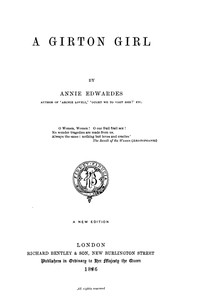
A Girton Girl
Language: en615 downloads on Project Gutenberg
Subjects
Public-domain ebook sourced from Project Gutenberg #67733.
Public-domain ebook
Language: en615 downloads on Project Gutenberg
Subjects
Public-domain ebook sourced from Project Gutenberg #67733.
The opening · free to read
But a plate piled with luscious Guernsey strawberries happening to be placed, by a jaunty Norman waitress, under Gaston’s nose, the generalisation, for the moment, ended abruptly.
Guernsey. Imagine that dot of granite washed round by such blue as our western Channel shows in June; imagine carnation-smelling sunshine, a friendly trio of young persons breakfasting, with appetite, on the lime-shaded lawn of Miller’s Sarnian Hotel; imagine the flutter of a muslin dress, the presence of a beautiful girl of two-and-twenty, and the opening scene of this little drama lies before you.
I may add that the friendship of the three persons was a paradox, as the reader of the succeeding pages shall be brought to see.
‘The heart of woman tends towards marriage. Well, a picturesque revival of Lady-Jane-Greyism,’ went on Gaston Arbuthnot, as his plate of strawberries subsided, ‘may be safe enough--to the Lady Jane Greys! Especially in an age when women, young or old, are by no means given to losing their heads. But let the Roger Aschams who bear them company look to it! This young person whom you, Geoffrey, propose to coach is probably neither worse nor better than her sisters. The man-hating story I flatly disbelieve. Marjorie Bartrand may or may not go to Girton. She is sure to prove herself a very woman in the end.’
‘Unfortunately, you flatly disbelieve so many things.’ As she spoke Gaston’s wife transferred a monster strawberry from her own plate to her husband’s. ‘You told me, only yesterday----’
‘Dinah, my love,’ interrupted Gaston, with good humour, ‘never remind a man who has well dined or well breakfasted of what he said yesterday. In what state were one’s nerves twenty-four hours ago? Was the wind in the east? Had our perennial duns arrived from England? Had our cousin Geoffrey been reading pauper statistics at us? Each or all of these accidents may have engendered scepticism which at this moment is replaced by the childlike faith born of idleness and a fine digestion.’
And Dinah’s strawberry, encrusted by sugar, delicately dipped in Guernsey cream, was placed between Gaston’s white teeth, savoured and swallowed.
It was not part of Mr. Arbuthnot’s philosophy to refuse any little choice morsel that the world, artistic, intellectual, or physical, thought fit to offer him.
He was a handsome man verging on his thirtieth year: tawny-bearded, fair, with hands that Titian or Velasquez might have loved to paint, and a profile of the type commonly known as Bourbon. (Although he may not play the first part in this or any other drama, one has a feeling that Gaston should advance to the footlights, make his bow, a good minute before his fellow-actors leave the slips.) His eyes were shrewd and near together, their colour and their expression alike prone to shift if a stranger sought, too persistently, to investigate them.
With a first look you felt sure that Mr. Gaston Arbuthnot bore a brain. You felt equally sure, with a second, that the opinion was shared, even to exaggeration, by Mr. Gaston Arbuthnot himself.
In dress it was his pleasure to affect Bohemianism. On this particular June morning Gaston wore a brown velveteen coat, a spun silk shirt, a white sombrero hat--the well-tailored man becoming only more conspicuous under the disguise. What smaller things shall be said of him? That he had been brought up as a child in Paris, the only son of a valetudinarian American widow, and spoke French to this hour with a better accent than English, rolling his ‘r’s’ and clipping his vowels like a born denizen of the boulevards. Item: that he had a fair English girl for his wife; item: a loyal, rough-hewn Scottish cousin for his friend--the Dinah and Geoffrey who, breakfasting with appetite although their discourse was of sentiment, made up the paradoxical little group under the lime trees at which we have glanced.
Let us turn to Geoffrey next, leaving Dinah, as I see they leave the first actress in the theatrical advertisements, for the bottom of the list.
The cousinship of the Arbuthnots might be divined at a glance, although, reviewed feature by feature, the two men were notably unlike in their likeness. Both were tall, both were wiry of build, both held their heads high, going along life’s road as though the world, taken from whichever point of view you liked, were decidedly a place worth living in. Here the likeness ended. Gaston, indeed, would declare that by virtue of his mother’s Yankee blood, and his own Parisian instincts, they were less related, physically, than any ordinary cousin-germans.
One overwhelming difference between them was patent. Geoffrey was no beauty-man! When he was the freshest of freshmen, five or six years before the morning of this Guernsey breakfast, Geff went in, one November night, for a little bit of guerilla fighting in the Cambridge streets, which, without quenching the guerilla spirit, effectually left a beauty-spoiling brand upon himself for the remainder of his life.
It happened thus. Geoffrey, raw from school, had newly carried off one of the scholarships best worth winning in the University. Although brave, manly, impetuous, the lad’s hours were early, his habits sober. He belonged, indeed, to a class which young gentlemen, fond of their pleasure, and of modest mental gifts, are apt to label during their first two terms of residence under the generic name of smug. Well, with an old schoolmate, less versed in Greek than himself, Geff had been drinking coffee and conning over such portions of Plato as would be wanted by his friend for the coming Little Go. He was midway on his way back to his scholar’s attic in John’s when, turning sharply round a corner of Petty Cury, he found himself in the thick of a small but classic ‘town and gown.’ A brace of undergraduates, raw as himself, held a mob of roughs at bay; stones, oaths, and brickbats flew about with Homeric profusion. A fine Cambridge drizzle gave atmosphere to the scene. Police, bull-dogs, proctors, were beneath the horizon.
With no other weapons than his fists and his Plato, Geff rushed to the fore. In those early days he had neither the weight nor the staying power which on many a well-contested football field have since made his name a terror to the foe and a tower of strength to All England. He had, however, the force born of will, of brain, of generous impulse. Ere twenty seconds had sped Plato, with all the Platonic philosophy, went to the winds, and the biggest, brawniest of the roughs, stoutly gripped about the neck-cloth region, gave tokens of surrender.
Unfortunately for Geff’s beauty, his antagonist’s left hand held a broken stone bottle. As the ruffian felt himself reel to earth he swung the missile, with dastard might, into the Scotch lad’s face, cutting his nose and forehead very literally to the bone. There came a cry of ‘Proctor!’ There was the shuffle of departing feet. Then Geoffrey, blinded, stunned, fell into a bull-dog’s arms and heard the usual proctorial question as to name and college, addressed with the usual calm proctorial courtesy to himself.
It was a week before the Little Go exams.; and Geoffrey Arbuthnot, as soon as the surgeons could strap his face into a grim resemblance of humanity, went down.
The incident in nowise lessened his Cambridge reputation. Although he eventually came out eighth in the Classical Tripos, it is not known that the most foolish tongue called Arbuthnot of John’s a smug again; tacitly, he was recognised, even by pleasure-loving young gentlemen, as one of that queer ‘good-all-round sort’ in whom the defects of bookishness and staid living are condoned by certain sterling natural virtues--glorious muscle, unconquerable pluck. ‘Virtues that a man can’t help, don’t you know, if they are born in him!’ And which, confusing to the pleasure-loving intelligence though such facts may be, do certainly, in the long run, bring public credit to the Alma Mater.
But the blow from his street antagonist had marred Geoffrey Arbuthnot’s looks for life.
Strength, loyalty, gentleness, were written large upon his face. His dark, somewhat sunken eyes had in them the glow of an intellect high above the level of his handsome cousin! His smile, though Geff did not resemble the family of Bourbon, was finer, because sweeter, more wholly human than Gaston’s. But his looks were marred. That rugged cicatrice across nose and forehead could never wear out, and Geoffrey possessed not the thousand little drawing-room graces that, in some women’s sight, might go far towards rendering such a blemish ‘interesting.’ His hands, however firm, lithe, adequate for a surgeon’s work, did neither suggest Titian nor Velasquez to your mental eye. His dress bespoke the student. His French was grotesque. Although a second Bayard in his reverence for abstract Woman, he had no small attentions for concrete idle ladies.
Garden parties Geoffrey Arbuthnot evaded; dancing parties he abhorred. In regard to matrimony he would shake his head, not holding it a state meet for all men.
Concerning this latest clause, however, the reader shall learn more when we come to ask why the triangular friendship of the persons breakfasting together under the shadow of Mr. Miller’s limes was paradoxical.
‘Yes,’ resumed Gaston Arbuthnot, tilting himself to the outside limit of equilibrium on his garden-chair, and clasping his arms, with a gesture admirably suggestive of habitual laziness, above his head, ‘look the position in the face for one moment, and you reduce it to an absurdity. No girl of seventeen has ever yet been a man-hater; has she, Dinah?’
‘I was not,’ admitted Mrs. Arbuthnot frankly, although she blushed. ‘But Miss Bartrand of Tintajeux, young though she is, has gone through disappointment. Mrs. Miller told me so when I showed her the paper with the advertisement. Miss Bartrand, more than a year ago, was engaged to the major of some English regiment stationed in Guernsey.’
‘Is that a disappointment, my love?’
‘The major of the regiment proved a sorry character,’ said Dinah gravely. ‘Miss Bartrand found out that he had broken the heart of some poor girl at a former garrison town.’
‘And, from that hour forth, swore to look on all men as in the conspiracy,’ interrupted Gaston. ‘What breadth of discrimination, what knowledge of the world, these simple-seeming schoolgirls occasionally show!’
‘When I was eighteen, that spring I went to stay with Aunt Susan at Lesser Cheriton, I knew no more of the world’s ways than a baby, did I, Geff?’
‘The philosophers are divided as to how much a baby does know,’ answered Geoffrey, fixing his dark eyes with discrimination upon Mrs. Gaston Arbuthnot’s face.
‘There is an unexpected parry for you, my dear girl.’ Shifting his chair away from the table, Dinah’s lord began to fold himself a loose, or Spanish-modelled cigarette. Pipes and cigars of ordinary goodness Gaston would no more smoke than he would swallow any of the popular fluids known among Britons as wine. He had the virtue of facile temperance, wore the blue ribbon of a fastidious taste. Unless his small luxuries were of the choicest, he could at any time fill the anchorite’s rôle without effort. ‘You had better apply to your own lawful husband, Dinah, than to Geff, when you want a compliment.’
The book keeps going
Reading is free forever. Sign up and watch scenes appear while you read.



Scenes Storieta drew for other classics.
New illustrated classics
Once or twice a month: the latest books to get full character casts, scene art, and free comic editions. No account needed.