Public-domain ebook
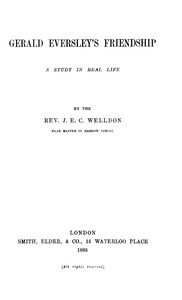
Gerald Eversley's Friendship: A Study in Real Life
Language: en527 downloads on Project Gutenberg
Subjects
Public-domain ebook sourced from Project Gutenberg #67914.
Public-domain ebook
Language: en527 downloads on Project Gutenberg
Subjects
Public-domain ebook sourced from Project Gutenberg #67914.
The opening · free to read
It was a day in September 186-. It was between five and six o’clock in the afternoon. The railway station of St. Anselm’s seemed to be asleep save for the movement of four people, or, more strictly, of two pairs of people, who were pacing up and down at opposite ends of the platform, apparently awaiting the arrival of the same train to take them to London. Each pair consisted of a gentleman and a boy. It was evident that the two pairs were not acquainted one with the other. Once, but only once, in their patient promenade they approached and passed each other; and in so doing each of the two boys eyed the other with the curiously distant inquisitiveness of English schoolboys who have not met before, but who are dimly conscious that, as members of the same great institution, they have entered, or are about to enter, into a mysterious relation; and, as soon as they had got out of earshot, each of them, turning at the same moment almost half round, whispered to his father, ‘I’m sure that fellow is a new boy; I wonder whose house he’s in.’ It was one of the many questions that are asked in life more for the sake of putting them than in the hope that they will be answered. But there would have been no disposition to answer it, if answer had been possible; for just then a train drew up at the opposite platform, and out of it poured a number of boys, of all sorts and ages, clamouring for porters, clamouring for luggage, greeting one another, chaffing one another, rushing out of the station to secure cabs or other conveyances, rushing back to recover articles which they had left in the racks or under the seats of the carriages, turning the quiet of the little station into such a Babel or Bedlam as can be caused by no human beings but English public school boys in the last half-hour of freedom before the ringing of the bell which marks the fatal time when they must be all in their boarding houses--the end of the holidays, the beginning of a new term.
At last the train, looking desolate when it had discharged its freight of youthful humanity, moved on; the platform on which the boys of St. Anselm’s had alighted was deserted once more, and the two fathers and their sons, who had watched the scene with unmistakable amusement and interest, resumed their walk on the other side of the station. The pairs were strangely different in appearance. One of the gentlemen was tall and strongly built; his face was sunburnt; he possessed the indescribable athletic, unliterary air of an English country gentleman. He walked with a rapid step, spoke in hearty, cheery tones, appeared to be in good humour with himself and with the world, and it was difficult, in looking at him, to mistake the characteristics of easy temper, ample fortune, and high breeding. The boy at his side, lithe and stalwart, whose bright complexion and soft blue eyes were passports to favour, even without the radiant smile that played now and again, like a wandering sunbeam, on his mobile features, was a type of generous, healthy English boyhood. No being, perchance, is so distinct, none so beautiful or attractive, as a noble English boy. He is open-hearted, open-handed; there is not a cloud upon his brow; he looks the world in the face; for him all life is, as it were, sunshine without rain. Such a boy was Harry Venniker. He was like his father, yet with a delicate grace that was not altogether his father’s. He was now nearly fourteen years of age, and he seemed a little older than his years. The boy at the other end of the platform, who was nearly of the same age, though he looked younger, was thin and pale; he wore spectacles, and stooped a little in his walk, and there was a certain nervous anxiety, not unmixed with a fine intelligence, in his demeanour whenever he met the gaze of any man or woman, even of one of the porters in the station, directed towards himself. His father was a country clergyman (like so many another) with a small income and a large family--an income growing unfortunately smaller and a family growing, shall it be said fortunately? larger--who, though he had come down a little in the world, as he would at times rather sorrowfully confess, had set his heart upon giving his eldest son--the only child of the first Mrs. Eversley--a good education; and, finding him clever, much above the average of boys in his own rural experience, had been so far encouraged by his success in winning a scholarship and by the generosity of a wealthy friend, a near relative of the first Mrs. Eversley, who had offered to undertake all responsibility for his educational expenses, that he had resolved, not without many painful misgivings, to send him to school at St. Anselm’s. There was an aspect of bygone gentility about Mr. Eversley; he looked like a man who had seen better days, though nobody could tell or guess how long it was since he had seen them. The memory of those days was somehow written upon his face; and yet, if the truth must be told, a casual observer would have been more likely to notice that his coat was a little threadbare at the elbow, and his clerical hat a little soiled about the brim, than that his personal appearance was not unworthy of a better garb.
Different, however, as the fathers were and the sons, the conversation at the two ends of the platform was not entirely dissimilar. ‘Train’s due, Harry,’ said Lord Venniker, taking his watch out of his pocket and looking at it with just sufficient attention to forget in half a minute what the time was when he looked. ‘Here she comes. Now here’s a 5_l._ note for you, and when you want more, you must write for it; don’t spend it all, you young rogue, at the tuckshops. Go straight back to Brandiston’s as soon as I’m off and make yourself happy.’ Then, after a brief pause, ‘You’ve not got to earn your living, you know, so you need not work your eyes out; I’d much rather you got into the eleven; but do your duty like a Christian; don’t swear, don’t cheat, don’t ...’ and Lord Venniker’s speech, one of the longest he had made in his life, was cut short by the train. He had barely time to add, as a summary of moral wisdom, ‘Whatever you do, don’t do anything unworthy of a gentleman--and a Venniker.’
At the same time, but at the other end of the platform, Mr. Eversley was saying in a low voice, ‘My dear Gerald, before the train, which is to part us for so long, comes in--she is signalled now--let me say this last word to you. You are going to an expensive school, more expensive, I am afraid, than it is right for me to afford; but I have longed to give you a good education--for your dear mother’s sake, and your own, Gerald--and when I have done that, you must make your own way in the world. Work hard then; remember that Satan finds some mischief for idle hands. You have been brought up in the faith of Christ as your Redeemer and your Master; be true to Him, pray to Him every morning and night, and, whatever you do, don’t forget what is expected of you as a Christian gentleman, and always ask yourself what He would wish you to do, if He were present.’
The train drew up. Lord Venniker stepped into a first class, Mr. Eversley into a third class, compartment; a few hurried last words--the world-old effort to say in half a minute all that might have been said, and ought, it seems, to have been said, in the past half-hour--and there was a whistling, a waving of hands, a tear rising in the eyes that would disown it if they could, and the parting was over. Who is there among us that has ever waved ‘Farewell’ and has not felt as though it were ‘Farewell for ever’?
Harry Venniker stood gazing after the train until it wound its way along the curve some three or four hundred yards from the station, and he could see nothing of it but the smoke-wreath fading away into thin air; then he turned quickly upon his heel, and as he turned almost ran into the other boy, who was making his way with slow steps towards the exit from the station.
‘I beg your pardon,’ he said. ‘I’m awfully sorry. I’m always doing that kind of thing.’ Then he looked at the straw hat and broad white collar which are the infallible marks of a boy at St. Anselm’s, and added, ‘I say, are you a new boy? So am I. Was that your governor? Whose house are you in? There’s no cab; those chaps have taken them all; we may as well walk up to the school together, eh? There’s time, isn’t there?’
Gerald Eversley made no attempt to answer the questions which came leaping from his companion’s lips, but contented himself with saying that he was a new boy, he had only once been at St. Anselm’s before, and then with walking quietly at his side. In his heart he could not help wondering how any boy, being new to public school life, could feel so much at his ease.
Both boys, it is needless now to say, were taking the fateful step--more fateful perhaps than any other that is taken in life--of entering a great public school. Their parents had brought them earlier in the day to be introduced to the master in whose house they were to be placed, and after the introduction they had been permitted to see the last of their parents at the station. They had never met before; they did not know each other’s names; it was only by such a chance as has been described that they came to be walking together. Who can tell at any moment of his life that for him there may not be some one coming from a distant home, drawn onwards by divine guiding, some one whose name he has not heard, and yet whose destiny is indissolubly linked to his own?
For two or three minutes they walked in silence; but it was not in Harry Venniker’s nature to be silent for long, and he soon began to interrogate his companion with the good-natured, but almost brutal, frankness which is exclusively characteristic of schoolboys.
‘I say,’ was his first remark, ‘what’s your name, though?’
‘Gerald Simeon Eversley,’ was the reply, delivered in a low tone, and with something not altogether unlike a choking of the throat.
It was not, perhaps, a remarkable name; but Mr. Eversley had called his son ‘Simeon’ after the great Evangelical leader whose funeral at King’s College in Cambridge he had himself, as a young man, attended.
‘Oh! Eversley, is it?’ The name did not appear to awaken any reminiscences in Harry Venniker’s mind.
‘Whose house are you in?’
‘Mr. Brandiston’s.’
‘Brandiston’s! Bless my soul! why, so am I,’ said Venniker; but there was something in his tone which seemed to imply that the pale, spectacled boy to whom he spoke was not quite the kind of boy whom he had expected to find in Mr. Brandiston’s house, the most popular and fashionable house at St. Anselm’s. ‘They say he’s not a bad sort, old Brandiston, but awfully strict. However, I don’t mind that so long as he’s just. I know a lot of fellows there, some of them were at my preparatory school; it’s cock house at cricket; it has got five of the eleven in it, and one of them is the captain--Stanley, you know. But, I say, what school have you been at? Were you in the eleven there? What was your top score?’ But here he paused, as if a gentle voice had reminded him that the boy at his side was not quite likely to have achieved reputation as a cricketer, and he repeated his first question quickly, ‘What school?’
The book keeps going
Reading is free forever. Sign up and watch scenes appear while you read.



Scenes Storieta drew for other classics.
New illustrated classics
Once or twice a month: the latest books to get full character casts, scene art, and free comic editions. No account needed.