Public-domain ebook
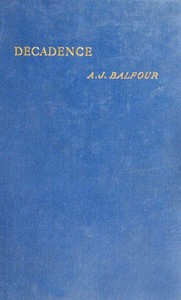
Decadence Henry Sidgwick memorial lecture, 1908
Language: en418 downloads on Project Gutenberg
Subjects
In: Essays, Letters & Speeches·History - Other·Philosophy & Ethics
Public-domain ebook sourced from Project Gutenberg #68219.
Public-domain ebook
Language: en418 downloads on Project Gutenberg
Subjects
In: Essays, Letters & Speeches·History - Other·Philosophy & Ethics
Public-domain ebook sourced from Project Gutenberg #68219.
The opening · free to read
Cambridge: PRINTED BY JOHN CLAY, M.A. AT THE UNIVERSITY PRESS.
DECADENCE.
I must begin what I have to say with a warning and an apology. I must warn you that the present essay makes no pretence to be an adequate treatment of some compact and limited theme; but rather resembles those wandering trains of thought, where we allow ourselves the luxury of putting wide-ranging questions, to which our ignorance forbids any confident reply. I apologise for adopting a course which thus departs in some measure from familiar precedent. I admit its perils. But it is just possible that when a subject, or group of subjects, is of great inherent interest, even a tentative, and interrogative, treatment of it may be worth attempting.
My subject, or at least my point of departure, is Decadence. I do not mean the sort of decadence often attributed to certain phases of artistic or literary development, in which an overwrought technique, straining to express sentiments too subtle or too morbid, is deemed to have supplanted the direct inspiration of an earlier and a simpler age. Whether these autumnal glories, these splendours touched with death, are recurring phenomena in the literary cycle: whether, if they be, they are connected with other forms of decadence, may be questions well worth asking and answering. But they are not the questions with which I am at present concerned. The decadence respecting which I wish to put questions is not literary or artistic, it is political and national. It is the decadence which attacks, or is alleged to attack, great communities and historic civilisations: which is to societies of men what senility is to man, and is often, like senility, the precursor and the cause of final dissolution.
It is curious how deeply imbedded in ordinary discourse are traces of the conviction that childhood, maturity, and old age, are stages in the corporate, as they are in the individual, life. “A young and vigorous nation,” “a decrepit and moribund civilisation”--phrases like these, and scores of others containing the same implication, come as trippingly from the tongue as if they suggested no difficulty and called for no explanation. To Macaulay (unless I am pressing his famous metaphor too far) it seemed natural that ages hence a young country like New Zealand should be flourishing, but not less natural that an old country like England should have decayed. Berkeley, in a well-known stanza, tells how the drama of civilisation has slowly travelled westwards to find its loftiest development, but also its final catastrophe, in the New World. While every man who is weary, hopeless, or disillusioned talks as if he had caught these various diseases from the decadent epoch in which he was born.
But why should civilisations thus wear out and great communities decay? and what evidence is there that in fact they do? These questions, though I cannot give to them any conclusive answers, are of much more than a merely theoretic interest. For if current modes of speech take decadence more or less for granted, with still greater confidence do they speak of Progress as assured. Yet if both are real they can hardly be studied apart, they must evidently limit and qualify each other in actual experience, and they cannot be isolated in speculation.
Though antiquity, Pagan and Christian, took a different view, it seems easier, a priori, to understand Progress than Decadence. Even if the former be limited, as presumably it is, by the limitation of human faculty, we should expect the ultimate boundary to be capable of indefinite approach, and we should not expect that any part of the road towards it, once traversed, would have to be retraced. Even in the organic world, decay and death, familiar though they be, are phenomena that call for scientific explanation. And Weismann has definitely asked how it comes about that the higher organisms grow old and die, seeing that old age and death are not inseparable characteristics of living protoplasm, and that the simplest organisms suffer no natural decay, perishing, when they do perish, by accident, starvation, or specific disease.
The answer he gives to his own question is that the death of the individual is so useful to the race, that Natural Selection has, in all but the very lowest species, exterminated the potentially immortal.
One is tempted to enquire, whether this ingenious explanation could be so modified as to apply not merely to individuals but to communities. Is it needful for the cause of civilisation as a whole, that the organised embodiment of each particular civilisation, if and when its free development is arrested, should make room for younger and more vigorous competitors? And if so can we find in Natural Selection the mechanism by which the principle of decay and dissolution shall be so implanted in the very nature of human associations that a due succession among them shall always be maintained?
To this second question the answer must, I think, be in the negative. The struggle for existence between different races and different societies has admittedly played a great part in social development. But to extend Weismann’s idea from the organic to the social world, would imply a prolonged competition between groups of communities in which decadence was the rule, and groups in which it was not;--ending in the survival of the first, and the destruction of the second. The groups whose members suffered periodical decadence and dissolution would be the fittest to survive: just as, on Weismann’s theory, those species gain in competitive efficiency whom death has unburdened of the old.
Few will say that in the petty fragment of human history which alone is open to our inspection, there is satisfactory evidence of any such long drawn process. Some may even be disposed to ask whether there is adequate evidence of such a phenomenon as decadence at all. And it must be acknowledged that the affirmative answer should be given with caution. Evidently we must not consider a diminution of national power, whether relative or absolute, as constituting by itself a proof of national decadence. Holland is not decadent because her place in the hierarchy of European Powers is less exalted than it was two hundred and fifty years ago. Spain was not necessarily decadent at the end of the seventeenth century because she had exhausted herself in a contest far beyond her resources either in money or in men. It would, I think, be rash even to say that Venice was decadent at the end of the eighteenth century, though the growth of other Powers, and the diversion of the great trade routes, had shorn her of wealth and international influence. These are misfortunes which in the sphere of sociology correspond to accident or disease in the sphere of biology. And what we are concerned to know is whether in the sphere of sociology there is also anything corresponding to the decay of old age--a decay which may be hastened by accident or disease, which must be ended by accident or disease, but is certainly to be distinguished from both.
However this question should be answered the cases I have cited are sufficient to shew where the chief difficulty of the enquiry lies. Decadence, even if it be a reality, never acts in isolation. It is always complicated with, and often acts through, other more obvious causes. It is always therefore possible to argue that to these causes, and not to the more subtle and elusive influences collectively described as ’decadence,’ the decline and fall of great communities is really due.
Yet there are historic tragedies which (as it seems to me) do most obstinately refuse to be thus simply explained. It is in vain that historians enumerate the public calamities which preceded, and no doubt contributed to, the final catastrophe. Civil dissensions, military disasters, pestilences, famines, tyrants, tax-gatherers, growing burdens, and waning wealth--the gloomy catalogue is unrolled before our eyes, yet somehow it does not in all cases wholly satisfy us: we feel that some of these diseases are of a kind which a vigorous body politic should easily be able to survive, that others are secondary symptoms of some obscurer malady, and that in neither case do they supply us with the full explanations of which we are in search.
Consider for instance the long agony and final destruction of Roman Imperialism in the West, the most momentous catastrophe of which we have historic record. It has deeply stirred the imagination of mankind, it has been the theme of great historians, it has been much explained by political philosophers, yet who feels that either historians or philosophers have laid bare the inner workings of the drama? Rome fell, and great was the fall of it. But why it fell, by what secret mines its defences were breached, and what made its garrison so faint-hearted and ineffectual--this is not so clear.
In order to measure adequately the difficulty of the problem let us abstract our minds from historical details and compare the position of the Empire about the middle of the second century, with its position in the middle of the third, or again at the end of the fourth, and ask of what forces history gives us an account, sufficient in these periods to effect so mighty a transformation. Or, still better, imagine an observer equipped with our current stock of political wisdom, transported to Rome in the reign of Antoninus Pius or Marcus Aurelius, and in ignorance of the event, writing letters to the newspapers on the future destinies of the Empire. What would his forecast be?
We might suppose him to examine, in the first place, the military position of the State, its probable enemies, its capacities for defence. He would note that only on its eastern boundary was there an organised military Power capable of meeting Rome on anything like equal terms, and this only in the regions adjacent to their common frontier. For the rest he would discover no civilised enemy along the southern boundary to the Atlantic or along its northern boundary from the Black Sea to the German Ocean. Warlike tribes indeed he would find in plenty: difficult to crush within the limits of their native forests and morasses, formidable it may be in a raid, but without political cohesion, military unity, or the means of military concentration;--embarrassing therefore rather than dangerous. If reminded of Varus and his lost legions, he would ask of what importance, in the story of a world-power could be the loss of a few thousand men surprised at a distance from their base amid the entanglements of a difficult and unknown country. Never, it would seem, was Empire more fortunately circumstanced for purposes of home defence.
But (it might be thought) the burden of securing frontiers of such length, even against merely tribal assaults, though easy from a strictly military point of view, might prove too heavy to be long endured. Yet the military forces scattered through the Roman Empire, though apparently adequate in the days of her greatness would, according to modern ideas, seem hardly sufficient for purposes of police, let alone defence. An army corps or less was deemed enough to preserve what are now mighty kingdoms, from internal disorder and external aggression. And if we compare with this the contributions, either in the way of money or of men, exacted from the territories subject to Rome before the Empire came into being, or at any period of the world’s history since it dissolved away, the comparison must surely be entirely in favour of the Empire.
The book keeps going
Reading is free forever. Sign up and watch scenes appear while you read.



Scenes Storieta drew for other classics.
New illustrated classics
Once or twice a month: the latest books to get full character casts, scene art, and free comic editions. No account needed.