Public-domain ebook
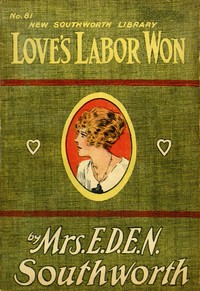
Love's labor won
by Emma Dorothy Eliza Nevitte Southworth
English421 downloads on Project GutenbergDownload EPUB
Public-domain ebook sourced from Project Gutenberg #68610.
Public-domain ebook
by Emma Dorothy Eliza Nevitte Southworth
English421 downloads on Project GutenbergDownload EPUB
Public-domain ebook sourced from Project Gutenberg #68610.
The opening · free to read
“Hers was the spell o’er hearts That only genius gives; The mother of the sister Arts, Where all their beauty lives.” --VARIED FROM CAMPBELL.
“Beautiful.”
“Glorious.”
“Celestial!”
Such were the exclamations murmured through the room, in low but earnest tones.
“So fair and dark a creature I have never seen,” said the French ambassador.
“The rarest and finest features of the blonde and the brunette combined; look at her hair and brow! It is as if the purple lustre of Italia’s vines lay upon the snow of Switzerland’s Alps,” said a young English gentleman, of some twenty years of age, and from whom the air of the university had scarcely fallen.
“You are too enthusiastic, Lord William,” gravely observed an elderly man, in the dress of a clergyman of the Church of England.
“Too enthusiastic, sir! Ah, now! do but see for yourself, if it be not profane to gaze at her. Is she not now--what is she? Queenly? Pshaw! I was, when a boy, at Versailles with my father; I saw Marie Antoinette and the beautiful princesses of her train; but never, no, never, have I seen beauty and dignity and grace like this. You have the honor of knowing the lady, sir?” he concluded, turning abruptly to a member of the French legation, standing near him.
“Oh, yes, monsieur, I have that distinction,” said the affable Parisian, with a bow and smile.
“And her name is----”
“Ah, pardon me, monsieur--Mademoiselle Marguerite De Lancie.”
“Oh! a countrywoman of your own?”
“Excuse, monsieur--a Virginie.”
“Ah, ha! Miss De Lancie, of Virginia,” said the young Englishman, who, having thus ascertained all that he wished to know for the present, now, with the characteristic and irresponsible bluntness of his nature, turned his back upon the small Frenchman, and gave himself up to the contemplation of the lady seated at the harp.
This conversation occurred in a scene and upon an occasion long to be remembered. The scene was the saloon of the old Presidential mansion at Philadelphia. The occasion was that of Mrs. Washington’s last reception, previous to the final retirement of General Washington from office. The beauty, talent, fashion and celebrity of the “Republican Court” were present--heroes of the Revolutionary struggle--warriors, whose mighty swords had cleft asunder the yoke of foreign despotism; sages, whose gigantic minds had framed the Constitution of the young Republic; men whose names were then, as now, of world-wide glory and time-enduring fame; foreign ministers and ambassadors, with their suites, all enthusiastic admirers, or politic flatterers of the glorious New Power that had arisen among the nations; wealthy, aristocratic or otherwise distinguished tourists, whom the fame of the young Commonwealth and the glory of her Father had attracted to her shores; women, also, whose beauty, grace and genius so dazzled the perceptions of even these late habitues of European courts that they avowed themselves unable to decide whether were the sons of Columbia the braver or her daughters the fairer!
And through them all, but greater than all, moved the Chief, arrayed simply, as a private gentleman, but wearing on his noble brow that royalty no crown could give.
But who is she, that even in this company of splendid magnificence, upon this occasion of supreme interest, can for an hour become the magnet of all eyes and ears!
Marguerite De Lancie was the only child of a Provençal gentleman and a Virginia lady, and combined in her person and in her character all the strongest attributes of the Northern and the Southern races; blending the passions, genius and enthusiasm of the one with the intellectual power, pride and independence of the other; and contrasting in her person the luxuriant purplish-black hair and glorious eyes of the Romaic nations, with the fair, clear complexion and roseate bloom of the Saxon. Gifted above most women by nature, she was also favored beyond most ladies by fortune. Having lost her mother in the tender age of childhood, she was reared and educated by her father, a gentleman of the most accomplished cultivation. He imbued the mind of Marguerite with all the purest and loftiest sentiments of liberty and humanity, that in his country somewhat redeemed the wickedness of the French Revolution. Monsieur De Lancie, dying when his daughter was but eighteen years of age, made her his sole heiress, and also, in accordance with his own liberal and independent principles, and his confidence in Marguerite’s character and strength of mind, he left her the irresponsible mistress of her own property and person. Marguerite was not free from grave faults. A beautiful, gifted and idolized girl, left with the unrestrained disposal of her time and her ample fortune, it was impossible but that she must have become somewhat spoiled. Her defects exhibited themselves in excessive personal pride and extreme freedom of thought and speech, and some irradicable prejudices which she took no trouble to conceal. The worshiped of many suitors, she had remained, up to the age of twenty-two, with her hand unengaged and her heart untouched. Several American women had about this time married foreign noblemen; and those who envied this superb woman averred that the splendid Marguerite only waited for a coronet.
When at home, Miss De Lancie resided either at her elegant town house in the old city of Winchester, or upon one of her two plantations, situate, the upper among the wildest and most beautiful hills of the Blue Ridge, and the lower upon the banks of the broad Potomac, where she reigned mistress of her land and people, “queen o’er herself.”
Marguerite was at present in Philadelphia, on a visit to her friend, Miss Compton, whose father occupied a “high official station” in the Administration. This was Miss De Lancie’s first appearance in Philadelphia society. And now that she was there, Marguerite, with the constitutional enthusiasm of her nature, forgot herself in the deep interest of this assembly, where the father of his country met for the last time, socially, her sons and daughters.
In accordance with the elegant ease that characterized Mrs. Washington’s drawing-rooms, several ladies of distinguished musical taste and talent had varied the entertainment of the evening by singing, to the accompaniment of the harp, or piano, the national odes and popular songs of that day.
Then ensued a short interval, at the close of which Miss De Lancie permitted herself to be led to the harp by Colonel Compton. She was a stranger to most persons in that saloon, and it was simply her appearance as she passed and took her place at the harp that had elicited that restrained burst of admiration with which this chapter opens.
She was, indeed, a woman of superb beauty, which never shone with richer lustre than upon this occasion that I present her to the reader.
Her figure was rather above the medium height, but elegantly proportioned. The stately head arose from a smoothly-rounded neck, whose every curve and bend was the very perfection of grace and dignity; lustrous black hair, with brilliant purple lights like the sheen on the wing of some Oriental bird, was rolled back from a queenly forehead, and turned over a jeweled comb in a luxuriant fall of ringlets at the back of her head; black eyebrows distinctly drawn, and delicately tapering toward the points, were arched above rich, deep eyes of purplish black, that languished or glowed, rocked or flashed, from beneath their long lashes with every change of mood; and all harmonized beautifully with a pure, rich complexion, where the clear crimson of the cheeks blended softly into the pearly whiteness of the blue-veined temples and broad forehead, while the full, curved lips glowed with the deepest, brightest flush of the ruby. She was arrayed in a royal purple velvet robe, open over a richly-embroidered white satin skirt; her neck and arms were veiled with fine point lace; and a single diamond star lighted up the midnight of her hair.
Having seated herself at the harp and essayed its strings, she paused, and seemingly unconscious of the many eyes riveted upon her, she raised her head, and gazing into the far-off distance, threw her white arm across the instrument, and swept its chords in a deep, soul-thrilling prelude--not to a national ode or popular song, but to a spirit-stirring, glorious improvisation! This prelude seemed a musical paraphrase of the great national struggle and victory. She struck a few deep, solitary notes, and then swept the harp in a low, mournful strain, like the first strokes of tyranny, followed by the earliest murmurs of discontent; then the music, with intervals of monotone, arose in fitful gusts like the occasional skirmishes that heralded the Revolution; then the calm was lost in general storm and devastation--the report of musketry, the tramp of steeds, the clashing of swords, the thunder of artillery, the fall of walls, the cries of the wounded, the groans of the dying, and the shouts of victory, were not only heard, but seen and felt in that magnificent tempest of harmony.
Then the voice of the improvvisatrice arose. Her subject was the retiring chief. I cannot hope to give any idea of the splendor of that improvisation--as easily might I catch and fix with pen, or pencil, the magnificent life of an equinoctial storm, the reverberation of its thunder, the conflagration of its lightning! Possessed of Apollo, the light glowed upon her cheeks, irradiated her brow, and streamed, as it were, in visible, living rays from her glorious eyes! The whole power of the god was upon the woman, and the whole soul of the woman in her theme. There was not a word spoken, there was scarcely a breath drawn in that room. She finished amid a charmed silence that lasted until Colonel Compton appeared and broke the spell by leading her from the harp.
Then arose low murmurs of enthusiastic admiration, restrained only by the deep respect due to the chief personage in that assembly.
“_La Marguerite des Marguerites!_” said the gallant French attaché.
“A Corinne! I must know her, sir. Will you do me the honor to present me?” inquired the English student, turning again to the Frenchman.
“Lord William!” interrupted the clerical companion, with an air of caution and admonition.
“Well, Mr. Murray! well! did not my father desire that I should make the acquaintance of all distinguished Americans?--and surely this lady must be one of their number.”
“Humph,” said the clergyman, stroking his chin, “the marquis did not, probably, include distinguished actresses, Lord William.”
“Actresses! have you judgment, Mr. Murray? Do but look with what majesty she speaks and moves!”
“So I have heard does Mrs. Siddons. Let us withdraw, Lord William.”
“Not yet, if you please, sir! I must first pay my respects to this lady. Will you favor me, monsieur?”
“Pardon! I will make you known to Colonel Compton, who will present you to the lady under his charge,” said the Frenchman, bowing, and leading the way, while the clergyman left behind only vented his dissatisfaction in a few emphatic grunts.
The book keeps going
Reading is free forever. Sign up and watch scenes appear while you read.



Scenes Storieta drew for other classics.
New illustrated classics
Once or twice a month: the latest books to get full character casts, scene art, and free comic editions. No account needed.