
Public-domain ebook
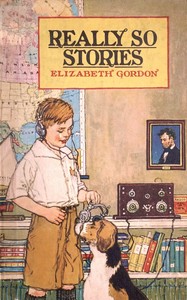
Really so stories
Language: en460 downloads on Project Gutenberg
Subjects
In: Short Stories·Children & Young Adult Reading
Public-domain ebook sourced from Project Gutenberg #68902.
Public-domain ebook
Language: en460 downloads on Project Gutenberg
Subjects
In: Short Stories·Children & Young Adult Reading
Public-domain ebook sourced from Project Gutenberg #68902.
The opening · free to read
The boy named Billy had begged to be allowed to stay up to greet the New Year. He had something he wanted to ask him if he could only see him, but he presently got so sleepy that his eyes wouldn’t stay open and so off he went to bed and to sleep.
But all at once there was a great tooting of whistles and ringing of bells, and a skyrocket went “_whiz_” right past his window. The boy named Billy sat up straight in bed.
“Oh,” said he, rubbing his eyes, “the New Year has come and I didn’t even see him.”
“Happy New Year, Billy,” said a jolly little voice. The boy named Billy rubbed his eyes to make sure--yes--he really did believe that there was a roly-poly little person sitting on the edge of the clock shelf swinging his bare pink feet and smiling happily.
“Why,” gasped Billy, “who are you?”
“Whom did you expect?” asked the little fellow. “I’m Father Time’s youngest year, to be sure. Haven’t got my license, or my number yet; I’m waiting until this racket stops. Were you looking for me for any special reason?”
“What I want to know,” said the boy named Billy, “is, how does the world know where one year ends and a new one begins?”
“That’s some question, youngster,” said the jolly New Year, laughing merrily, “and it took the funny old world some time to settle it. You see the year cannot be divided evenly into months and days, because the time actually required for the earth’s journey around the sun is 365 days, 5 hours, 48 minutes and 46 seconds. You call that the solar year, because the word ‘solar’ means concerning the sun.
“The old Romans tried having the New Year come on March first, but they had no real system, and were always in trouble. So Julius Caesar, the king, told the world that it was most important to have a calendar that could be depended upon to take care of all the time, because there wasn’t any too much, anyhow. So with the help of some very wise men he took the twelve new moons of the year and built a calendar around them. This was called the Julian calendar, and every fourth year figured this way was made a ‘leap year,’ and was given an extra day, making it 366 days long.
“But putting in a whole day every four years was too much, and after this calendar had been used over 1,500 years it was found that the calendar year was about ten days behind the solar year which wouldn’t do at all.
“So Pope Gregory XIII directed that ten days be dropped from the calendar that year and that the day after October 4, 1582, should be October 15. Then he rearranged the calendar so the New Year would begin January 1 and the calendar year and the solar year kept together. The Gregorian or New Style calendar as this one was called is the one we are using today.
“New Year’s Day has been celebrated in various ways since the dawn of civilization, and if today we could travel around the world on a magic carpet what a wonderfully interesting sight we would see!
“If you were in China you might think the Chinese saved their holidays to celebrate all at once. They close their shops for several days while they make merry with feasts and fireworks and general exchange of gifts and good wishes. In preparation every debt must have been paid, every house swept and cleaned, and each person furnished with holiday clothes and a supply of preserved fruits, candies, and ornamental packages of tea to give to his acquaintances.
“In some European nations, especially France and Scotland, New Year’s Day is a more important holiday than Christmas. If you were a French peasant child you might put a wooden shoe on the hearth for a gift at Christmas, but grownups in France exchange gifts at the New Year festival, at which time there are family parties, with much merrymaking.
“In America the observance of New Year’s Day is varied. New Year’s Eve there are ‘watch night’ services in the churches--gay street revelers--dancing and theater parties; and New Year’s Day is a time for general entertaining and visiting. However, the old custom of keeping open house and making New Year’s calls has practically disappeared.
“People are always glad to see the New Year and always welcome us in some glad and cheery way,” went on the New Year. “And it has always been the custom among all people to exchange gifts and greetings in the name of Happiness on New Year’s day. The Old Year is supposed to take away all sorrow and sadness, and the little New Year is supposed to bring nothing but happiness into the world, so it depends upon each person to see that he gets his share of the happiness.”
“How?” asked the boy named Billy.
“Easily,” answered the little New Year. “By living straight, playing fair, being kind and honest and helping those not so fortunate as you are. That’s all there is to it, little friend. And there goes the last whistle and now for three hundred and sixty-five days of real living. Happy New Year, Billy.”
“Now I wonder,” murmured Billy sleepily, “if that was really so, or did I dream it. I’m going to read up on that calendar thing the very first thing I do, and I’m going to play I saw the New Year anyway; and I’m going to try to do just as I think he would want me to ’cause I want my share in making this year a very, very happy one.”
“Mother has just had a telegram from Grandmother that she’s on her way to visit us,” said the boy named Billy. “I’m strong for Grandmother and I’m going to train to meet her.”
“We’re all fond of Grandmother,” corrected Big Sister, “and we’re all going to the train to meet her. Who brought the telegram?”
“Nobody brought it,” said the boy named Billy. “When it got to town it just hopped off the telegraph wires and hopped on the telephone wire and came right out here. That’s got magic beaten a mile I’ll say. Whoever invented the telegraph system anyhow?”
“Oh, you with your ‘who inventeds’!” said Big Sister. “Why don’t you study up such things yourself?”
“I can read it afterwards,” said the boy named Billy, “but when Somebody tells it to me that makes a story of it. Please, who did invent the Telegraph?”
“Samuel F. B. Morse did,” said Somebody. “He was born at Charlestown, Massachusetts, April 27th, 1791, and lived until April 2nd, 1872. He was a portrait painter, and student of chemistry, and went to London to study painting under Benjamin West, where he made such progress that when he returned to America he was given a commission to paint a full length portrait of LaFayette.”
“LaFayette was some hero and worth painting,” said the boy named Billy, “but when do we come to the telegraph?”
“Right now,” smiled Somebody. “The idea of electricity had been talked of for a long time, and while Mr. Morse was away on one of his trips to England it was found by some experimenting that electricity could be conveyed by means of wire over distances.
“A gentleman whom Mr. Morse met on ship board told him of these experiments and it brought to his mind the old belief held by Benjamin Franklin that intelligence some time would be conveyed by electricity, a belief which he had always shared. He went to work to perfect an instrument and a code for the system which he had in mind, with the result that when the boat landed his idea was ready to present.”
“He struck before the iron was hot, didn’t he?”
“In a manner of speaking, yes,” said Somebody, “but it was two long years after that before the system was completed and in working order. And it took quite some persuasion also to get other people to believe in it, but finally Congress voted him thirty thousand dollars to help him along with his project and so he won out.
“Where, before, it had taken months and years to get word from or to distant places, it could now be done almost instantly. Samuel Morse’s life was one long record of courage, integrity, patience and faith.”
“Bob White and I are fixing up a wireless on the roof of our garage,” said the boy named Billy. “It’s two hours before Grandmother’s train pulls in. Don’t forget to call me, and many thanks, Somebody!”
“I can’t seem to get the real snap into the salute that Sergeant Jim does,” said the boy named Billy. “He drills me on it every time I see him. But try as I may I can’t seem to get the style into it, and I’ve just got to learn it before I go into Scout camp; want to spring it on the fellows.”
“Sergeant Jim didn’t learn it in a lesson or two, either,” said Somebody. “He had it literally drilled into him. So don’t get discouraged, Billy.”
“I’m not discouraged; I’m going to get it,” said the boy named Billy. “Sergeant Jim says that when he first went into the service he just hated the salute. But after a while when he began to know what it meant, he didn’t mind it. What does it mean? Why should a soldier salute an officer? An officer’s no better than a soldier, is he?”
“Depends on how you look at it,” said Somebody quietly. “The officer occupies a higher position and the salute is a matter of courtesy--like saying ‘Good morning,’ to your mother, or the boy next door.”
“It is also a matter of discipline, isn’t it?” asked Big Sister.
“It has grown to be that, of course,” answered Somebody. “But it first came into being because the soldiers who were called the ‘Free Men of Europe’ were allowed to carry arms, while the slaves or serfs and poorer classes were not. When one military man met another it was customary for him to raise his arm to show that he had no weapon in it, and that the meeting was friendly. The slaves and serfs, not being allowed to carry weapons, passed without salute. But so imitative are we all that it was not long before everybody was saluting everybody else, which did not suit the aristocratic army men, who then resolved to make their salute so hard to learn that it could not be imitated without real military service, so that an outsider using it would brand himself as a commoner by his incorrect manner of saluting.”
“And so that’s how it became,” said the boy named Billy. “Well, I may not be a soldier, but I am going to get it if Sergeant Jim’s patience holds out.”
“You may not be a soldier, but you are a soldier’s grandson,” said Somebody. “And all of your people have been soldiers when there was any need to fight for the Stars and Stripes.”
The book keeps going
Reading is free forever. Sign up and watch scenes appear while you read.



Scenes Storieta drew for other classics.
New illustrated classics
Once or twice a month: the latest books to get full character casts, scene art, and free comic editions. No account needed.