Public-domain ebook
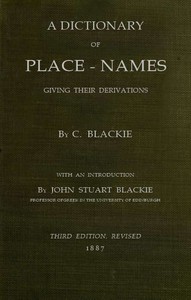
Geographical etymology: A Dictionary of Place-names Giving Their Derivations
English3,483 downloads on Project GutenbergDownload EPUB
Public-domain ebook sourced from Project Gutenberg #69018.
Public-domain ebook
English3,483 downloads on Project GutenbergDownload EPUB
Public-domain ebook sourced from Project Gutenberg #69018.
Geographical Etymology is a reference work devoted to the meanings and origins of place-names. Christina Blackie arranges root words alphabetically and explains how they appear in names from Britain and beyond, with particular attention to Celtic, Teutonic, and Scandinavian elements. The book shows how a name may preserve clues about a landscape’s size, shape, position, colour, geology, vegetation, or use, while also acknowledging that some derivations remain uncertain or omitted. Its method is practical as well as scholarly: an index and guidance on locating altered or compound names make it suitable for study, teaching, and the curious traveller. Along the way, geography becomes a record of language, history, and observation rather than a list of names to be memorised.
Written in the earnest, expansive manner of an 1887 work of popular scholarship, the book combines philological discussion with vivid descriptions of Highland scenery and examples drawn from many regions. Blackie is careful to distinguish evidence from attractive conjecture, yet her explanations retain a strong sense of discovery, making words feel like compact verbal pictures of the places they denote. It will appeal to readers interested in geographical names, Celtic and northern European languages, Scottish landscapes, historical linguistics, and the intellectual culture of Victorian education.
The opening · free to read
When I was myself one of a class in this city where Geography and History were taught, no information connected with etymology was imparted to us. We learned, with more or less trouble and edification, the names of countries, towns, etc., by rote; but our teacher did not ask us who gave the names to these places, nor were we expected to inquire or to know if there was any connection between their names and their histories. Things are changed now; and I believe the first stimulus to an awakening interest in Geographical Etymology was given by the publication of the Rev. Isaac Taylor’s popular work, Words and Places. About ten years ago, I found that the best teachers in the English schools of Edinburgh did ask questions on this subject, and I discovered, at the same time, that a book specially bearing upon it was a desideratum in school literature. As no one better qualified came forward, I was induced to make the attempt; and I hope the following pages, the result of much research and in the face of no small discouragement, may prove useful to teachers, as well as to their pupils.
The Index at the end of the volume, although it contains many names not included in the body of the work, does by no means include all that I have given there. This did not seem necessary, because, the root words being alphabetically arranged, an intelligent teacher or pupil will easily find the key to the explanation of any special name by referring to the head under which it is naturally classed. I must, however, premise that, with regard to names derived from the Celtic languages, the root word is generally placed at the beginning of the name--that is, if it contain more than one syllable. This is the case with such vocables as pen, ben, dun, lis, rath, strath, etc.; e.g. Lismore, Benmore, Dungarvan, Strath-Allan. On the other hand, in names derived from the Teutonic or Scandinavian languages, the root word comes last, as will be found with regard to ton, dale, burg, berg, stadt, dorf, ford, etc.
The index, therefore, may be expected to include principally such names as, either through corruption or abbreviation, have materially changed their form, such as are formed from the simple root, like Fürth, Ennis, Delft, or such as contain more than one, as in Portrush, it being uncertain under which head I may have placed such names. Along with the root words, called by the Germans Grundwörter, I have given a number of defining words (Bestimmungswörter)--such adjectives as express variety in colour, form, size, etc.
It is to be regretted that many names have necessarily been omitted from ignorance or uncertainty with regard to their derivation. This is the case, unfortunately, with several well-known and important towns--Glasgow, Berlin, Berne, Madrid, Paisley, etc. With regard to these and many others, I shall be glad to receive reliable information.
And now it only remains for me to express my obligations to the gentlemen who have kindly assisted me in this work, premising that, in the departments which they have revised, the credit of success is due mainly to them; while I reserve to myself any blame which may be deservedly attached to failures or omissions. The Celtic portion of my proof-sheets has been revised by Dr. Skene, the well-known Celtic scholar of this city, and by Dr. Joyce, author of Irish Names of Places. I have also to thank the Rev. Isaac Taylor, author of Words and Places, for the help and encouragement which he has given me from time to time; and Mr. Paterson, author of the Magyars, for valuable information which I received from him regarding the topography of Hungary. I appreciate the assistance given me by these gentlemen the more, that it did not proceed from personal friendship, as I was an entire stranger to all of them. It was the kindness and courtesy of the stronger and more learned to one weaker and less gifted than themselves; and I beg they may receive my grateful thanks, along with the little volume which has been so much their debtor.
C. B.
EDINBURGH, July 1887.
Among the branches of human speculation that, in recent times, have walked out of the misty realm of conjecture into the firm land of science, and from the silent chamber of the student into the breezy fields of public life, there are few more interesting than Etymology. For as words are the common counters, or coins rather, with which we mark our points in all the business and all the sport of life, any man whose curiosity has not been blunted by familiarity, will naturally find a pleasure in understanding what the image and superscription on these markers mean; and amongst words there are none that so powerfully stimulate this curiosity as the names of persons and places. About these the intelligent interest of young persons is often prominently manifested; and it is a sad thing when parents or teachers, who should be in a position to gratify this interest, are obliged to waive an eager intelligence aside, and by repeated negations to repel the curiosity which they ought to have encouraged. Geography indeed, a subject full of interest to the young mind, has too often been taught in such a way as neither to delight the imagination with vivid pictures, nor to stimulate inquiry by a frequent reference to the history of names; and this is an evil which, if found to a certain extent in all countries, is particularly rank in Great Britain, where the language of the country is composed of fragments of half a dozen languages, which only the learned understand, and which, to the ear of the many, have no more significance than if they were Hebrew or Coptic. The composite structure of our English speech, in fact, tends to conceal from us the natural organism of language; so that in our case, it requires a special training to make us fully aware of the great truth announced by Horne Tooke, that “in language there is nothing arbitrary.” Nevertheless, the curiosity about the meaning of words, though seldom cherished, is not easily extinguished; and, in this age of locomotion, there are few scraps of information more grateful to the intelligent tourist than those which relate to the significance of topographical names. When, for instance, the London holiday-maker, in his trip to the West Highlands, setting foot in one of Mr. Hutchinson’s steamboats at Oban, on his way to the historic horrors of Glencoe, finds on his larboard side a long, low island, green and treeless, called Lismore, he will be pleased, no doubt, at first by simply hearing so euphonious a word in a language that he had been taught to believe was harsh and barbarous, but will be transported into an altogether different region of intelligent delight when he is made to understand that this island is wholly composed of a vein of limestone, found only here in the midst of a wide granitic region skirted with trap; that, by virtue of this limestone, the island, though treeless, is more fertile than the surrounding districts; and that for this reason it has received the Celtic designation of Liosmor, or the great garden. Connected with this etymology, not only is the topographical name made to speak reasonably to a reasonable being, but it contains in its bosom a geological fact, and an œconomical issue, bound together by a bond of association the most natural and the most permanent. The pleasant nature of the intelligence thus awakened leads us naturally to lament that, except to those who are born in Celtic districts and speak the Celtic language, the significance of so many of our most common topographical names in the most interesting districts is practically lost; and it deserves consideration whether, in our English and classical schools, so much at least of the original speech of the country should not be taught as would enable the intelligent student to know the meaning of the local names, to whose parrot-like repetition he must otherwise be condemned.
Some of the Celtic words habitually used in the designation of places--such as Ben, Glen, Strath, and _Loch_--have been incorporated into the common English tongue; and the addition to this stock is not very large, which would enable an intelligent traveller to hang the points of his picturesque tour on a philological peg that would most materially insure both their distinctness and their permanence. Nay, more; the germ of appreciation thus begotten might lead a sympathetic nature easily into some more serious occupation with the old language of our country; and this might lead to a discovery full of pleasant surprise, that in the domain of words, as of physical growth, the brown moors, when examined, often produce flowers of the most choice beauty with which the flush of the most cultivated gardens cannot compete, and that a venerable branch of the old Indo-European family of languages, generally ignored as rude and unlettered, is rich in a popular poetry, as fervid in passion, and as healthy in hue, as anything that Homer or Hesiod ever sang.
In the realm of etymology, as everybody now knows, before Bopp and Grimm, and other great scholars, laid the sure foundation of comparative philology on the principles of a philosophy, as all true philosophy is, at once inductive and deductive, the license of conjecture played a mad part--a part, it is only too evident, not yet fully played out--and specially raised such a glamour of illusion about topographical etymology, that the theme became disgusting to all sober-minded thinkers, or ludicrous, as the humour might be. We must, therefore, approach this subject with a more than common degree of caution, anxious rather to be instructed in what is solid, than to be amazed with what is ingenious. It shall be our endeavour to proceed step by step in this matter--patiently, as with the knowledge that our foot is on the brink of boggy ground, starting from obvious principles given by the constitution of the human mind, and confirmed by a large induction of unquestioned facts.
The most natural and obvious reason for naming a place so-and-so would be to express the nature of the situation by its most striking features, with the double view of impressing its character on the memory, and conveying to persons who had not seen it an idea of its peculiarity; i.e. the most obvious and natural topographical names are such as contain condensed descriptions or rude verbal pictures of the object. Thus the notion of the highest mountain in a district may be broadly conveyed by simply calling it the big mount, or, according to the order of words current in the Celtic languages, mount big; which is exactly what we find in BENMORE, from mor, big, the name of several of the highest mountains in the Highlands of Scotland, specially of one in the south of Perthshire, near Killin, of another in Mull, the highest trap mountain in Scotland, and a third in Assynt. Again, to mark the very prominent feature of mountains elevated considerably above the normal height, that they are covered with snow all the year round, we find LEBANON, in the north of Palestine, named from the Hebrew leban, white; MONT BLANC, in Switzerland, in the same way from an old Teutonic word signifying the same thing, which found its way into Italian and the other Romanesque languages, fairly ousting the Latin albus; OLYMPUS, from the Greek λάμπομαι, to shine; the SCHNEEKOPPE, in Silesia, from schnee, snow, and koppe, what we call kip in the Lowland topography of Scotland, i.e. a pointed hill, the same radically as the Latin caput, the head. In the same fashion one of the modern names of the ancient Mount Hermon is Jebel-eth-Thelj, the snowy mountain, just as the Himalayas receive their names from the Sanscrit haima = Greek χεîμα, winter.
The book keeps going
Reading is free forever. Sign up and watch scenes appear while you read.



Scenes Storieta drew for other classics.
New illustrated classics
Once or twice a month: the latest books to get full character casts, scene art, and free comic editions. No account needed.