Grace and increace of knowelege frō God the Father through oure Lorde Jesus Christ, be with the Christen reader, and with all thē that loue the Lorde vnfaynedly Amen.
[Sidenote: 1. Tim. 3. Tit. 1.]
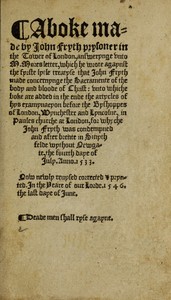
I chaunced beynge in these partyes, to be in companye with a Christen brother which for hys commendable conversaciō, and sobre behaueoure myght better be a Byshoppe thē many that weare myters, yf the rule of .S. Paule were regarded in their electyon. Thys brother after moche cōmunycacyō, desyred to knowe my mynde as touchynge the sacramēt of the body ād bloode of our sauyoure Christ. Which thynge I opened vnto hym accordynge to the gyfte that God had geuen me. Firste I proved vnto hym that yt was no article of oure fayth necessarye to be beleued vnder payne of dampnacyon. Then I declared that Christe had a naturall bodye, euen as myne ys (savynge synne) and that yt coulde no more be in two places at ones then myne can. Thyrdly, I shewed hym that it was not necessarye, that the wordes shulde so be vnderstonde as they sownde. But that yt myght be a phrase of scrypture, as there are innumerable. After that I shewed hym certen suche phrases ād maner of speakynges. And that yt was well vsed in oure Englyshe tongue. And fynally, I recyted after what maner they myght receyue yt accordynge to Christes institucyon, not fearynge the frowarde alteracyon that the Prestes vse, contrarye to the fyrste forme and institucion.
When I had suffycyently publyshed my mynde, he desyred me to entitle the some of my wordes, ād write them for hym, because they semed ouerlonge to be well reteyned in memorye. And albeit I was loth to take the matter in hāde, yet to fullfyll his instaunte intercession, I toke vpon me to touche this terryble tragedye, and wrote a treatyse, whiche beside my paynfull impresonment, is lyke to purchace me moste cruell death, which I am readye ād gladde to receyue with the spiryte and inwarde man (although the fleshe be frayle) when so euer yt shall please God to laye yt vpon me. Notwithstondynge to saye the truthe, I wrote yt not to the intent that yt shulde haue bene publyshed. For thē I wolde haue towched the matter more earnestlye, and haue wryten, as well of the spyrytuall eatynge & drynkynge whiche is of necessyte, as I ded of the Carnall, whiche is not so necessarye. For the treatyse that I made was not expedyent for all men, albeit yt were suffycient for thē whō I toke in hande to instructe. For they knewe the spyrytuall and necessarye eatynge and drynkynge of his bodye and bloode, whiche is not receyued with the teth and belye, but with the eares and fayth, and onely neaded instructyon in the outwarde eatynge, which thynge I therfore onely declared. But now it is commen a brode and in many mens mowthes, in so moche that master More which of late hathe busyed hym selfe to medle in all soche mattres (of what zele I wyll not defyne) hath sore laboured to confute yt. But some mē thynke that he is ashamed of his parte, ād for that cause doth so dylygently suppresse the worke whiche he prynted. For I my selfe sawe the worke in prynte in my Lorde of Wynchesters howse, upon S. Stephens day last paste. But neyther I, nor all the fryndes I coulde make, myght attayne any copye, but onely one wryten copye whiche as yt semed was drawen out in greate haste. Not withstondynge I can not well Judge, what the cause shulde be, that hys boke is kept so secrete. But this I am ryght sure of, that he neuer touched the foundacyō that my treatyse was buylded upon. And therfore syth my foundacyon stondeth so sure and invyncyble (for els I thynke verely he wolde sore haue laboured to haue undermyned yt) I wyll therupon buylde a lytle more, and also declare that hys ordynaunce is to slender to breake it downe although it were sett vpon a worse foundacyon.
❧ The foundacyon of that lytle treatyse was, that it is no artycle of our fayth necessarye to be beleued under payne of dampnacyon, that the Sacramēt shuld be the naturall bodye of Christe: which thynge is proued after this maner as foloweth.
Firste we muste all aknowlege that it is no artycle of our fayth whiche can saue vs nor whiche we are bounde to beleue under the payne of eternall dampnacyon. For yf I shulde beleue that hys verye naturall bodye bothe fleshe and bloode were naturally in the breade and wyne, that shulde not save me, seynge many beleue that, and receyue it to their dampnacyon, for it is not hys presēce in the breade that cā saue me, but hys presence in my harte through fayth in hys bloode, which hathe washed out my synnes and pacyfyed the Fathers wrathe towarde me.
[Sidenote: Obiection.]
And a gayne yf I do not beleue hys bodelye presence in the breade and wyne, that shall not dampne me, but the absence out of my harte through vnbeleue. Now yf they wolde here obiecte that thoughe yt be true that the absence out of the breade coulde not dampne vs: yet are we bounde to beleue it because of Goddes worde, whiche who beleueth not, as moche as in hym lyeth, maketh God a lyer. And therfore of an obstynate mynde not to beleue hys worde, maye be an occasyon of dampnacyon.
To this we may answere, that we beleue Goddes worde and knowlege that it is true: but in this we dissent, whether it be true in the sense that we take it in, or in the sense that ye take it in. And we saye agayne, that though ye haue (as yt apereth vnto yow) the evidēt wordes of Christe, and therfor consiste in the barke of the letter: yet are we compelled by conferrynge of the scryptures together, within the letter to serche out the mynde of our sauiour whiche spake the worde. And we saye thyrdly, that we do it not of an obstinate mynde. For he that defendeth a cause obstinatly (whether yt be true or false) is euer to be reprehended. But we do yt to satysfye our consciences whiche are compelled by other places of scripture, reasons, and doctours, so to Iudge of yt.
And euen so ought yow to Iudge of youre partye, and to defend youre sentence not of obstinacye, but by the reason of scriptures which cause you so to take yt. And so ought neyther partye to dispyse other, for eche seaketh the glory of God, and the true vnderstondynge of the scripture. This was the foundacyon of my fyrste treatyse that he hathe left vnshaken, which ys agreate argument that yt is very true. For els hys pregnant witte could not haue passed yt so cleane over. But wolde haue assayled yt with some sophisticall cavillacyon which by hys paynted poetrye he myght so haue colloured, that at the least he myght make the ignoraunt some apparēce of truthe, as he hathe done agaynste the resydue of my fyrste treatyse, which neuertheles ys true ād shall so be proved. ¶And firste that it is none article of our faythe necessarye to be beleued vnder payne of dampnacyon, may thus be furder cōfyrmed. The same faithe shall saue vs whiche saued the old fathers before Christes incarnacyon: But they were not bounde vnder payne of dāpnacyon to beleue this poynte, therfore yt foloweth that we are not bounde therto vnder the payne of dampnacyon. The fyrste parte of myne argument ys proued by S. Austen ad Dardamum. And I dare boldly say almost in an .C. places more. For I thynke there be no proposicyon which he doth more often inculcate then thys, that the same faythe saved vs which saued our fathers. The secōde parte ys manyfest, that yt nedeth no probacyon. For how coulde they beleue that thynge which was neuer sayde nor done, and without the worde they coulde haue no faythe. Upon the truthe of these two partes muste the conclusyon neades folowe. Not withstōdynge they all ded eate Christes bodye and dronke hys bloode spirytually, although they had hym not presēt to their teth. And by that spirytuall eatynge (which is the fayth in hys body ād blode) were saued as well as we are. For assoone [Sidenote: Adam.] as our fore father Adam had transgressed Godes precepte, & was fallē vnder cōdēpnacyō, oure moste mercyfull father of hys gracyous favoure gaue hym the promyse of helthe and conforte, wherby as many as beleued yt, were saued frō the thraldome of their transgressyon. The worde and promyse was this. I shall put enmyte betwene thy sede and her sede, [Sidenote: Gene. 3.] that sede shalt treade the on the heade, and thou shall trede yt on the hele. In this promyse they had knowlege that Christe shulde destroye the devyll with all his power, ād delyuer hys faythfull from their synnes. And where he sayd that the devyl shulde treade yt on the hele, they vnderstode ryght well that the devyll shulde fynde the meanes by his wyles and wycked mynysters to put Christe to deathe. And they knewe that God was true, and wolde fulfyll hys promyse vnto them, and hartely longed after this sede, and so dede bothe eate hys bodye and drynke his bloode, acknowlegynge with infynyte thankes, that Christ shulde for their synnes take the perfecte nature of manhode upon hym and also suffer the deathe: This promyse was geuen to Adam, and saued as many as ded beleue and were thankefull to God for his kyndnes, ād after yt was [Sidenote: Abrahā. Gene. 12] establyshed vnto our father Abraham by the worde of God, which sayde, in thy sede shall all nacyons of the earthe be blessed. And with hym God made a couenāt, that he wolde be his God and do hym good. And Abraham a gayne promysed to kepe his preceptes and walke in hys wayes. Then God gaue hym the sacrament of circumsicion and called that hys couenaunte, which thynge notwithstōdynge was not the very couenaunt in dede although yt were so called. But was only a sygne, token, sacrament, or memoryall of the couenaunte that was betwene God and hym, whiche myght expounde our matter, yf men had eyes to see. After that God promysed him a sone whē hys wyfe was past chylde bearynge and he also very olde. Neuerthelesse he doubted not of Goddes worde. But surely beleued, that he which promysed it was able to perfourme it. And that was recounted vnto hym for ryghtuousnes. This Abraham ded bothe eate hys bodye ād drynke hys blode (through faythe) belevynge verely that Christ shulde take our nature and sprynge oute of hys seede (as touchynge his fleshe) and also that he shulde suffer deathe to redeme vs. And as Christ testifyeth, [Sidenote: Ioan. 8.] he hartely desyred to see the day of Christ. And he sawe it and reioysed. He sawe yt in faythe ād had the day of christ, that is to say, all those thynges that shulde chaunce hym, playnly revelated vnto hym, albeit he were deade many hundred yeres before yt were actually fulfylled ād reuelated vnto the worlde. And by that fayth was he saued, and yet neuer ded eate hys fleshe with hys teth, nor neuer beleued that breade shulde be hys bodye and wyne hys bloode. And therfore syth he was also saued without that fayth, and the same faythe shall saue vs which saued hym, I thynke that we shall also be saued yf we eate hym spiritually (as he ded) although we neuer beleued that the breade ys hys bodye. Furthermore that mercyfull [Sidenote: Moses.]Moses (which brought the chyldern of Israell out of Egypte in to the wyldernes) obtayned of God by prayers, both manna from heauen to feade hys people, also water out of the stone to refresh and comforte them. This māna and water were even the same thynge vnto thē that the breade and wyne ys to vs. For as S. Austyn saythe: [Sidenote: Aug. de uite agē darum.] Quicunque in manna Christum intellexerunt eumdem quem nos cibum spiritualem manducauerunt. Quicunque autem de manna solam saturitatem quesiuerunt manducabant et mortui sunt. Sic etiam eundem potum: petra enim erat Christus.
The book keeps going
Keep reading, and see it illustrated
Reading is free forever. Sign up and watch scenes appear while you read.
Scenes Storieta drew for other classics.