Public-domain ebook
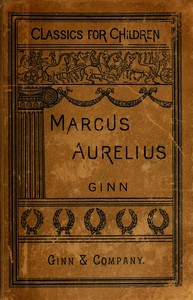
Thoughts of Marcus Aurelius
by Emperor of Rome Marcus Aurelius
Language: en1,780 downloads on Project Gutenberg
Subjects
In: Classics of Literature·Philosophy & Ethics
Public-domain ebook sourced from Project Gutenberg #6920.
Public-domain ebook
by Emperor of Rome Marcus Aurelius
Language: en1,780 downloads on Project Gutenberg
Subjects
In: Classics of Literature·Philosophy & Ethics
Public-domain ebook sourced from Project Gutenberg #6920.
The work is a collection of personal reflections by Marcus Aurelius, the Roman emperor and Stoic philosopher, assembled into eleven books that he wrote for his own use. The opening pages present a modern editor’s preface that explains why these thoughts were chosen for schoolchildren, emphasizing the emperor’s generosity, humility and lifelong self‑examination. The editor argues that the “illnesses of life” arise from our imagination, that injustice is rooted in ignorance, and that true value comes from directing one’s attention toward reason rather than material comforts. After the preface, a biographical sketch follows, tracing Aurelius’s birth in 121 AD, his education, adoption by Antoninus Pius, and his rise to power, while noting his dedication to philosophy, law, and military service. This introductory material sets the tone for a book that blends ethical counsel with the lived experience of a ruler.
The voice is that of a reflective, middle‑class Roman aristocrat, expressed in a measured, didactic style characteristic of late‑first‑century Stoic prose. The language is formal yet accessible, interweaving personal anecdote with broader moral principles. Readers who enjoy contemplative philosophy, especially those interested in how ancient ethical ideas intersect with political life, will find the text rewarding. It also appeals to history enthusiasts who appreciate a first‑hand glimpse of an emperor’s inner life, and to anyone seeking a sober, rational perspective on the challenges of self‑governance.
The opening · free to read
PREFACE BIOGRAPHICAL SKETCH THE THOUGHTS PHILOSOPHY OF MARCUS AURELIUS ANTONINUS GENERAL INDEX
[TRANSCRIBER’S NOTE: All the footnotes have been moved to the end of the text. I have also relabeled the book headings; [I., II., … XI.] has been changed to [BOOK I., BOOK II., … BOOK XI.] at the start of each Section. I have also added a “1.” before the first “thought” in each BOOK.]
PREFACE.
Perhaps some may question the wisdom of putting out the Thoughts of Marcus Aurelius Antoninus to be used as a Reader by children in the schools. It may appear to them better suited to the mature mind. The principle, however, that has governed us in selecting reading for the young has been to secure the best that we could find in all ages for grown-up people. The milk and water diet provided for “my dear children” is not especially complimentary to them. They like to be treated like little men and women, capable of appreciating a good thing. One finds in this royal philosopher a rare generosity, sweetness and humility, qualities alike suited to all ages.
Adopting the philosopher’s robe at twelve, he remains a student all his life. The precepts that he would give for the government of others, he has practised upon himself. In his time, as in ours, there were good physicians for the mind and body, who could make wise prescriptions for the government of their neighbors, but were unable to apply them to themselves. The faults of our fellows are so numerous and so easy to cure that one is readily tempted to become the physician, while our own faults are so few and so unimportant that it is hardly worth while to give any attention to them. Hence we have a multitude of physicians for humanity in general, and a scarcity of individual healers.
It was the doctrine of Marcus Aurelius that most of the ills of life come to us from our own imagination, that it was not in the power of others seriously to interfere with the calm, temperate life of an individual, and that when a fellow being did anything to us that seemed unjust he was acting in ignorance, and that instead of stirring up anger within us it should stir our pity for him. Oftentimes by careful self-examination we should find that the fault was more our own than that of our fellow, and our sufferings were rather from our own opinions than from anything real. The circle of man’s knowledge is very limited, and the largest circles do not wholly include the smallest. They are intersecting and the segment common to any two is very small. Whatever lies outside this space does not exist for both. Hence arise innumerable contests. The man having the largest intelligence ought to be very generous to the other. Being thankful that he has been blessed in so many ways, he should do all in his power to enlighten his less favored fellow, rather than be angry with him on account of his misfortune. Is he not sufficiently punished in being denied the light?
Assisting his uncle in the government of the great Roman Empire at seventeen, it was his aim constantly to restrain the power of the strong and to assist the weak. He studied the laws of his country, not for wisdom alone, but that he might make them more beneficial to his people. All his life he tried to bring his fellows to a higher level, and to think charitably of each other. Occupying himself a palace he lived simply, like other men. It was his greatest delight to retire to his country home and there, dwelling among his books, to meditate upon the great problems of life. He claimed that a man’s life should be valued according to the value of the things to which he gave his attention. If his whole thought was given to clothing, feeding and housing himself comfortably, he should be valued like other well-housed and well-fed animals. He would, however, derive the greatest pleasure and benefit in this life by acting in accordance with reason, which demands of every human being that his highest faculties should govern all the rest, and that each should see to it that he treated his fellow kindly and generously and that if he could not assist him to a higher level he should at least not stand in his way. When he speaks of the shortness of time and the value of fame, riches and power, for which men strive in this world, he speaks not from the standpoint of one who would wish to obtain these things, but as a Roman emperor enjoying the highest honors that man might expect to attain in this world. He certainly was in a position to speak intelligently concerning these matters, and his opinions ought to have weight with the coming generations. Children may not prefer to read such thoughts; perhaps the majority of children do not prefer the Bible to other books. Still, we all think it is well for them to be obliged to read it. Perhaps requiring the use of such literature in the schools might be as valuable as the adding, subtracting, multiplying and dividing of interminable numbers, the memorizing of all the capes, bays and rivers in the world, and the dates of all the battles that have occurred since the creation of man. We should strive to stimulate the thinking powers of children, leading them to form wise judgments concerning the important things of life, without catering too much to their own wishes at an age when they cannot form an intelligent opinion of what is best for themselves.
At our first reading of the Thoughts of Marcus Aurelius Antoninus, we marked many sentences that appeared to us specially good; in the second, twice as many more. Where all is good it is hard to emphasize, but we will cite just one of his reflections, as illustrating the trend of his mind: “I have often wondered,” he says, “how it is that every man loves himself more than all the rest of men, and yet sets less value on his own opinion of himself than on the opinion of others.”
We have given Long’s translation of the Thoughts complete, as published by Messrs. Little, Brown & Co., but we have omitted some unimportant portions of the biography and philosophy in the interest of space and economy. We have also given the philosophy in a supplement, thinking it better that it should come after the Thoughts themselves. We shall issue a pocket edition on very thin paper for the convenience of such as wish to make a special study of the work. We also propose to issue a similar edition of the writings of Epictetus.
EDWIN GINN.
January 20, 1893.
BIOGRAPHICAL SKETCH OF MARCUS AURELIUS ANTONINUS.
M. Antoninus, the son of Annius Verus and Domitia Calvilla, was born at Rome, A.D. 121. The Emperor T. Antoninus Pius married Faustina, the sister of Annius Verus, and was consequently the uncle of M. Antoninus. When Hadrian adopted Antoninus Pius and declared him his successor in the empire, Antoninus Pius adopted both L. Ceionius Commodus and M. Antoninus, generally called M. Aurelius Antoninus.
The youth was most carefully brought up. He thanks the gods (I. 17) that he had good grandfathers, good parents, a good sister, good teachers, good associates, good kinsmen and friends, nearly everything good. He had the happy fortune to witness the example of his uncle and adoptive father, Antoninus Pius, and he has recorded in his work (I. 16; VI. 30) the virtues of this excellent man and prudent ruler. Like many young Romans he tried his hand at poetry and studied rhetoric. There are letters extant showing the great affection of the pupil for the master, and the master’s great hopes of his industrious pupil.
When he was eleven years old he assumed the dress of philosophers, something plain and coarse, became a hard student, and lived a most laborious, abstemious life, even so far as to injure his health. He abandoned poetry and rhetoric for philosophy, and attached himself to the sect of the Stoics. But he did not neglect the study of law, which was a useful preparation for the high place which he was designed to fill. We must suppose that he learned the Roman discipline of arms, which was a necessary part of the education of a man who afterwards led his troops to battle against a warlike race.
Antoninus has recorded in his first book the names of his teachers, and the obligations which he owed to each of them. The way in which he speaks of what he learned from them might seem to savor of vanity or self- praise, if we look carelessly at the way in which he has expressed himself; but if anyone draws this conclusion, he will be mistaken. Antoninus means to commemorate the merits of his several teachers, what they taught, and what a pupil might learn from them. Besides, this book, like the eleven other books, was for his own use; and if we may trust the note at the end of the first book, it was written during one of M. Antoninus’ campaigns against the Quadi, at a time when the commemoration of the virtues of his illustrious teachers might remind him of their lessons and the practical uses which he might derive from them.
Among his teachers of philosophy was Sextus of Chaeroneia, a grandson of Plutarch. What he learned from this excellent man is told by himself (I. 9). His favorite teacher was Rusticus (I. 7), a philosopher, and also a man of practical good sense in public affairs. Rusticus was the adviser of Antoninus after he became emperor. Young men who are destined for high places are not often fortunate in those who are about them, their companions and teachers; and I do not know any example of a young prince having had an education which can be compared with that of M. Antoninus. Such a body of teachers distinguished by their acquirements and their character will hardly be collected again; and as to the pupil, we have not had one like him since.
Hadrian died in July, A.D. 138, and was succeeded by Antoninus Pius. M. Antoninus married Faustina, his cousin, the daughter of Pius, probably about A.D. 146, for he had a daughter born in A.D. 147. He received from his adoptive father the title of Caesar, and was associated with him in the administration of the state. The father and the adopted son lived together in perfect friendship and confidence. Antoninus was a dutiful son, and the emperor Pius loved and esteemed him.
Antoninus Pius died A.D. 161. The Senate, it is said, urged M. Antoninus to take the sole administration of the empire, but he associated with himself the other adopted son of Pius, L. Ceionius Commodus, who is generally called L. Verus. Thus Rome for the first time had two emperors. Verus was an indolent man of pleasure, and unworthy of his station. Antoninus however bore with him, and it is said that Verus had sense enough to pay to his colleague the respect due to his character. A virtuous emperor and a loose partner lived together in peace, and their alliance was strengthened by Antoninus giving to Verus for wife his daughter Lucilla.
The reign of Antoninus was first troubled by a Parthian war, in which Verus was sent to command; but he did nothing, and the success that was obtained by the Romans in Armenia and on the Euphrates and Tigris was due to his generals. This Parthian war ended in A.D. 165. Aurelius and Verus had a triumph (A.D. 166) for the victories in the East. A pestilence followed, which carried off great numbers in Rome and Italy, and spread to the west of Europe.
The book keeps going
Reading is free forever. Sign up and watch scenes appear while you read.



Scenes Storieta drew for other classics.
New illustrated classics
Once or twice a month: the latest books to get full character casts, scene art, and free comic editions. No account needed.