Public-domain ebook
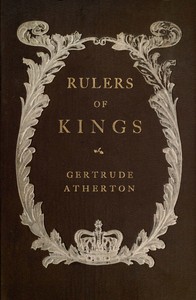
Rulers of kings: A novel
by Gertrude Franklin Horn Atherton
Language: en557 downloads on Project Gutenberg
Subjects
In: Novels·American Literature
Public-domain ebook sourced from Project Gutenberg #69460.
Public-domain ebook
by Gertrude Franklin Horn Atherton
Language: en557 downloads on Project Gutenberg
Subjects
In: Novels·American Literature
Public-domain ebook sourced from Project Gutenberg #69460.
The opening · free to read
May it not be that in every family there are unborn children--souls that have come too late perhaps to find a medium, yet, in consequence of their hereditary particles, unable to seek it elsewhere? We know not what mysterious dissolutions and recombinations of spirit take place in the realm where the released forces go, with what deliberation the essences of families are remixed; oftenest, no doubt, with commonplace results; sometimes with intent to bring humiliation and disaster upon a house which has transgressed too many laws; yet again, combining the great characteristics of mind and soul and temperament of those who have distinguished themselves in history, with such weaknesses as must inevitably destroy all three--as in the notable instance of the last Rudolf von Hapsburg. Again, the best may have been remixed with only enough of human weakness and passion that love may be inspired instead of awe, that happiness without disaster may be possible. And yet the most fortunate of these fusions may be finished too late for its generation, and be forced to bide its time invisible; or perhaps, by some spiritual statute of limitations, is deprived of its earthly rights forever. Nevertheless, it may linger in spirit where it should walk in its servant of flesh, and unknown, unsuspected, take its part in the daily life of its kin, having its own influence perhaps on their destinies and on history. And the romanticist, so much of whose time is spent in the unreal world, may fancy, once in a way, that one of these belated souls has swum into his ken, and that his privilege is to rescue it, to fit it to the part for which Nature so tirelessly equipped it.
NOTE.--The dinner described in Chapter IV., Part II. occurred in 1897, but it being necessary that the action of the story should take place several years later, I have brought it forward. This of course could not have been done had certain circumstances arisen which might have given immediate historic results to the speech of the Emperor of Germany. Those circumstances not having arisen, it makes little difference whether the speech was delivered yesterday or six years ago. Otherwise, the dinner, the speech, its effect upon the Hungarian magnates present, its reception next day by the Hungarian press and people, were as described.
When Fessenden Abbott heard that he was to inherit four hundred millions of dollars he experienced the profoundest discouragement he was ever to know, except on that midnight ten years later when he stood on a moonlit balcony in Hungary, alone with the daughter of an Emperor, and opened his contemptuous American mind to the deeper problems of Europe.
His ambition had been immeasurable, yet almost defined. His hopes had been the confident imperious extravagances of a youth in whom narrow circumstances and a high indomitable spirit had developed that ardent personal force which equips man to conquer life. His ideals had soared in stellar spaces--ideals created by passionate brooding on the careers of Washington, Hamilton, Napoleon, Nelson, Cromwell, Kossuth, the great Hunyadis, Alexander, Cæsar, Rudolph the First of Austria. How he had pored over the lives of this catholic assortment of heroes while his fingers froze and the winds roared through the Adirondack wilderness; on hot summer afternoons as he trudged behind his plough, the reins wound about one arm, his book in the bend of the other, vaguely wondering sometimes why his manifest delinquencies were never noticed.
As he looked back he marvelled at the bluntness of his observation. His difference from the other young men of that high gallery of the continent must have been obvious, and whenever he thought of his dead mother it was to associate her with a magnificence of personal environment which in time he grew to believe he had borrowed from the Arabian Nights for the more loyal framing of a created memory; certainly in real life, even in those huge cities where men made money, even in the vast cold palaces of Europe, of which he had read, there could be nothing to-day like those splendors which haunted his young mind.
He had just investigated the interiors of the toys of his third Christmas when he was made to keep so quiet for four days that he became a miserable and obstreperous baby; on the fifth he forgot the troubles of his past in a twelve-hours’ journey with his doting father. His indulgent nurse had been dismissed, and a woman with a white cap and a firm admonishing eye formed the rear of his body-guard, and held him to the window when his restless legs sent his father to the smoking compartment. He could remember still his bewildered sensation as the train climbed slowly through dark forests, as hard black peaks travelled across his blinking vision. Of the night ride through the woods in a springless wagon he recalled little but the sharp accentuations of the “bull’s-eye” and the deep sighs of his nurse. After that, life for several years was too monotonous for memories. He lived in a farm-house without toys and sweets--which he quickly forgot--and after the departure of his nurse at the end of three months his was the life of any mountain-boy; out of doors in the wildest weather, out of bed at six o’clock, cuffed, spanked, roughly petted by the farmer’s mother, beside whose bed he slept during the remaining years of his childhood. Twice a year his father came and spent a day on the Nettlebeck farm. In summer Fessenden led him through the woods, and exhibited his many treasures, expounded the forest lore to which he had instinctively applied himself as soon as he could run alone--unanticipative of the lore to which it would be the golden key in more difficult years. In winter they sat in the best parlor, close to a red stove, which made the boy, little used to the luxury of fires, sleepy and almost ill. Neither woods nor fire inspired Mr. Abbott to many words. He examined the boy in his studies, and took his physical measurements, comparing them with previous entries in a little red book. Then, after an interval of sound fatherly advice, and another of tender interest, he usually went to sleep; or remained motionless for hours, his weary eyes fixed and rapt, his lips and nostrils quivering occasionally, but stern, immobile, relentless, the lower lip raised, the upper drawn down and under. His little son fidgeted, coughed respectfully, yawned shamelessly, and finally stole away. Mr. Abbott, upon his arrival, always presented Fessenden with a box of books, several red sweaters, and, as soon as he was old enough, a new pair of trousers--for his Sunday use; the boy wore overalls on other days. Mr. Abbott forbade him to clothe his more conspicuous part in anything but red, that he might be found in briefer time if lost, and avoided with less effort in the hunting season.
The books were selected with a careful regard for his succeeding years, and under their insidious gardening his imagination developed and his horizon receded. He received his elementary schooling from a young woman on a neighboring farm. At the same time his body grew tall and strong and his temper fierce. He took as easily to fighting as to books; he was sometimes ignominiously whipped by hulking mountain-boys, sometimes he won against heavy odds, for he had an instinct for the scientific rules of the game, a long wind, hard muscles, and the primitive delight of the small boy in war. The fights were not uncommonly for the favor of some baby minx, but oftener for the pure lust of battle. He was frequently mangled and battered when his father arrived, but Mr. Abbott merely laughed, and, on the whole, seemed to approve his appearance. So passed the uneventful years until his tenth birthday, when life began to ring its changes.
Mr. Abbott sat in the rocking-chair by the hot stove regarding his son with his dreamy far-seeing eyes. For the first time Fessenden wondered who and what his father was. This man was like no one in the books he had read, like no one in the Adirondacks. He was a boy of direct methods, and was about to ask for information when his father spoke.
“I am more gratified at your physical development than you will ever know, my son,” said Mr. Abbott, tenderly. “When I brought you here you were fragile and undersized; it was thought that your chance of becoming a strong man, or of reaching manhood at all, was perhaps two in ten. But I knew the magic of the mountains; I made my experiment, and I have succeeded. There are other things I wish to say to you, however, so sit down and listen attentively.”
Fessenden, in a glow of expectation, fell upon a corner of the sofa, and Mr. Abbott continued.
“Originally I planned to speak to you decisively when you were thirteen or fourteen, but it seems to me that you are brighter than most boys of your age; I think I cannot begin too soon to prepare you for the future. Some boys are taught to say their prayers. I presume you have been taught to say yours by our good Mrs. Nettlebeck, and I am sure I hope you say them; but I want you to repeat, every Saturday night before you lie down, these words I am going to teach to you; if you forget them, to rise in the coldest and darkest night, stand in the middle of the room, and repeat them twice. The words are these--write them down: ‘Life is a fight. Millions fail. Only the strong win. Failure is worse than death. Man’s internal strength is created by watching Circumstance like a hawk, meeting her every spring stiff and straight, laughing at her pitfalls--which in the beginning of life are excess, excess, and always excess, and all manner of dishonor. Strength is created by adversity, by trying to win first the small battles of life, then the great, by casting out fear, by training the mind to rule in all things--the heart, the passions, the impulses, which if indulged make the brain the slave instead of the master. Success, for which alone a man lives, if he be honest with himself, comes to those who are strong, strong, strong.’ When you have finished that I want you to repeat ‘No’ aloud for ten minutes. The time will come when you will rejoice that ‘No’ flies, instead of moving reluctantly, to your tongue. As for that prayer I have given you, you may not understand it all now, but you will as you grow older, better and better; you will analyze and ponder upon it. Life is choked and gasping with young men trying to get a decent living, with thousands besides struggling for a career, reputation. I shall do my best to educate you, but I want you to grow up with the distinct understanding that you must support yourself when that preparatory period is over. I may be able to help you to some sort of a position, but I may be dead--and I must do what I can for your sister--”
“My what?” shouted Fessenden. “You never told me I had a sister!”
“Did I not? I should have thought I must have mentioned it. She was born when your mother died, and her name is Alexandra. Do not interrupt me again, and listen attentively. I wish you, as I have just said, to grow up with the clearly defined idea that you must make your own way in the world, make every dollar you spend, owe your position, and the respect you may be able to inspire, to your personality--to the dignity of your character and the brilliancy of your mind. I shall keep you here until you are ready for college, where I hope to be able to send you; for, unlike many Americans, I believe in educating a man like a gentleman. I have just met with a piece of extraordinary good fortune: the other day an old friend called on me for the first time in many years; he told me that his son, a Harvard man, and a profound student, was so delicate that he might be obliged to spend the remainder of his life in the high altitudes. I called on the young man immediately--his name is Stanley Morris--and persuaded him to come here, for I realized what such companionship would mean to my bright little son. He was very glad of the suggestion, and agreed, for the sake of a small annual sum, to become your teacher--in time to prepare you for college. It was a great relief to my mind, for I want you to remain in this healthy mountain region until you are grown, and, of course, expensive tutors and schools are out of the question. He will be able to teach you German and French among other things, and he has a large library. Therefore, I shall not send you any more books. Fortunately you need only these rough clothes up here. I feel quite confident that I shall be able to afford the small yearly sum Mr. Morris demands. But you are never to forget that you are studying for equipment, not as the mere routine of youth. Do you understand?”
The book keeps going
Reading is free forever. Sign up and watch scenes appear while you read.



Scenes Storieta drew for other classics.
New illustrated classics
Once or twice a month: the latest books to get full character casts, scene art, and free comic editions. No account needed.