Public-domain ebook
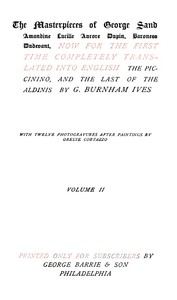
The Piccinino, Volume 2 (of 2); The last of Aldinis
by George Sand
Language: en582 downloads on Project Gutenberg
Subjects
Public-domain ebook sourced from Project Gutenberg #69840.
Public-domain ebook
by George Sand
Language: en582 downloads on Project Gutenberg
Subjects
Public-domain ebook sourced from Project Gutenberg #69840.
The opening · free to read
"Well," replied Michel, emboldened by his host's dignified arguments and sincere kindliness, "I will tell you my whole thought; and I trust that Master Barbagallo will permit me to speak before him, even though what I have to say may be offensive to his beliefs. If the study of heraldic science were a useful and moral study, Master Barbagallo, the favored nursling of that science, would regard all men as equal before God, and would recognize no distinction except between narrow-minded or wicked and intelligent or virtuous men. He would appreciate fully the vanity of titles and the very doubtful value of genealogical trees. He would have broader views concerning the history of the human race, as we were saying just now; and he would view that wonderful history with a glance no less firm than impartial. Whereas, if I am not mistaken, he views it with a certain narrowness of vision which I cannot accept. He esteems nobility an excellent thing because it is privileged; he despises the common people because they have no history and no memories. I will wager that he despises himself by dint of admiring the grandeur of others, unless he has discovered amid the dust of some library some document which affords him the honor of deeming himself related in the fourteenth degree to some illustrious family."
"I have not that honor," said the majordomo, somewhat disconcerted. "However, I have had the satisfaction of assuring myself that I am not descended from ignoble stock; some of my male ancestors were men of distinction in the clergy and in business."
"I congratulate you most sincerely," said Michel, ironically; "for my own part, it has never occurred to me to ask my father whether our ancestors were sign-painters, beadles or majordomos. Indeed, I admit that it is a matter of perfect indifference to me, and that I have never had but one thought in that direction--namely, to owe any celebrity I may attain to myself, and to create my own coat-of-arms with my palette and brushes."
"Good!" exclaimed the marquis, "a noble ambition. You aspire to be the founder of a race illustrious in the arts, and to earn your own nobility, instead of throwing it away, as so many poor creatures do who are unworthy to bear a great name. But would you consider it a disadvantage that your descendants should be proud to bear your name?"
"Yes, signor marquis, I would, if my descendants were ignorant fools."
"My friend," replied the marquis, very calmly, "I am aware that the nobility has degenerated in all countries, and I do not need to tell you that it is the less pardonable in proportion to the degree of distinction that it had to bear and of grandeur to maintain. But is it for us to call this or that social rank to book, or to attempt to decide concerning the merit or lack of merit of the individuals who compose it? The most interesting, and at the same time the most profitable course for us all, in a discussion of this sort, would be to examine the institution in itself. Will you not tell me your ideas, Michel, and whether you approve or disapprove the distinctions established between different classes of men?"
"I approve them," said Michel, unhesitatingly, "for I aspire to distinguish myself; but I disapprove any application of the principle of heredity in such distinctions."
"Of the principle of heredity?" repeated the marquis. "In so far as fortune and power are concerned, I agree. That is a French idea--a bold idea. I like such ideas! But in so far as regards disinterested renown, honor pure and simple--will you allow me to ask you a few questions, my boy?
"Let us assume that Michelangelo Lavoratori, here present, was born only two or three hundred years ago. Let us assume that he was the rival of Raphael or Titian, and that he left a name worthy to stand beside those glorious names. I will assume, also, that this palace in which we now are belonged to him, and that it has remained in his family. Lastly, let us assume that you are the last scion of that family, and that you do not cultivate the art of painting. Your inclinations have turned you toward some other profession, or perhaps you have no profession, for you are rich; the noble works of your illustrious ancestor produced a fortune which his descendants have faithfully transmitted to you. You are standing here under your own roof, in the portrait gallery in which your ancestors have their places one after another. Moreover, you know the history of all of them. It is contained in manuscripts which have been carefully preserved and handed down in your family.
"Let us suppose, further, that I, a child picked up on the steps of a hospital, wander into this palace. I am ignorant of my father's name, and even of that of the unfortunate creature who gave birth to me. I have no ties whatever that bind me to the past, and, born but yesterday, I gaze with surprise upon this succession of ancestors from whom you have descended through well-nigh three centuries. I question you in open-mouthed wonder, and I am even inclined to make sport of you for living thus with the dead and through the dead; and I doubt whether this brilliant lineage has not deteriorated a little in the lapse of time.
"You answer me by pointing with pride to the founder of your race, the illustrious Michelangelo Lavoratori, who, from nothing at all, had become a great man, and whose memory will never perish. Then you tell me a fact at which I marvel greatly: that the sons and daughters of this Michel, overflowing with veneration for their father's memory, chose to be artists too. One was a musician, another an engraver, a third a painter. If they did not receive from heaven the same talents as their father, they did at all events retain in their hearts and transmit to their children respect and love for art. Their children, in their turn, did likewise, and all these talents, all these mottoes, all these biographies, which you exhibit to me and explain to me, present the spectacle of several generations of artists, eager to maintain the standard of their hereditary profession. Unquestionably only a few among all these seekers after glory were truly worthy of the name they bore. Genius is an exception, and it takes you but a short time to point out to me the small number of noteworthy artists who have upheld by their own labors the glory of your family. But that small number has been sufficient to replenish your generous blood, and to maintain in the ideas of the intermediate generations a certain fire, a certain pride, a certain thirst for grandeur which may still produce distinguished men.
"But I, a foundling, isolated in the vast expanse of time--I continue my apologue,--a natural scorner of all hereditary celebrity, seek to lower your pride. I smile with an air of triumph when you admit that this or that ancestor, whose portrait impresses me by its air of innocence, was never anything more than a paltry genius, a narrow-minded creature; that a certain other, whose rakish dress and bristling moustache I do not like, was a black sheep, a fool or a fanatic; in short, I give you to understand that you are a degenerate artist, because you have not inherited the sacred fire, and that you have fallen asleep in a luxurious far niente, contemplating the fruitful life of your forefathers.
"Thereupon you reply to me; and you will allow me to place in your mouth a few words which seem to me not devoid of sense:
"'I am nothing at all in myself; but I should be even less had I not a venerable past to lean upon. I am overborne by the apathy natural to minds devoid of inspiration; but my father taught me one thing which passed from his blood into mine: that I come of a distinguished family, and that if I could do nothing to renew its splendor, I should, at all events, abstain from tastes and ideas which might tarnish it. In default of genius, I have respect for family tradition, and, having no ground for pride in myself, I repair the wrong which my nullity might inflict upon my ancestors by bestowing a sort of adoration upon them. I should be a hundred times more guilty if, caring naught for my ignorance, I should shatter their images and profane their memory by airs of contempt. To deny one's father because one cannot equal him is the act of a fool or a dastard. On the other hand, it is a pious duty to invoke his memory in order to obtain forgiveness for being less eminent than he; and the artists with whom I consort and to whom I have no works of my own to show, listen to me with interest, at all events, when I speak to them of the works of my ancestors.'
"That is the answer you would make to me, Michel, and do you think that it would have no effect upon me? It seems to me that if I were the poor, abandoned child that I have imagined, I should fall into profound melancholy, and should complain of fate for having dropped me upon the earth alone, and, so to speak, without sponsors.
"But I pass to a less ponderous apologue, and one better adapted to your artistic imagination, which, however, I beg you will interrupt immediately if you have already heard it. The anecdote has been attributed to several persons cut after the pattern of Don Juan, and as old stories are rejuvenated from generation to generation, it has been told recently of Cæsar de Castro-Reale, the Destatore, the famous brigand, who was no ordinary man either in good or evil.
"At Palermo, in the days when he sought to deaden his faculties in wild dissipation, uncertain whether he should succeed in making a perfect brute of himself, or should decide to raise the standard of rebellion, it is said that he went one evening to visit a venerable palace which he had just lost at play, and which he wished to see once more before leaving it never to return. It was the last remnant of his fortune, and perhaps the only thing which caused him the slightest regret; for it was there that he had passed his early years, there that his parents had died, there that the portraits of his ancestors were buried in the dust of long neglect.
"He went there to notify his steward to receive on the morrow, as the proprietor of the estate, the nobleman who had won it on a cast of the dice.--'What,' said the steward, who, like Master Barbagallo, had a profound respect for family traditions and portraits; 'you have staked everything, even your father's grave, even the portraits of your ancestors?'
"'Staked and lost everything,' replied Castro-Reale, heedlessly. 'However, there are a few articles which I am able to redeem, and my successful adversary will not haggle over them. Let us look at these family portraits! I have forgotten all about them. I used to admire them at a time when I knew nothing about such things. If there are some which have merit, I will set them aside and make some arrangement with their new owner. Take a light and follow me.'
"The steward, agitated and trembling, followed his master through the dark and deserted palace. Castro-Reale strode before, with arrogant assurance; but they say that he had drunk immoderately on arriving at his palace, in order to provide himself with a store of stoicism or recklessness that should last to the end. He himself opened the rusty door, and seeing that the hand trembled in which the old majordomo held the light, he took it in his own and held it on a level with the face of the first portrait in the gallery. It was a fierce warrior armed from top to toe, with a broad ruffle of Flemish lace over his iron cuirass. See! here he is, Michel, for the same pictures which play a part in my narrative are here before your eyes; they are the same which were sent from Palermo to me, as the last heir of the family."
The book keeps going
Reading is free forever. Sign up and watch scenes appear while you read.



Scenes Storieta drew for other classics.
New illustrated classics
Once or twice a month: the latest books to get full character casts, scene art, and free comic editions. No account needed.