Public-domain ebook
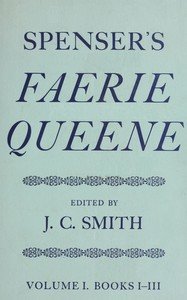
Spenser's Faerie Queene, Vol. 1 (of 2): Books I-III
Language: en7,924 downloads on Project Gutenberg
Subjects
In: Poetry·Classics of Literature·British Literature
Public-domain ebook sourced from Project Gutenberg #70717.
Public-domain ebook
Language: en7,924 downloads on Project Gutenberg
Subjects
In: Poetry·Classics of Literature·British Literature
Public-domain ebook sourced from Project Gutenberg #70717.
The work is an early‑modern English epic poem that sets out to present a “true text” of Edmund Spenser’s *Faerie Queene* by collating the 1590 and 1596 quartos with the 1609 folio. The editor explains that the first three books (I‑III) are reproduced from the 1596 edition, with careful notes on variant spellings, punctuation and typographical quirks such as the long s and superscripted letters. The introduction details how the editor has retained most of Spenser’s original punctuation, especially the lack of commas with vocatives and the single comma after qualifying phrases, while recording any departures from the 1596 source. It also outlines the scholarly apparatus that accompanies the text: notes on phonological variants, explanations of Spenser’s deliberate archaisms, and a discussion of the poet’s occasional metrical slips and imperfect rhymes. This makes the volume as much a study of Elizabethan textual practice as a reading of the poem itself.
The language is dense, formal and richly allusive, reflecting the poet’s late‑sixteenth‑century style and his penchant for elaborate allegory. Spenser’s verse is built on the Spenserian stanza (ababbcbcc) and is riddled with archaic spellings, occasional hypermetrical lines, and a rhetoric‑driven punctuation that rewards aloud reading. Readers who enjoy close‑reading of historic poetry, the mechanics of early modern printing, or the interplay of virtue, knighthood and myth will find this edition rewarding. It especially appeals to scholars of Elizabethan literature, students of poetic form, and anyone fascinated by the complexities of establishing a canonical text from multiple early editions.
INTRODUCTION. I. In these volumes I seek to present a true text of the Faerie Queene , founded upon a fresh collation of the Quartos of 1590 and 1596 and the Folio of 1609. I shall call these editions by their dates for short. The fragmentary Seventh Book appeared first in 1609: for the rest the text is based on 1596. Some typographical peculiarities—long s, &, ô, and superscribed m and n (e.g. frõ, whẽ)—have not been reproduced, but noted only where they first occur. With these exceptions, the readings of 1596 if not adopted in the text are recorded in the notes; so that text and notes together amount, in effect, to a complete reprint of 1596. No such completeness has been attempted in recording variants from 1590 and 1609. But all verbal differences are recorded, and all differences of punctuation that imply a different view of the meaning. …
Keep reading free · chapter 1 needs no account