Public-domain ebook
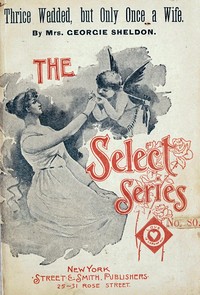
Thrice wedded, but only once a wife
English447 downloads on Project GutenbergDownload EPUB
Public-domain ebook sourced from Project Gutenberg #70837.
Public-domain ebook
English447 downloads on Project GutenbergDownload EPUB
Public-domain ebook sourced from Project Gutenberg #70837.
The opening · free to read
STREET & SMITH’S SELECT SERIES No. 23.
Price, 25 Cents.
Some Opinions of the Press.
“As the probabilities are remote of the play ‘The Old Homestead’ being seen anywhere but in large cities it is only fair that the story of the piece should be printed. Like most stories written from plays it contains a great deal which is not said or done on the boards, yet it is no more verbose than such a story should be, and it gives some good pictures of the scenes and people who for a year or more have been delighting thousands nightly. Uncle Josh, Aunt Tildy, Old Cy Prime, Reuben, the mythical Bill Jones, the sheriff and all the other characters are here, beside some new ones. It is to be hoped that the book will make a large sale, not only on its merits, but that other play owners may feel encouraged to let their works be read by the many thousands who cannot hope to see them on the stage.”—_N. Y. Herald_, June 2d.
“Denman Thompson’s ‘The Old Homestead’ is a story of clouds and sunshine alternating over a venerated home; of a grand old man, honest and blunt, who loves his honor as he loves his life, yet suffers the agony of the condemned in learning of the deplorable conduct of a wayward son; a story of country life, love and jealousy, without an impure thought, and with the healthy flavor of the fields in every chapter. It is founded on Denman Thompson’s drama of ‘The Old Homestead.’”—_N. Y. Press_, May 26th.
“Messrs. Street & Smith, publishers of the New York Weekly, have brought out in book-form the story of ‘The Old Homestead,’ the play which, as produced by Mr. Denman Thompson, has met with such wondrous success. It will probably have a great sale, thus justifying the foresight of the publishers in giving the drama this permanent fiction form.”—_N. Y. Morning Journal_, June 2d.
“The popularity of Denman Thompson’s play of ‘The Old Homestead’ has encouraged Street & Smith, evidently with his permission, to publish a good-sized novel with the same title, set in the same scenes and including the same characters and more too. The book is a fair match for the play in the simple good taste and real ability with which it is written. The publishers are Street & Smith, and they have gotten the volume up in cheap popular form.”—_N. Y. Graphic_, May 29.
“Denman Thompson’s play, ‘The Old Homestead,’ is familiar, at least by reputation, to every play-goer in the country. Its truth to nature and its simple pathos have been admirably preserved in this story, which is founded upon it and follows its incidents closely. The requirements of the stage make the action a little hurried at times, but the scenes described are brought before the mind’s eye with remarkable vividness, and the portrayal of life in the little New England town is almost perfect. Those who have never seen the play can get an excellent idea of what it is like from the book. Both are free from sentimentality and sensation, and are remarkably healthy in tone.”—_Albany Express._
“Denman Thompson’s ‘Old Homestead’ has been put into story-form and is issued by Street & Smith. The story will somewhat explain to those who have not seen it the great popularity of the play.”—_Brooklyn Times_, June 8th.
“The fame of Denman Thompson’s play, ‘Old Homestead,’ is world-wide. Tens of thousands have enjoyed it, and frequently recall the pure, lively pleasure they took in its representation. This is the story told in narrative form as well as it was told on the stage, and will be a treat to all, whether they have seen the play or not.”—_National Tribune_, Washington, D. C.
“Here we have the shaded lanes, the dusty roads, the hilly pastures, the peaked roofs, the school-house, and the familiar faces of dear old Swanzey, and the story which, dramatized, has packed the largest theater in New York, and has been a success everywhere because of its true and sympathetic touches of nature. All the incidents which have held audiences spell-bound are here recorded—the accusation of robbery directed against the innocent boy, his shame, and leaving home; the dear old Aunt Tilda, who has been courted for thirty years by the mendacious Cy Prime, who has never had the courage to propose; the fall of the country boy into the temptations of city life, and his recovery by the good old man who braves the metropolis to find him. The story embodies all that the play tells, and all that it suggests as well.”—_Kansas City Journal_, May 27th.
THRICE WEDDED.
CHAPTER I. “GO! AND MY WORST CURSES GO WITH YOU!”
In a retired street in one of the inland cities of Massachusetts stood a neat and attractive little cottage of purest white, the dark green of its blinds making it seem still whiter beneath the dazzling sunshine of a lovely June morning.
Its little gem of a yard was surrounded by the daintiest of white fences, and filled with the brightest and choicest of flowers, showing that the owner was a person of taste and refinement.
The neatly graveled walk, from which every intruding blade of grass was carefully plucked, led to a smooth, wide stepping-stone as clean and spotless as a daily application of soap and water could make it.
The door stands invitingly open this bright morning, but we will not enter just yet. An introduction first is necessary to its inmates.
The sound of wheels is heard, and down the street comes a light, elegant buggy, drawn by a noble, spirited, but yet gentle horse of coal black. On and on it comes, until, at a word from the driver, it stops directly in front of the gate before the little cottage.
A boy of perhaps fourteen or fifteen years of age sprang lightly to the ground, tied his horse, then, with a look of eager expectation upon his face, walked quickly toward the open door.
He was a bright and active-appearing youth, with a full, round face, whose frank, open expression won you at once. His eyes were a fine hazel, large and full. His forehead, as he lifted his hat and ran his fingers through the clustering rings of chestnut hair that crowned his head, shone white and fair as polished marble, and was broad and high. His nose was straight and rather thin for the rest of his face, while his mouth was small but very pleasant in its expression, though there were certain lines about in that indicated firmness and a will of his own.
He was manly in form and bearing, and there was a look of conscious pride upon his beaming face as he glanced complacently back at the handsome equipage at the gate, while the silver tinkle of a bell gave back an answering echo to his touch.
“Oh, mamma, Robbie has come at last.”
And a bright little elf sprang dancing into the hall, and instantly a pair of chubby arms were around Robbie’s neck, and a hearty smack testified to the warmth of his reception.
She was just the sweetest little bit of sunshine ever caught and imprisoned in human form. A little round rosy face, all smiles and dimples; a pair of laughing blue eyes that danced and sparkled every minute in the day with fun and mischief. A pug nose and a rosebud mouth, always ready to give and take the sweetest kisses, as she had already proved. Her hair hung in curls around her plump cheeks, and was a sort of yellowish brown—not at all red, reader, but the brightest and richest auburn you ever saw.
Her figure was short and plump, while her little skipping fairy feet seemed almost too tiny to hold up so much precious flesh and blood.
“Oh, Robbie!” she said, almost breathless with delight and anticipation. “I thought you never, never, never would come; and mamma has coaxed and scolded to get me from the window, watching for you. She says it’s so unbecoming and unladylike to be so impatient; but I couldn’t help it, it’s so long since I had a ride. How nice the old pony looks, doesn’t he? and o-oh! you’ve had the buggy newly painted, too. What a grand time we will have! Come, I can’t wait any longer.”
The little witch was about to spring down the step, when a voice from within arrested her.
“Dora, Dora, wait, my child, you have no collar or gloves. Your hat is on wrong side front, and your cape is not fastened; come here, my dear, and let me fix you.”
A quiet, lady-like looking woman followed the pleasant voice, and approached her lovely little daughter with the missing collar and gloves.
“Good-morning, Robert,” she said, smiling. “Did you ever see such a little Miss Wild-fire before?”
“Good-morning, auntie! I can’t blame Dora a mite, for I can hardly keep still myself this bright day. I wish you could go with us.”
“Thank you, Robert, I fear Dora would hardly consent, for she thinks it is a great thing for you to take her out alone. How is your father to-day?”
“He is about as usual, only he does not seem to be in very good spirits. I told him the other day he would be happier if he was a poor man and had to work for a living. He would then have something besides himself to think about.”
“What did he say to that?” asked Mrs. Dupont.
“Oh, he only laughed and said I was a queer boy, and that I might work for my living if I wanted to.”
“Now, Dora,” said her mother, “you must hold still or I shall never be able to dress you. Put on your gloves while I pin the collar. I fear Robert will not wish to take you riding often if you don’t make a better appearance. Ladies never go to ride without their gloves.”
“But, mamma, I ain’t a lady; I’m only a little girl, and I hate gloves and starched things.”
The bright little face was very red just now from the effort of putting on the troublesome gloves, and there was something very like a pout upon the red lips.
“Well, never mind, dear,” returned her mother, kindly, “you will forget all about them after you have started. Have a happy time, and come home and tell me all about it. I hope you are a careful driver,” she added, turning to Robert. “You won’t forget that Dora is my all now.”
“You may trust me, auntie, and then old Prince is so gentle there is no fear. Come, Brightie, you are ready now, and we will start.”
The book keeps going
Reading is free forever. Sign up and watch scenes appear while you read.



Scenes Storieta drew for other classics.
New illustrated classics
Once or twice a month: the latest books to get full character casts, scene art, and free comic editions. No account needed.