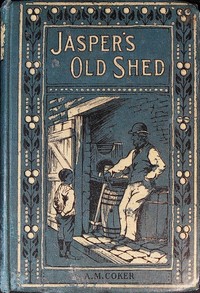
It required some little courage to penetrate into the dismal and dirty shed afore-mentioned; but Jasper was generally to be found somewhere near the entry, behind one of those three old barrels that had stood there ever since he began business. It was an understood fact now that the barrels were not for sale.
"Why, I should be quite lost without 'em," he used to say; "they be very handy for my old back to lean against, and when I'm tired of sitting by one, why, I've got two more to choose from." And so, while the sundry heaps of rags and bones, rusty iron and empty bottles and waste paper, etc., were constantly changing owners, the barrels remained in their original position, looking almost like sentries of the establishment.
There was a small room at one end of the shed, reached by a ladder, and this served as a sleeping-place for the old man. And here, amid these surroundings, had he lived for forty years, managing somehow or other to make a living in a generally honest way.
It was a fresh, bright morning in October, and, for a wonder, a ray of sunshine had found its way into the dismal shed, where Jasper, seated against his foremost barrel, was reading a newspaper, when a child's voice aroused him.
"Please, Mr. Jasper, I've come for our goods."
The tone was familiar, and with a look of genuine pleasure Jonas turned to see little Rob Mellor standing at his side. A strange, old-fashioned child he was, though barely eight years old; but, in spite of the ragged clothes and neglected appearance, there was a wonderful attraction about the little fellow, that even Jonas had been unable to resist, ever since he first knew him, some two years before.
"Ah, Rob, is that you back again?"
"Yes, Mr. Jasper."
"Well, I was thinking only last week it was about time for you to turn up; and where's Phil, and the rest of your party?"
"Well, Mr. Jasper, father and mother are coming to-morrow, so they say, and they sent Phil and me on to get things straight; only Phil's gone to the station now to carry a bag, and he thinks he'll get threepence for that; because, you see, Mr. Jasper, we've got to keep ourselves to-day and to-morrow, and we've taken our old room down at No. 20; and so I've come for our goods."
"And where have you been this turn, eh?"
"Please, Mr. Jasper, we've tramped about as usual, through Hampshire and Wiltshire, and lately we've been fruit-picking and hopping in Surrey and Kent; and mother has sold things out of her basket, and Phil and I have sung; and so we've got along nicely. But I'm oh so glad to be back home again."
"Home, eh? And is that what you call Helmstone?"
Rob was silent for a moment, but then replied slowly,—
"Well, you see, Mr. Jasper, 'tisn't Helmstone so much as you and the Mission Hall."
Jasper laughed.
"A queer mixture," said he. "However, I'm real glad to see you back, Rob. Sit down a bit till I've finished my pipe, and then we'll see to your chattels."
Quickly Rob obeyed, and curling himself up against one of the barrels, sat, looking supremely happy to be once more in the company of his old friend. For they were fast friends, Rob and Jasper, in spite of the nearly seventy years that lay between them. Perhaps, if the truth were told, that child could do more with the old man than any one living. Phil, too, was a favourite, but Rob stood first in Jasper's affection; and it was a real pleasure to him when the cold weather put an end to the Mellors' wandering life, and brought them back to that wretched attic in Preece's Place which Rob had called "home."
Poor little lad! Never yet had he known the real meaning of the word. It was a hard life that he and Phil led; up and down the country those children tramped, from May to October, sleeping where they could, and depending for a livelihood on what they begged or earned by the way, or what mother sold out of her pedlar's box. They never quite understood where father got money from; sometimes he seemed to have quite a lot. But they never dared ask where it came from, and Phil was always afraid it was not honestly gained.
No one who saw Stephen Mellor could doubt that he had seen better days; and sometimes Phil, who was nearly thirteen, would ask his mother if he was dreaming, or whether he really could recall a comfortable home away in the North. But she never satisfied his curiosity—only turned the conversation, and told him he always had such strange ideas; though Phil was sure the tears came in mother's eyes when he asked her; and then she would bid him say no more.
The love between the two boys was very strong and true. Phil was Rob's hero, Rob was Phil's charge; and Jonas Jasper was the friend of both. It was a strange thing that he should have taken such a fancy to the lads, for Jonas was reckoned anything but sociable among his neighbours; yet there was an exception even to this rule, and for two years now the old man and the children had been the fastest friends. Their quaint ways amused him, and nothing pleased him better than to see them come into his shed, and curl themselves up on the ground against the barrels.
"It's so nice there are three of them," Rob would say, "because that's one each. Anybody would think you had got them on purpose for us, you know."
And so now the happy intimacy was renewed for another winter; and Rob, sitting there, telling Jonas a summer's adventures, forgot all the hardships of the past in the happiness of the present.
It was not long before Phil joined them, as glad as Rob to be there again, but in no mood to sit down.
"No, no, Mr. Jasper, not yet. I've got some shopping to do. Look here!" and opening his hand he displayed a shilling. "Wasn't it fortunate? the gentleman whose bag I carried hadn't anything smaller, except a penny. I told him I'd go for change, but his train was just off, so he gave me this. And now, Rob, you and I will invite Mr. Jasper to dinner; only, as our room is not ready, perhaps he will allow us to dine here."
Rob clapped his hands in glee; but Jonas shook his head, though a smile crossed his face, at the boy's dry speech.
"You keep what you've got," he said. "My dinner has been ready since yesterday; see here!" and reaching down a plate from a shelf that hung near, he exhibited a black pudding and a hunch of bread.
But Phil was off, and presently returned with three pieces of cold cooked fish, a loaf of bread, and a can of hot coffee; and seating himself on the ground he held up his change.
"See here, fivepence to go on with; sevenpence spent; fish threepence, coffee twopence, bread (it's stale) twopence. Who says I don't know how to go to market? Now, Mr. Jasper, you lend us a knife, and we'll begin. But first we'll thank Jesus for giving us this;" and in a moment the two boys had bared their heads, while Phil, in simple words, asked a blessing on their meal.
Jonas sat watching them with a strange expression on his face; he had seen them do the same many times before, for they would never eat a meal without giving thanks. But somehow those boys seemed the only link between him and God. He was no infidel; there was a God, for certain, but he never thought of Him, except when, as now, the lads spoke to or of Him. And it was a strange sensation, there, in that dark shed, to be, as it were, suddenly brought to think about Him, by a few simple words like that.
"You don't suppose the Almighty is any the wiser for what you've said in this hole, do you?" he asked one day. And never had he forgotten the astonished look on Phil's face.
"Why, Mr. Jasper, God is here, close by; and we needn't have spoken out loud for Him to hear."
"God is here," and Jonas looked round the shed with its dirt and disorder, as though the thought was not altogether pleasant. A God far off was on the whole preferable to a God so very near; for it was only in His power Jasper thought of Him. God in Christ, a pitying, present, loving Saviour, was altogether unknown, and so, undesired.
A merry party were the three over their dinner. Jasper had to share the fish, and then his pudding came as second course, after which they all adjourned to the far end of the shed, in search of the Mellors' furniture, which he was obliging enough to store for them during their absence. And indeed it did not take up much room—an old mattress, two or three pieces of bedding, a couple of chairs, one or two stools, some crockery, a kettle, and an old box which did duty for a table; these comprised the whole of the family possessions.
The boys were not long in carrying the lot across to the attic, which happened to be untenanted again just when they wanted it. And so, in a settled resting-place once more (and that place Helmstone), the boys were in the highest spirits; forgetful of the past, fearless for the future, living in the present joy of Jasper's friendship, and full of simple trust in a loving Saviour who always cared for them.
FAR away from the sea front, with its fashionable crowd of visitors and pleasure-seekers, and its splendid terraces, where the wealthy and the worldly lived, there stood an old "gone-down" street (perhaps the oldest in Helmstone), with high, narrow houses on both sides, that so shaded each other as to allow very little sunshine to find its way in. But half-way down on the right-hand side there was a break in the regular row, and a new, attractive building stood out in striking contrast to its dismal surroundings. The John Street Mission Hall was indeed as bright a place as it looked, and ever since its erection, some six years before, it had been a centre of life and love and blessing. Indeed, it quite woke up the old sleepy street, for there was always something going on in one or another of its cheery rooms—mothers' meetings and men's classes, night schools, temperance gatherings, or mission services. The doors were nearly always open, and not only so, but inside the doors there was a welcome for every one who came.
As Phil expressed it one day, "At most places they'll put up with you; but at John Street they seem to want you."
Yes; Phil was right. The sinful, the weary, the wandering, the lost, were "wanted" at John Street, and every one who set foot inside the building found himself surrounded with an atmosphere of love that was difficult to resist; for the workers were men and women whose hearts God had touched, and who, through the love of Jesus to their own souls, were, like Him, full of love for sinners.
Perhaps it was a wise move to make Forbes the policeman caretaker of the premises; for although underneath the coat of blue there beat as warm and tender a heart as could be found, yet his tall, commanding presence and somewhat stern appearance had a beneficial effect; and dire mischievous or riotous, bent on disturbance, were oftentimes restrained when they remembered that the hall-keeper was a "bobby."
One great feature of the work carried on there was a free breakfast, given every Sunday morning to a certain number of destitute people, who were expected, and indeed almost obliged, to remain for a short gospel meeting afterwards. It was Forbes who first told the Mellor boys about it. Finding them asleep in an entry one Sunday morning, as he was going home from "night duty," he roused them, and soon heard from Phil how father and mother had "gone away yesterday, and locked the door," so that the poor lads were obliged to sleep where they could. "But we've been quite comfortable, sir; because, you see, we found an old sack, and it kept us so warm."