Public-domain ebook
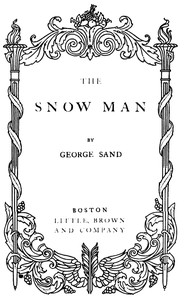
The snow man
by George Sand
Language: en479 downloads on Project Gutenberg
Subjects
In: Novels
Public-domain ebook sourced from Project Gutenberg #72122.
Public-domain ebook
by George Sand
Language: en479 downloads on Project Gutenberg
Subjects
In: Novels
Public-domain ebook sourced from Project Gutenberg #72122.
The opening · free to read
Copyright, 1870, BY ROBERTS BROTHERS.
Copyright, 1898, BY LITTLE, BROWN, AND COMPANY.
Printers S. J. PARKHILL & CO., BOSTON, U. S. A.
THE SNOW MAN.
WILL the reader be kind enough to enter with us at once into the subject of this story, as he does when, in the theatre, the curtain rises upon a situation which the actors proceed to explain.
In the same way, we beg him to go with us straightway into the heart of the locality which is the scene of this narrative;--yet there is this difference, that in the theatre the curtain seldom rises upon an empty stage; while in the present instance, the narrator and the reader are to be for a few moments alone together.
The place into which we are thus conveyed, is sufficiently strange and not particularly agreeable. It is a four-sided room, at first sight apparently a regular square, but one of its angles is really more acute than the others, as we observe the moment we notice the dark-colored wooden ceiling whose projecting beams cross each other in a distinctly irregular manner in the north-east corner.
This irregularity is made still more obvious by a wooden staircase with a balustrade somewhat elaborately worked, and of a massive character, seemingly of the end of the sixteenth century or the beginning of the seventeenth. This staircase goes up six steps, pauses at a small landing-place, turns a right angle, and after six steps more ends abruptly in the wall. The arrangements of the building have been changed; and it would have been natural to remove the staircase at the same time, for it only encumbers the room. Why was this not done? This, dear reader, is the question we put to each other. But, notwithstanding this proof of respect or indifference, the apartment which we are examining has retained all its ancient comforts. An immense circular stove, in which no fire has been lighted for a long time, serves as a pedestal for a very handsome clock of the style of Boule, whose glasses, tarnished and almost iridescent with moisture, throw out metallic reflections into the gloom. A handsome copper chandelier of the Dutch fashion hangs from the ceiling, covered with a coat of verdigris so thick, that it looks like a piece of malachite work. Twelve wax candles, whole (with one exception), though yellow with age, are still standing in the wide metallic sockets, whose size has the advantage of not allowing a drop of wax to fall, and the disadvantage of casting a deep shadow on the floor, while the light is all reflected up to the ceiling.
The twelfth of the candles in this chandelier is three-fourths burnt away. We happen to note this, friendly reader, because we are examining everything with such minute attention. Otherwise we might very easily have overlooked it, in consequence of the strange ornament which partly covers the chandelier and its candles, and hangs along its branches in opaque folds. Probably you take it to be a piece of gray cloth long ago thrown over the fixture to protect the copper. Touch it, if you can reach high enough. You see that it is an accumulation of spiders’ webs, almost as compact as parchment, and loaded with dust.
These spiders’ webs are everywhere else too. They hang all over the smoked frames of the large family portraits that fill three sides of the room, and in the corners they are festooned with a sort of regularity, as if some austere and industrious fate had assumed the form of a spider, and undertaken to furnish hangings for these deserted wainscots, complete enough to cover even the least crevice.
But of the spiders themselves you will not find one. The cold has made them torpid, or killed them; and if you should be obliged--as I hope you will not--to pass a night in this melancholy room, you would not have even these industrious little creatures to keep you company. The clock, whose tick-tack is not unlike the regular ticking of some insects, is mute as they. Its hands have stood still upon the dial at four o’clock in the morning, for God knows how many years.
I say four o’clock in the morning, for the reason that in the country where we now are, the striking part of old timepieces indicates whether the hours are those of the night or of the day--for there the days are sometimes only five hours long, and the nights nineteen. If you were fatigued with your journey and should sleep late, you might not know, when you awoke, whether it was the next morning after your arrival, or the next morning but one. If the clock were going it would tell you, but it is not, and it is impossible to tell whether it could be made to go.
Well; what country is it? We shall learn without having to go outside the room. Along the whole length of the irregular wall, by which the staircase is built, and which, like the three other sides, is more than half covered with oaken wainscot, large maps are hung; very likely because their shape rendered it a convenient place. They are longer horizontally than their height, and accordingly just cover that part of the wall above the wood-work. They seem to be banished here rather than exhibited, and we shall have to go up the twelve steps of the staircase ending in the wall, to convince ourselves that these long bands of parchment, colored in the hardest tints, are maps, charts, and plans of strong cities.
The staircase leads us precisely to the height of that one of these maps representing the country, which was undoubtedly placed just there for convenience of consultation; and also, perhaps, to hide the place where a door has been built up.
This great green serpent in the middle of the picture is the Baltic Sea. I presume that you recognize it from its resemblance to a dolphin with a double tail, and from the innumerable indentations of its _fiords_--narrow and winding gulfs that run far into the rocky coast.
Don’t get lost on the side of Finland, which is there painted in yellow ochre; look on the other shore for about the middle of Sweden (painted red), and you will recognize, from its lakes, from its rivers and mountains, the province of Dalecarlia, a region which was still comparatively uncivilized at the time to which this story refers. It is in the last century, towards the close of the kindly but troubled reign of Adolphus-Frederick of Holstein-Gottorp, at one time the Protestant Bishop of Lubeck, but who afterwards married Ulrica of Prussia, the friend of Voltaire, the sister of Frederick the Great; in a word, as far as we can judge, it is about the year 1770.
Rather later, we shall see the aspect of this country. You must be satisfied at present, dear reader, to know that you are in a small, old chateau, perched on a rock, in the very centre of a frozen lake, which will naturally lead you to conclude that I have carried you there in midwinter.
And now a last glance at this room while it is still ours; for, gloomy and cold as it is, we shall soon have competitors for the use of it. It is furnished with old chairs of wood, quite artistically carved, but massive and inconvenient. One arm-chair, comparatively modern--that is of the time of Louis XVI.--is covered with silk that has become yellowed and stained, but it is still soft, and of a convenient shape for sleeping; it looks out of place in the solemn company of the other worm-eaten chairs, with their high backs, which, for more than twenty years, have not been moved from the wall. To conclude, an old bed, with four twisted columns and curtains of tattered silk, stands in the corner opposite the staircase, and adds, by its dilapidated appearance, to the gloomy and sinister aspect of the place.
But we must retire, reader. The door opens, and you must depend upon me hereafter if you wish to know about the past and future events whose theatre I have thus shown you.
I.
FOR a full quarter of an hour some one had been knocking and ringing at the outside door of the gothic manor of Stollborg; but the bourrasque was blowing so very furiously, and old Stenson was so extremely deaf! The old man’s nephew, Ulphilas, a colossal blond who assisted him in his duties, heard somewhat better, but he believed in ghosts, and was not at all anxious to open the door to them. M. Stenson, former steward of the Baron de Waldemora, was an invalid, and a man of melancholy character; he was at present the overseer of Stollborg; and he lived in one of the pavilions of this old, battered, and abandoned chateau. It really seemed to him that some one was knocking at the door of the court, but Ulphilas judiciously called his attention to the fact that the goblins and trolls of the lake were in the habit of playing just such tricks. Stenson, with a sigh, began to read his old Bible again, and in a very few moments went to bed.
At last, the persons outside became so impatient that they forced the lock of the door, introduced themselves into the court, and, following a narrow gallery on the ground-floor, entered, with their ass, the very room that we have just described, which was called the bear-room, from the crowned animal carved on the armorial shield above the outside window.
The door of this room was usually fastened, and its being open to-day was due to an unusual circumstance, about which, however, the strangers did not trouble themselves at all.
Rather strange-looking individuals were these unexpected visitors of Stollborg! One of them was wrapped up in a sheepskin, and looked like one of those ugly scarecrows that are used in gardens and hemp-fields to frighten birds; the other, who was tall and well made, resembled a good-natured Italian brigand.
The ass was a fine ass: strong, and carrying a load that would have been sufficient for an ox; he was so accustomed to travelling adventures, that he made no sort of objection to going up several steps, and showed no surprise when he found himself treading upon a pine floor instead of the straw of a stable. The poor ass was ill, however, and the taller of the two travellers who was leading him, looked after his comfort before attending to anything else.
“Puffo,” he said, placing his lantern on a large table in the middle of the room, “Jean has a cold; he is coughing as if he would split his lungs.”
“_Parbleu_, I am no better off myself!” replied Puffo in Italian, the same language which his companion had employed; “do you suppose, master, that it makes a fellow fresh and jolly to drag him about in this devil of a country?”
“I too am cold and tired,” replied the master, as Puffo called him; “but there is no use in complaining. Here we are, and we must not allow ourselves to die of cold. Look and see whether this is really the bear-room that we were told about.”
“How shall I recognize it?”
“By those maps, and a staircase which leads nowhere. Was not that what they told us at the farm?”
“I don’t know anything about it,” replied Puffo. “I can’t understand their beastly patois.”
As he spoke, he took the lantern, and holding it higher than his head, said:
“What do I know about geography?”
“This is the very room. There are the maps; and here,” he added, running lightly up the wooden staircase, and lifting the map that hung over the wall at the top of it, “is the place walled up. It’s all right, Puffo, we need not distress ourselves any longer. The room is perfectly tight, and we can sleep here like princes.”
The book keeps going
Reading is free forever. Sign up and watch scenes appear while you read.



Scenes Storieta drew for other classics.
New illustrated classics
Once or twice a month: the latest books to get full character casts, scene art, and free comic editions. No account needed.